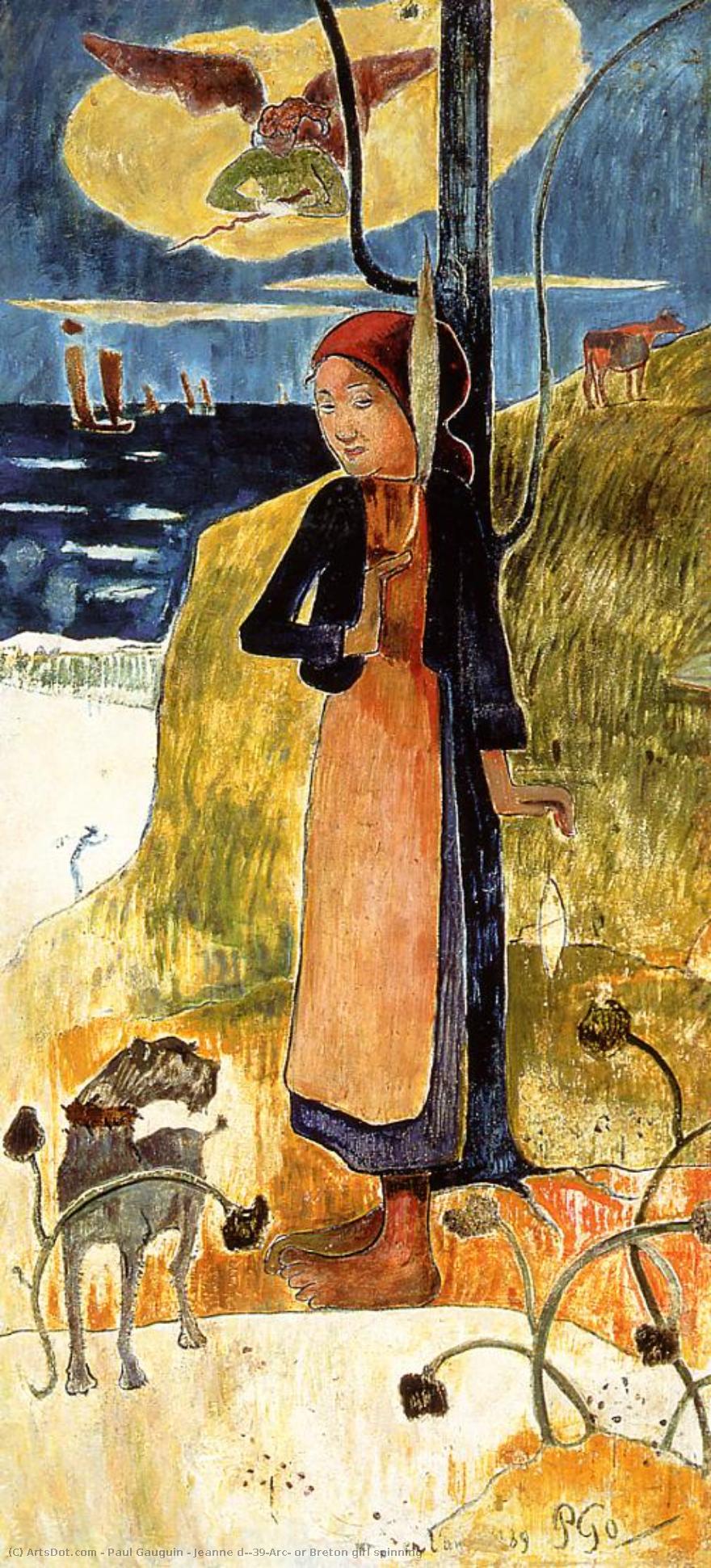
Jeanne d'Arc, or Breton girl spinning – A Symbol of Innocence Amidst Rustic Beauty
Eugène Henri Paul Gauguin’s “Jeanne d’Arc, or Breton girl spinning,” completed in 1889 during his prolific period in Brittany, France, stands as a cornerstone of Post-Impressionism and exemplifies Gauguin's unwavering commitment to capturing raw emotion and exploring cultural authenticity. More than just a portrait of a woman engaged in domestic labor—spinning wool by hand—the painting embodies profound symbolism rooted in Breton folklore and Christian iconography.
- Style: Cloisonnism – Gauguin deliberately eschewed traditional oil paint techniques, opting for a method characterized by applying pigment onto a gilded plaster surface divided into geometric panels resembling cloisonné enamelware. This technique prioritizes visual impact over meticulous realism, favoring bold color palettes and simplified forms.
- Technique: Gauguin meticulously layered thin washes of color—primarily ochre, crimson, and ultramarine—creating an ethereal luminosity that contrasts sharply with the earthy tones of the landscape. He employed a glazing process to build up depth and richness, resulting in a textured surface that invites contemplation.
- Historical Context: Painted during Gauguin’s stay at La Buvette de la Plage inn, alongside his pupil Meijer de Haan, “Jeanne d’Arc” reflects the broader artistic movement of Impressionism's rejection of academic conventions. However, Gauguin pushed beyond Impressionistic aesthetics, forging a path toward Expressionism by prioritizing subjective experience and conveying spiritual significance.
The Landscape as Spiritual Reflection
Brittany’s rugged coastline—specifically the headland where La Buvette de la Plage is situated—serves as more than just a backdrop; it functions as an integral component of the painting's symbolic narrative. The solitary tree dominating the composition symbolizes resilience and spiritual aspiration, mirroring Joan of Arc’s unwavering faith amidst adversity. Gauguin skillfully utilizes atmospheric perspective to convey the serenity and grandeur of the natural world.
- Color Palette: Gauguin’s masterful use of color—particularly the dominant hues of ochre and crimson—creates a harmonious blend that evokes feelings of warmth, passion, and solemn reverence.
- Composition: The triangular arrangement of figures and tree reinforces stability and directs the viewer's gaze upward toward the celestial realm, emphasizing the painting’s spiritual dimension.
Symbolism Beyond Representation
"Jeanne d’Arc," or Breton girl spinning" is replete with symbolic references that extend beyond literal depiction. The angel hovering above Joan of Arc represents divine protection and embodies Christian virtue—a deliberate allusion to biblical narratives concerning salvation and redemption. Furthermore, the cow depicted in the distant background symbolizes fertility and pastoral innocence, reinforcing the painting's overarching theme of purity and spiritual renewal.
Note: This artwork was rediscovered in 1924 under several layers of wallpaper, alongside two other murals by Meijer de Haan.
Emotional Resonance – A Moment Frozen in Time
Gauguin’s “Jeanne d’Arc” transcends mere visual representation; it communicates a palpable emotional resonance that speaks to the viewer's innermost sensibilities. The painting captures a fleeting moment of tranquility—a woman engaged in simple tasks amidst breathtaking scenery—yet imbued with profound spiritual depth. It invites contemplation on themes of faith, innocence, and resilience—qualities that continue to inspire admiration and fascination centuries after its creation.
Location: Amsterdam, Netherlands
Artist: Eugène Henri Paul Gauguin
Year Created: 1889
Style: Cloisonnism