Man with an Ax: A Post-Impressionist Masterpiece
- Title: Man with an Ax
- Artist: Paul Gauguin
- Date: 1891
- Current Location: Private Collection
- Medium: Oil on Canvas
The Painting's Composition and Symbolism
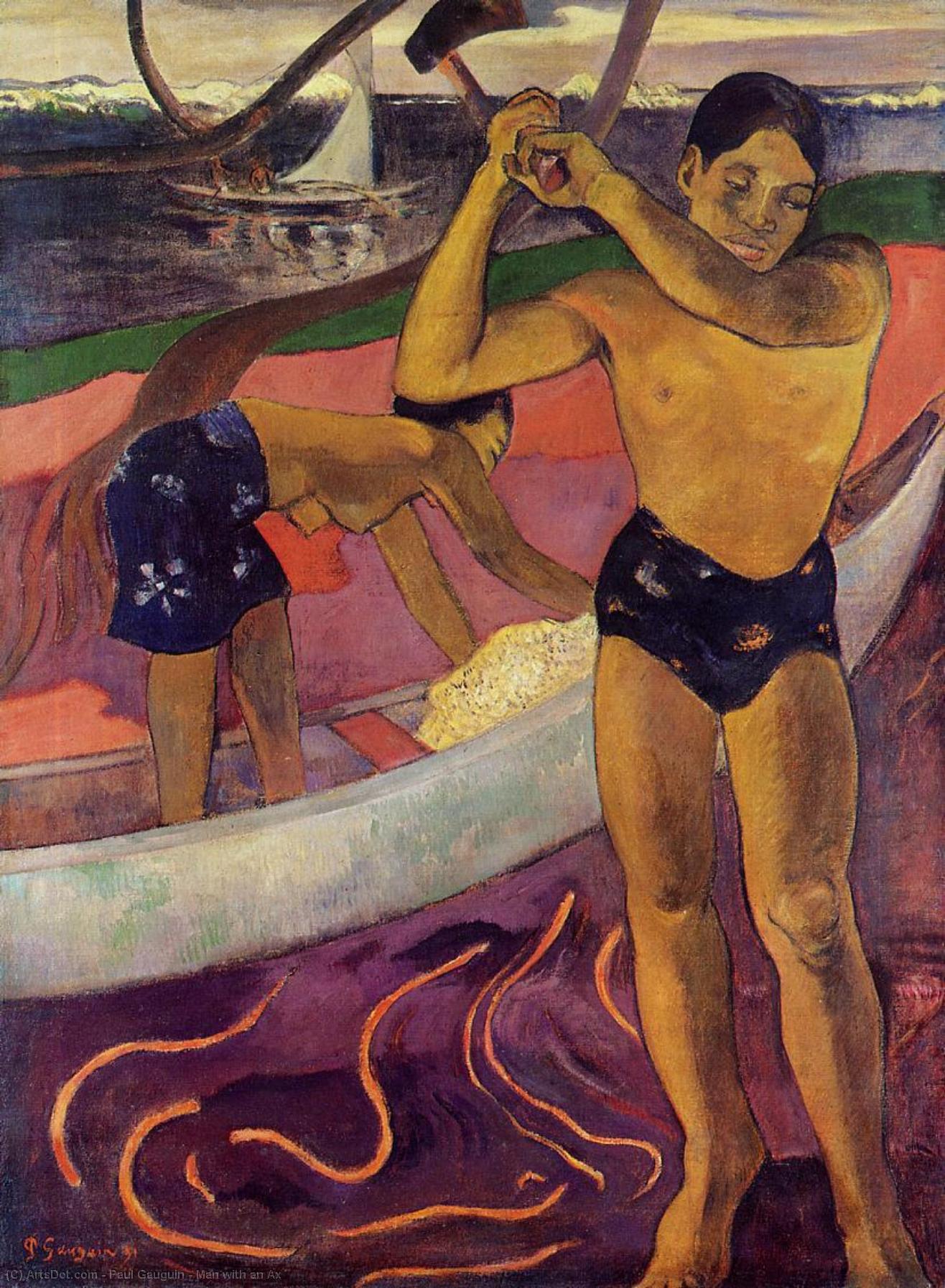
“Man with an Ax” is a captivating piece that showcases Paul Gauguin’s unique style and his ability to evoke emotions through his work. Created in 1891, this oil on canvas painting is a quintessential example of Post-Impressionism, a movement that Gauguin was heavily influenced by. The artwork depicts a man holding a large axe over his head while standing in a boat. The man appears to be the main focus of the scene, with the boat occupying most of the background. There are two other people visible in the image, one on the left side and another on the right side of the painting. The presence of bananas scattered throughout the boat adds a sense of liveliness to the scene, indicating that the man might be preparing for a journey or engaging in some form of transportation using the boat.
The symbolism within "Man with an Ax" is rich and layered. Gauguin was deeply interested in exploring non-Western cultures and sought to capture their essence through his art. The figure of the man, often referred to as “Totefa” or “Jotefa,” embodies a raw masculinity and connection to nature. His pose suggests both strength and vulnerability, hinting at the complexities of human existence. The surrounding landscape, with its vibrant colors and simplified forms, represents Gauguin’s attempt to move beyond mere representation and convey emotional truth.
Gauguin's Post-Impressionist Style
“Man with an Ax” exemplifies Gauguin’s distinctive Post-Impressionist style. Departing from the Impressionists’ focus on capturing fleeting moments of light, Gauguin sought to express deeper emotions and symbolic meanings through his art. He employed bold colors, simplified forms, and expressive brushstrokes to create a sense of emotional intensity. The flattened perspective and lack of traditional depth contribute to the painting's immediacy and impact.
Gauguin’s use of color is particularly striking in “Man with an Ax.” The vibrant hues of pink, purple, and orange in the background create a dreamlike atmosphere, while the darker tones used for the figures add a sense of drama. His brushwork is loose and impasto, creating texture and adding to the painting's overall energy.
Historical Context and Gauguin’s Tahitian Period
“Man with an Ax” was created during Gauguin’s time in Tahiti, a period that profoundly influenced his artistic development. Seeking refuge from European society and its perceived materialism, Gauguin traveled to the South Pacific islands in search of a more authentic and spiritual way of life. He was captivated by the Polynesian culture and sought to capture its essence in his art.
However, Gauguin’s relationship with Tahitian culture was complex and controversial. While he admired certain aspects of their traditions, his portrayal of them has been criticized for being romanticized and exoticizing. Nevertheless, “Man with an Ax” remains a significant work in Gauguin's oeuvre, offering insights into his artistic vision and his exploration of cultural identity.
Emotional Impact and Legacy
“Man with an Ax” evokes a range of emotions in the viewer – awe, mystery, and perhaps even a sense of unease. The painting’s powerful imagery and symbolic depth invite contemplation and interpretation. It is a testament to Gauguin's ability to capture not only the visual world but also the complexities of human experience.
As a handmade oil painting reproduction, “Man with an Ax” can be appreciated in a new light, allowing viewers to experience the beauty and emotion of Gauguin’s original work. It is a timeless masterpiece that continues to inspire and captivate art lovers around the world.