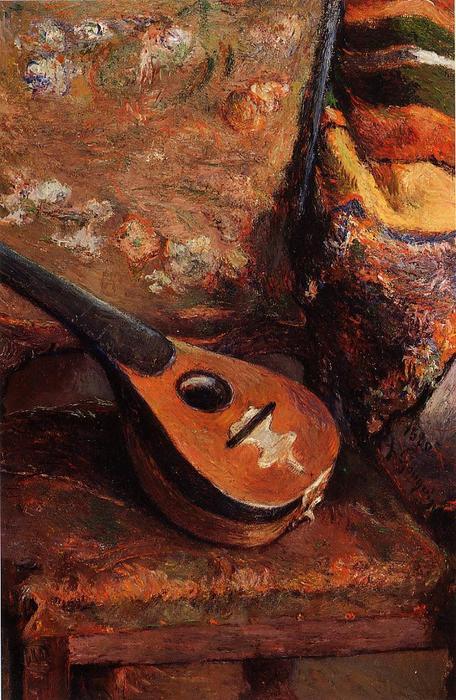
Admire Paul Gauguin’s iconic ‘Mandolin on a Chair,’ a masterpiece of Post-Impressionism and Symbolism capturing Tahitian tranquility. Explore its vibrant colors & expressive brushstrokes – available as stunning reproductions.
Paul Gauguin: A revolutionary Post-Impressionist painter known for bold colors, exotic subjects & Symbolist themes. Explore his journey from finance to artistic legend.
Mandolin on a Chair: A Symphony of Color and Symbolism
Paul Gauguin’s “Mandolin on a Chair,” painted in 1880 during his formative years as a Post-Impressionist, transcends mere depiction; it embodies the artist's profound exploration of primal emotion and spiritual resonance. This oil on canvas masterpiece resides within the Wildenstein Index Number (W. Georges/Daniel) and Gabriele Mandel Sugana Index Number (S.), offering an unparalleled glimpse into Gauguin’s artistic vision. Found prominently displayed at ArtsDot.com, alongside other iconic works like “The Haystacks,” this painting exemplifies his distinctive style—a bold departure from Impressionistic realism—marking a pivotal moment in the evolution of modern art.
Stylistic Innovation and Technique
Gauguin's approach to color is immediately striking. Unlike Impressionists who sought to capture fleeting moments of light, Gauguin employed vibrant hues – reds, yellows, blues – not merely for visual accuracy but as conduits for conveying psychological states. Thick brushstrokes dominate the composition, creating a palpable textural richness that draws the viewer’s eye into the scene. The artist deliberately distorted forms, prioritizing expressive gesture over precise representation. This technique aligns perfectly with Synthetism, Gauguin's artistic philosophy which championed simplification and abstraction to convey deeper meanings beyond surface appearances. As demonstrated in “The Haystacks,” housed at The Courtauld Institute of Art, Gauguin’s commitment to conveying emotion through color and form established a precedent for subsequent artists.
Post-Impressionism: Beyond Observation
The Post-Impressionist movement arose as a reaction against Impressionism's focus on optical perception. Artists like Gauguin and Franz Marc rejected the pursuit of objective representation, instead prioritizing subjective experience and spiritual contemplation. They experimented with expressive color palettes and distorted forms to communicate inner feelings and ideas—a deliberate rejection of the naturalistic conventions championed by Impressionists. For a deeper understanding of this movement’s intellectual currents, visit ArtsDot.com's introduction to Post-Impressionism – it delves into the philosophical underpinnings that fueled artistic innovation during this era. Gauguin’s exploration of primitivism—drawing inspiration from Polynesian cultures—further solidified his position as a pioneer in challenging Western artistic traditions.
Symbolic Resonance and Compositional Narrative
“Mandolin on a Chair” is more than just a depiction of an instrument and a chair; it's laden with symbolic significance. The mandolin itself represents harmony, contemplation, and perhaps even melancholy—themes frequently explored by Gauguin in his oeuvre. Its placement atop the wooden chair suggests stability amidst inner turmoil, mirroring the artist’s own struggles during this period. The subtle background contributes to the painting’s atmosphere of serenity and introspection. Two figures appear in the periphery, adding a layer of narrative complexity without dominating the central focus. These individuals serve as silent witnesses to the scene's emotional core—a testament to Gauguin’s masterful ability to convey profound ideas through visual imagery.
A Legacy Enduring Inspiration
Paul Gauguin’s influence extends far beyond his own lifetime, resonating powerfully in the works of artists like Pablo Picasso and Henri Matisse. His bold experimentation with color and form irrevocably altered the trajectory of modern art, establishing Synthetism as a cornerstone of artistic expression. To learn more about Gauguin's artistic style and its impact on subsequent generations, explore ArtsDot.com’s artist page – it provides invaluable insights into his creative process and enduring legacy. And don’t miss the opportunity to acquire a stunning reproduction of “The Haystacks,” currently displayed at The Courtauld Institute of Art—a masterpiece that embodies Gauguin's unwavering dedication to conveying emotion through art.