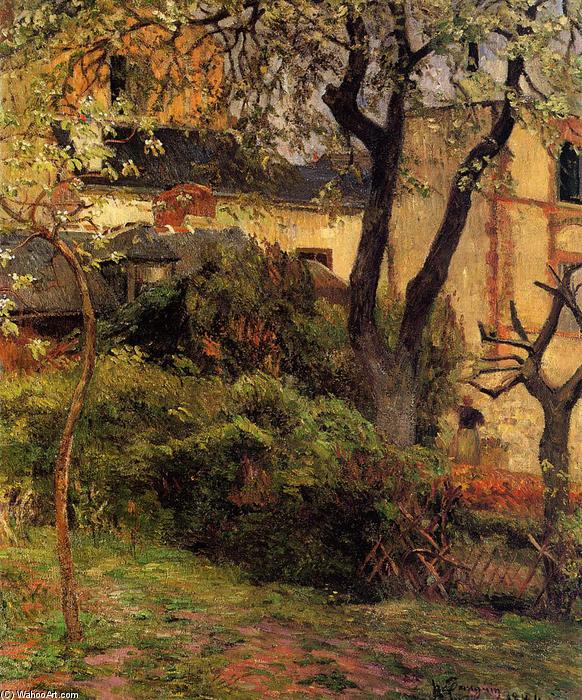
Explore Paul Gauguin's 'Rouen, Spring,' a vibrant Impressionist landscape capturing Rouen’s beauty with lush greenery and architectural details—a masterpiece reflecting Symbolist influences.
Rouen, Spring – A Symphony of Color and Symbol
Paul Gauguin’s “Rouen, Spring,” painted in 1884, stands as a cornerstone of Post-Impressionism—a movement that dared to reject the fleeting impressions of light favored by its predecessors and instead embraced subjective emotion and expressive color. More than just a depiction of a Rouen streetscape, it's an embodiment of Gauguin’s artistic philosophy: a deliberate attempt to capture not merely what he saw but what he felt.
- Artist Background: Gauguin’s journey into art began unexpectedly. Born in Paris in 1848, he initially pursued a conventional path as a stockbroker before discovering his true vocation after the financial crisis of 1882. His formative association with Camille Pissarro—a pivotal figure in Impressionism—provided an initial grounding in observation and tonal harmony. However, Gauguin swiftly moved beyond mere imitation, forging his own distinctive style rooted in Symbolist principles.
- Post-Impressionism & Symbolism: Unlike the Impressionists’ focus on capturing transient moments of light, Gauguin prioritized conveying inner emotion and spiritual significance. His explorations in Brittany and Martinique solidified this inclination towards portraying indigenous cultures and landscapes—a reaction against European artistic conventions. The 1890s witnessed a dramatic shift as he immersed himself in Tahiti, seeking refuge from Western societal pressures.
The Painting's Composition & Technique
“Rouen, Spring” presents a deceptively simple scene: a solitary tree dominating the foreground against a brick building backdrop. Yet, Gauguin’s masterful technique elevates this commonplace subject into an arresting visual experience. He employed bold brushstrokes—characteristic of Synthetist style—to build up layers of color and texture, creating a palpable sense of atmosphere. The artist skillfully utilized complementary colors—greens and reds—to heighten the vibrancy of the composition and draw the viewer’s eye across the canvas.
- Color Palette: Gauguin's audacious use of color is paramount to understanding the painting’s emotional impact. Dominant hues of emerald green and fiery crimson dominate, symbolizing vitality and passion respectively. These colors aren’t blended smoothly; instead, they are applied in thick impasto—a technique that lends physicality to the surface and imbues it with a sense of immediacy.
- Brushwork: Gauguin's distinctive brushstrokes—often visible as ridges on the canvas—are deliberately expressive, conveying movement and energy. They contribute significantly to the painting’s textural richness and reinforce its symbolic resonance.
Historical Context & Symbolic Significance
Painted during Gauguin’s Tahitian period, “Rouen, Spring” reflects his desire to transcend mere representation and delve into deeper psychological truths. The tree itself—a recurring motif in Gauguin's oeuvre—represents resilience and spiritual growth—themes central to Symbolist thought. Its branches reaching upwards symbolize aspiration and connection with the divine, while its foliage embodies fecundity and renewal.
- Symbolism: Gauguin’s artistic vision aligns seamlessly with Symbolist ideals, which sought to express emotions and ideas beyond the realm of rational observation. The tree serves as a visual metaphor for spiritual transformation—a concept deeply ingrained in Gauguin's worldview.
- Influence & Legacy: Gauguin’s groundbreaking approach profoundly impacted subsequent generations of artists, notably Pablo Picasso and Henri Matisse. His unwavering commitment to personal expression paved the way for Abstract Expressionism and continues to inspire contemporary painters today.