Paul Gauguin’s “Self Portrait with Hat”: A Window into the Soul of Post-Impressionism
Paul Gauguin's "Self Portrait with Hat," painted in 1893, isn’t merely a depiction of an artist; it’s a profound exploration of identity, introspection, and the burgeoning spirit of modern art. Emerging from the tail end of Impressionism, Gauguin deliberately pushed beyond its fleeting light and objective observation, forging a path toward a more subjective and emotionally charged style – a movement he himself termed “Synthetism.” This painting stands as a pivotal example of that approach, offering a glimpse into the artist’s complex psyche during a period of intense artistic and personal transformation. The work's power resides not just in its visual elements but also in the questions it subtly raises about representation itself.
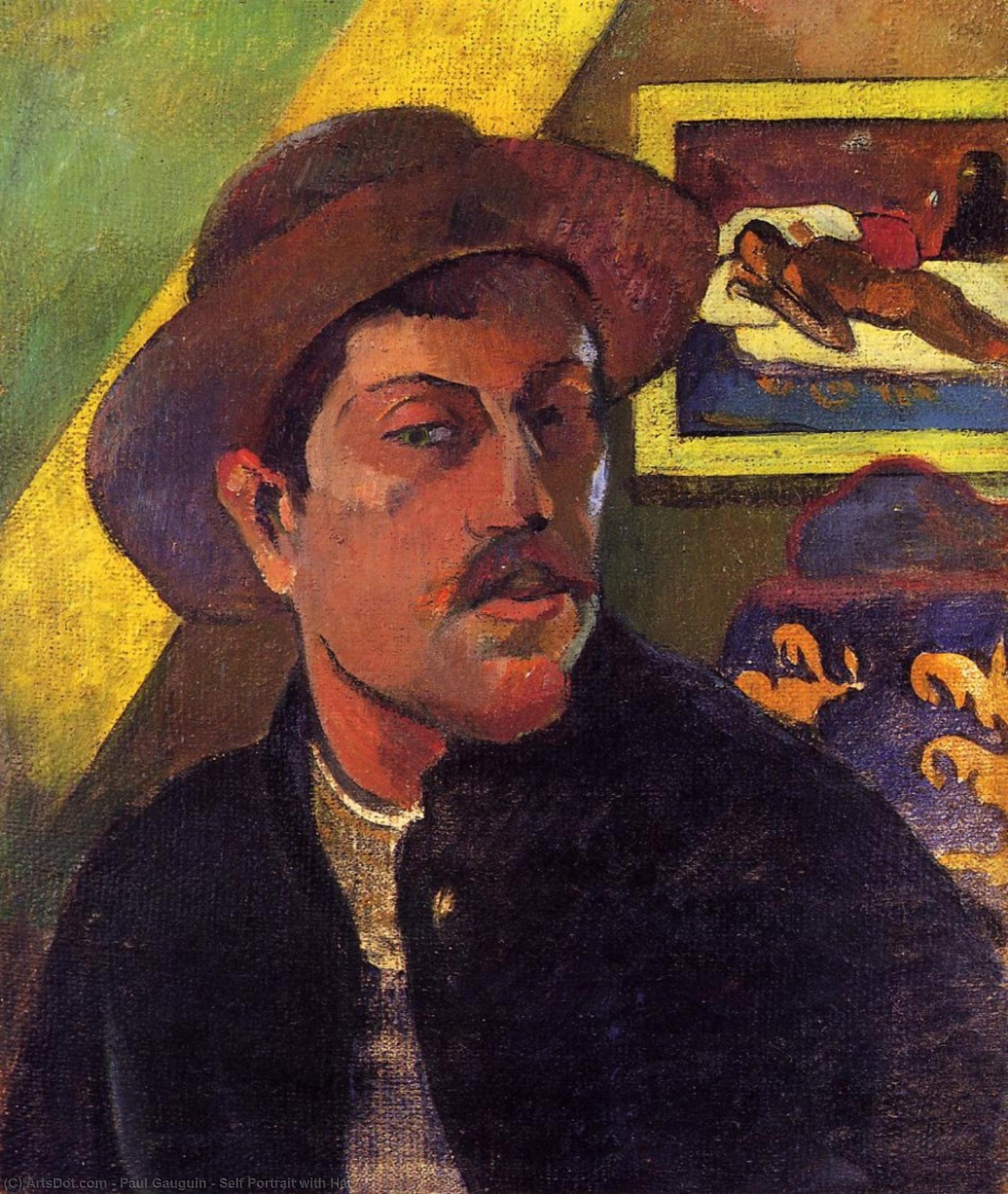
The composition is deceptively simple yet remarkably effective. Gauguin presents himself against a muted backdrop – a wall adorned with a framed picture, likely a print or drawing – that serves to both ground the portrait and emphasize the figure’s isolation. The focus immediately rests upon his face: a serious, almost melancholic expression dominates, framed by a neatly trimmed mustache and a thoughtful gaze directed squarely at the viewer. He wears a brown hat, a detail that adds a touch of formality and perhaps a hint of self-consciousness, while a black shirt provides a stark contrast to the warmer tones of his skin. The deliberate arrangement of these elements suggests an artist acutely aware of how he is being perceived – both by himself and by the world.
Synthetism and the Language of Color
Gauguin’s “Self Portrait with Hat” exemplifies the core tenets of Synthetism, a style characterized by its deliberate blending of disparate elements. Rather than striving for photographic realism, Gauguin employed bold, non-naturalistic colors – vibrant blues, greens, and ochres – to convey emotion and atmosphere. The brushstrokes are thick and visible, creating an impasto texture that adds depth and physicality to the painting. This technique wasn’t simply decorative; it was a conscious effort to move away from the delicate, blended strokes of Impressionism and create a more direct and immediate connection between the viewer and the artwork. Notice how he uses color not just to represent reality but to *feel* it – the blues suggesting introspection, the browns hinting at a groundedness beneath the surface.
Furthermore, Gauguin’s use of flattened planes of color, reminiscent of Japanese prints which profoundly influenced his work, departs from traditional Western perspective. This flattening effect contributes to the painting's sense of immediacy and simplifies the spatial relationships, drawing attention to the figure itself and its emotional state. The background is deliberately indistinct, further isolating the subject and reinforcing the feeling of introspection.
Symbolism and the Artist’s Journey
Beyond its formal elements, “Self Portrait with Hat” is laden with symbolism. The hat, a common motif in Gauguin's work, can be interpreted as representing both social decorum and artistic rebellion – a conscious rejection of bourgeois expectations while simultaneously acknowledging his place within society. The framed picture hanging on the wall might symbolize the art world itself, or perhaps Gauguin’s own attempts to capture and represent the world around him. The serious expression on his face is particularly significant; it reflects the artist's growing disillusionment with European civilization and his yearning for a more authentic existence – a theme that would become increasingly central to his work in Tahiti.
Considering Gauguin’s personal journey, this painting can be seen as a reflection of his turbulent period. Following his return to Paris after his time in the South Pacific, he struggled with creative block and a sense of alienation. The portrait captures this internal conflict – the tension between his artistic ambitions and his emotional struggles. It's a raw, honest portrayal of an artist grappling with his identity and his place in the world.
Legacy and Enduring Appeal
"Self Portrait with Hat" is now housed at the Musée d’Orsay in Paris, a testament to Gauguin’s enduring influence on modern art. His innovative use of color, flattened planes, and symbolic imagery paved the way for movements like Fauvism and Cubism. Artists as diverse as Henri Matisse and Pablo Picasso acknowledged Gauguin's profound impact, recognizing him as a key figure in the transition from Impressionism to abstraction. Today, this painting continues to resonate with viewers because it offers a rare glimpse into the soul of an artist – a man who dared to challenge conventions and forge his own unique path.
ArtsDot is proud to offer meticulously crafted hand-painted reproductions of “Self Portrait with Hat,” allowing you to experience the power and beauty of this iconic masterpiece in stunning detail. Explore our collection today and bring a piece of art history into your home.