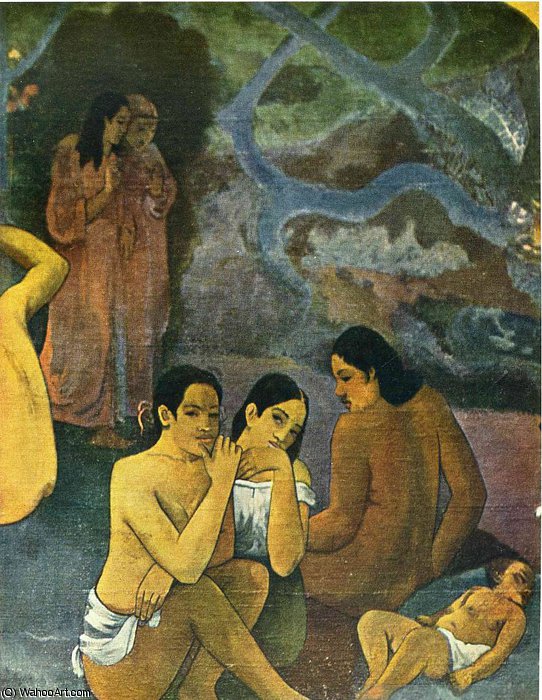
Discover "untitled (7128)" by Paul Gauguin – a vibrant Tahitian masterpiece! Explore flattened perspective, bold color & emotive figures in this Post-Impressionist work.
Paul Gauguin: A revolutionary Post-Impressionist painter known for bold colors, exotic subjects & Symbolist themes. Explore his journey from finance to artistic legend.
A Tahitian Reverie: Exploring Gauguin’s Untitled Composition
This captivating work by Paul Gauguin, designated ‘untitled (7128)’, transports viewers to the lush, enigmatic world of Polynesia. It is a compelling example of his mature style, deeply influenced by his time in Tahiti and his rejection of European academic conventions. The painting depicts a gathering of nude Polynesian figures amidst dense tropical foliage – a scene brimming with human connection and quiet contemplation.
Stylistic Echoes & Artistic Innovation
The artwork is immediately recognizable as belonging to the Gauguin canon, echoing the flattened perspectives, simplified forms, and vibrant color application characteristic of his Tahitian paintings. He deliberately moved away from traditional Western representation, embracing what he termed “Synthetism” – a style prioritizing expressive form over strict realism. This is evident in the deliberate distortion of perspective and the emphasis on bold, non-naturalistic colors. While clearly inspired by Gauguin’s earlier works like *Vision After the Sermon* or *Where Do We Come From? What Are We? Where Are We Going?*, this piece possesses a unique intimacy and focus on everyday life.
Technique & Materiality
Gauguin's masterful technique is readily apparent in the thick, textured impasto brushstrokes that build up the surface of the canvas. This tactile quality adds depth and vibrancy to the scene, enhancing the sense of immersion within the tropical environment. The use of oil paints allows for rich layering and blending of earthy tones – blues, greens, and ochres – creating a harmonious yet dynamic color palette. The organic, flowing lines mirror both the curves of the human figures and the abundant vegetation, further unifying the composition.
Subject Matter & Symbolism
The scene unfolds as a glimpse into Polynesian life: bathing figures, individuals lost in thought, and familial interactions all interwoven within the natural landscape. Gauguin wasn’t simply documenting reality; he was seeking to capture an idealized vision of primitive life – one free from the perceived corruption of Western civilization. The nude figures are not presented as objects of eroticism but rather as integral parts of a harmonious existence with nature. The very act of depicting these subjects, and Gauguin’s embrace of non-Western aesthetics, positioned him as a pivotal figure in Primitivism, a movement that profoundly influenced the development of modern art.
Emotional Resonance & Historical Context
Despite the vibrant colors and idyllic setting, a subtle undercurrent of melancholy pervades the artwork. The expressions on the figures’ faces suggest quiet reflection or perhaps even a sense of longing. This emotional complexity is characteristic of Gauguin's work, which often explores themes of alienation, spirituality, and the search for meaning. Created during a period of personal turmoil and artistic experimentation (between 1891-1903), this painting reflects Gauguin’s own internal struggles and his yearning for a simpler, more authentic way of life.
For Collectors & Designers
This piece – or a high-quality reproduction thereof – would serve as a striking focal point in any collection. Its bold colors and evocative imagery lend themselves well to both modern and traditional interiors. The painting’s themes of nature, human connection, and spiritual contemplation offer endless opportunities for interpretation and discussion. It is a testament to Gauguin's enduring legacy as one of the most innovative and influential artists of the Post-Impressionist era.