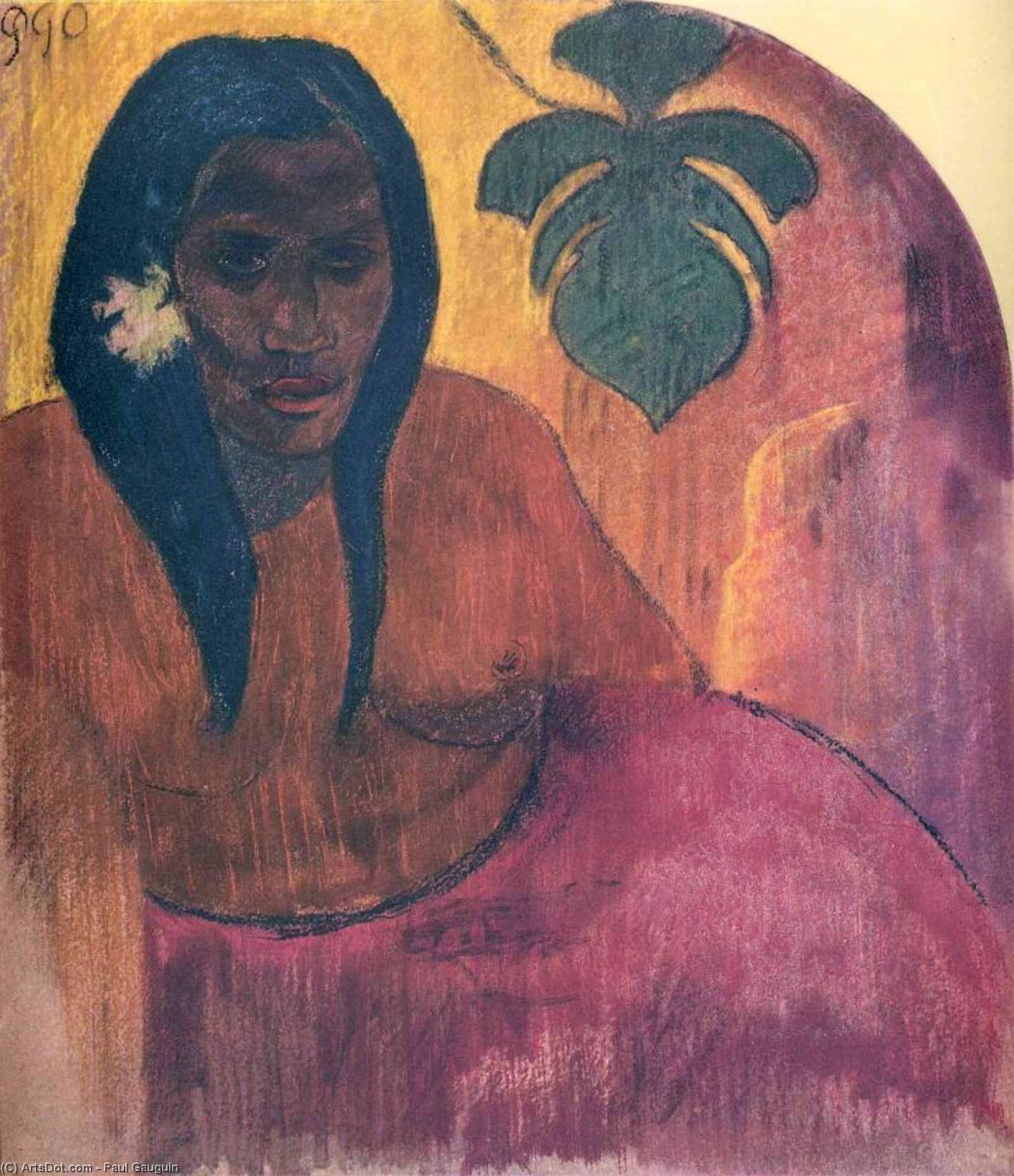
A Glimpse of Paradise: Exploring Gauguin’s Tahitian Woman
This captivating pastel work by
Paul Gauguin transports us to the exotic shores of Tahiti, offering a serene yet subtly complex portrait of Polynesian life. The artwork embodies the spirit of Post-Impressionism, moving beyond mere representation towards an exploration of emotion and symbolism through color and form. It’s a piece that invites contemplation, evoking a sense of both tranquility and mystery.
Subject & Composition
The composition centers on a Polynesian woman, presented with a dignified stillness. She is draped in richly colored fabric – likely *pareo* – suggesting status and cultural identity. The artist deliberately flattens the perspective, minimizing depth and bringing the figure forward, creating an intimate connection with the viewer. A large tropical leaf serves as a dramatic backdrop, framing the woman and emphasizing her connection to the lush natural environment of Tahiti. This deliberate arrangement isn’t about photographic accuracy; it's about distilling the essence of the subject and its surroundings.
Style & Technique
Gauguin’s distinctive style is immediately apparent. He eschews traditional academic techniques in favor of bold, expressive color and simplified forms. The artwork is rendered primarily in pastel chalks, a medium he embraced for its ability to create luminous effects and textured surfaces. Notice the layering of colors – a hallmark of his technique – which builds up form and creates a slightly rough, tactile quality. Lines are not sharply defined but rather suggested through broad strokes and blended hues. This approach contributes to the dreamlike atmosphere that permeates the piece.
Historical Context & Gauguin’s Journey
Born in Paris in 1848,
Paul Gauguin initially pursued a career in finance before dedicating himself to art. Dissatisfied with the constraints of European society and inspired by his search for what he considered a more authentic way of life, he traveled to Tahiti in 1891. This marked a pivotal moment in his artistic development. He sought to capture not just *what* he saw, but *how* it felt – the spiritual essence of Polynesian culture. His Tahitian paintings represent a radical departure from Impressionism and paved the way for Symbolism and other early modern movements.
Symbolism & Interpretation
The artwork is rich in symbolic meaning. The flower adorning the woman’s hair isn't merely decorative; it signifies beauty, femininity, and social standing within Polynesian culture. Similarly, the prominent tropical leaf symbolizes nature, fertility, and the life-giving forces of the island environment. Gauguin often imbued his works with layers of personal and cultural symbolism, inviting viewers to engage in a deeper interpretation beyond the surface level. It’s important to note that while Gauguin romanticized Tahitian culture, his depictions have also been subject to critique for their potential exoticization and simplification.
Emotional Impact & Interior Design
This piece evokes a sense of peaceful contemplation and longing for an idyllic paradise. The soft pastel tones create a calming atmosphere, making it suitable for bedrooms, living rooms, or studies. Its simplified forms and bold colors also lend themselves well to modern and eclectic interior design schemes. A high-quality reproduction of this artwork would serve as a stunning focal point, adding a touch of sophistication and artistic depth to any space. It’s a work that speaks to the enduring human fascination with exotic cultures and the search for meaning in a complex world.
Collecting Gauguin: Considerations
- Authenticity is paramount when considering original works by Gauguin. Expert authentication is crucial.
- Reproductions offer an accessible way to enjoy his aesthetic, with various print and canvas options available.
- Consider the artwork’s color palette and how it will complement your existing décor.
- The size of the piece should be proportionate to the space where it will be displayed.
This work is a testament to Gauguin's enduring legacy as a visionary artist who dared to challenge conventions and explore new frontiers in painting.