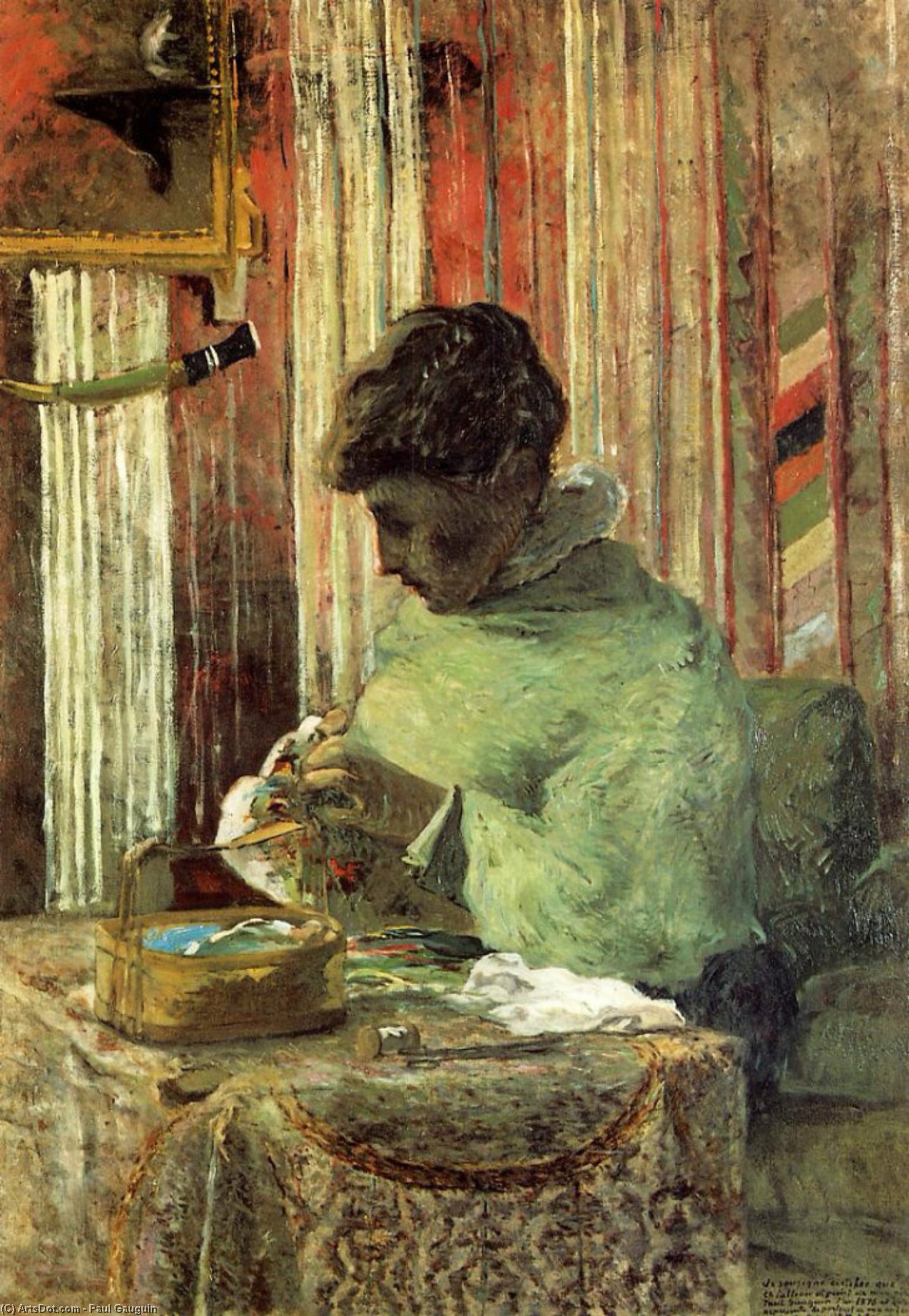
A Quiet Moment of Creation: Exploring Gauguin’s *Woman Embroidering* (1878)
Paul Gauguin's *Woman Embroidering*, painted in 1878, offers a captivating glimpse into the artist’s burgeoning Post-Impressionist style. This intimate portrait, measuring 116 x 81 cm and currently residing in the E. G. Buhrle Collection in Switzerland, transcends a simple depiction of domesticity; it's a study in focused concentration, subtle color, and the quiet dignity of everyday life.
Subject & Composition: A Scene of Domestic Intimacy
The painting centers on a young woman seated at a table, completely absorbed in her work – likely embroidery or sewing. Gauguin masterfully captures this moment of focused activity. The composition is deliberately simple yet effective. Her hands rest gently in her lap, suggesting a pause within the process, while surrounding objects—a bowl, spoon, and two bottles—hint at the comforts and routines of her environment. A chair positioned behind her implies a recent or impending continuation of her craft. The arrangement isn’t merely functional; it creates a sense of enclosed space, drawing our attention inward to the woman and her activity.
Style & Technique: Early Seeds of Post-Impressionism
*Woman Embroidering* is pivotal in understanding Gauguin's artistic evolution. While still bearing traces of Impressionistic influence – evident in the loose brushwork and exploration of light – it signals a departure towards his later, more radical style. The visible brushstrokes are not blended seamlessly; instead, they contribute to a textured surface that feels immediate and alive. The color palette is muted yet harmonious, relying on subtle variations rather than bold contrasts. This technique foreshadows the vibrant, non-naturalistic colors he would become famous for in his Tahitian paintings.
It’s a fascinating example of an artist finding his voice.
Historical Context & Gauguin's Artistic Journey
Painted during a transitional period in Gauguin’s life, *Woman Embroidering* reflects the broader artistic shifts occurring in late 19th-century France. Impressionism was challenging academic traditions, and artists were beginning to explore subjective experience and personal expression. Gauguin, initially influenced by Impressionists like Camille Pissarro, quickly sought a more profound and symbolic approach. He moved away from merely *representing* reality towards *interpreting* it through color and form. This painting marks an important step in that journey, prefiguring the Synthetist style he would later pioneer.
Symbolism & Emotional Resonance
The act of embroidery itself carries symbolic weight. Traditionally associated with femininity and domesticity, it can also be interpreted as a metaphor for creation, repair, or the preservation of tradition. The woman’s focused expression suggests not just labor but also a sense of quiet contemplation and self-sufficiency.
The painting evokes a feeling of peaceful intimacy, inviting viewers to share in this private moment. It's a celebration of everyday beauty and the dignity of work.
For Collectors & Interior Designers
*Woman Embroidering* is more than just a beautiful image; it’s a piece of art history. Its subdued palette and intimate subject matter make it exceptionally versatile for interior design. It would complement both traditional and contemporary spaces, adding a touch of sophistication and artistic depth. A high-quality reproduction captures the nuances of Gauguin's brushwork and color, bringing this captivating scene to life in your home or office.
- Artist: Paul Gauguin (1848 – 1903)
- Year: 1878
- Medium: Oil on Canvas
- Dimensions: 116 x 81 cm
- Location: E. G. Buhrle Collection, Switzerland
Discover the timeless beauty and artistic significance of Paul Gauguin’s *Woman Embroidering* – a testament to the power of quiet moments and the enduring allure of Post-Impressionism.