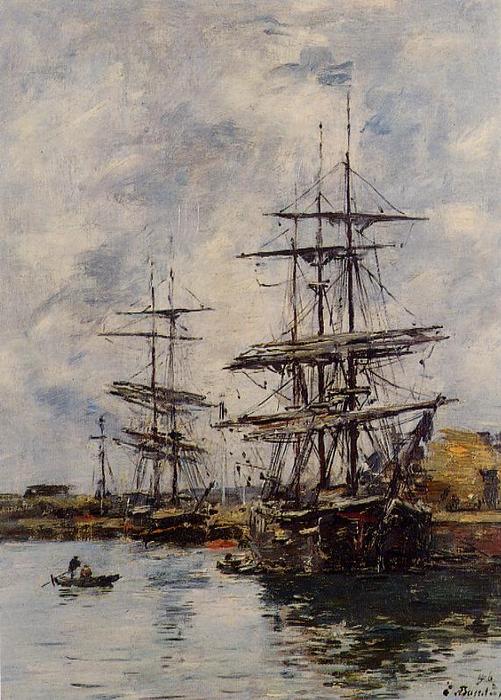
Deauville, Ships at Dock: A Glimpse of Impressionistic Tranquility
Eugène Louis Boudin's "Deauville, Ships at Dock," painted in 1896, offers a captivating snapshot of maritime life in the fashionable coastal town of Deauville. This work exemplifies Boudin’s signature Impressionistic style, characterized by loose brushwork and an acute observation of light and atmosphere. More than just a depiction of ships, it's a study in tranquility, capturing a fleeting moment of quietude on the harbor.
Subject & Composition: A Harmonious Harbor Scene
The painting presents a horizontal composition dominated by several tall-masted sailing vessels clustered towards the center of the frame. These ships form the focal point, their intricate rigging silhouetted against a cloudy sky. The shoreline is subtly suggested on either side, creating a sense of depth and breadth to the harbor scene. A small boat with a single figure in the foreground provides a crucial element of scale, grounding the viewer within the expansive landscape. Boudin masterfully utilizes size variation – larger ships appearing closer – and atmospheric haze to enhance the illusion of perspective.
Impressionistic Technique & Color Palette
Boudin’s technique is distinctly Impressionistic. He eschews precise lines in favor of loose, fluid strokes that capture the movement of water and clouds. The visible texture created by his impasto technique – a thick application of paint – adds dynamism and immediacy to the scene. The color palette is predominantly muted and cool, relying heavily on shades of grey, blue, and white to evoke the overcast conditions. Subtle hints of brown and ochre in the ships' hulls and shoreline provide warmth and contrast without disrupting the overall atmospheric feel. Boudin’s layering of paint contributes to a sense of depth and visual richness.
Historical Context & Artistic Legacy
Eugène Louis Boudin (1824-1898) was a pivotal figure in the development of Impressionism, often considered its precursor. Born in Honfleur, France, he developed an early affinity for the sea and spent much of his career painting coastal scenes. He was significantly influenced by Dutch masters and later by Johan Jongkind, who introduced him to the practice of plein air painting – working directly from nature outdoors. This approach allowed Boudin to faithfully capture the ever-changing effects of light and weather, a hallmark of Impressionism. His work profoundly impacted younger artists like Claude Monet, solidifying his place as a key figure in art history. "Deauville, Ships at Dock" exemplifies this legacy, showcasing Boudin's ability to transform an ordinary scene into a moment of poetic beauty.
Symbolism & Emotional Resonance
Beyond its visual appeal, “Deauville, Ships at Dock” evokes a profound sense of tranquility and quiet observation. The overcast sky and muted colors contribute to a feeling of nostalgia or the passage of time. The lone figure in the boat suggests solitude and contemplation, inviting viewers to reflect on their own connection to nature and the sea. Boudin’s painting is not merely a representation of ships at dock; it's an invitation to experience a moment of peaceful introspection.