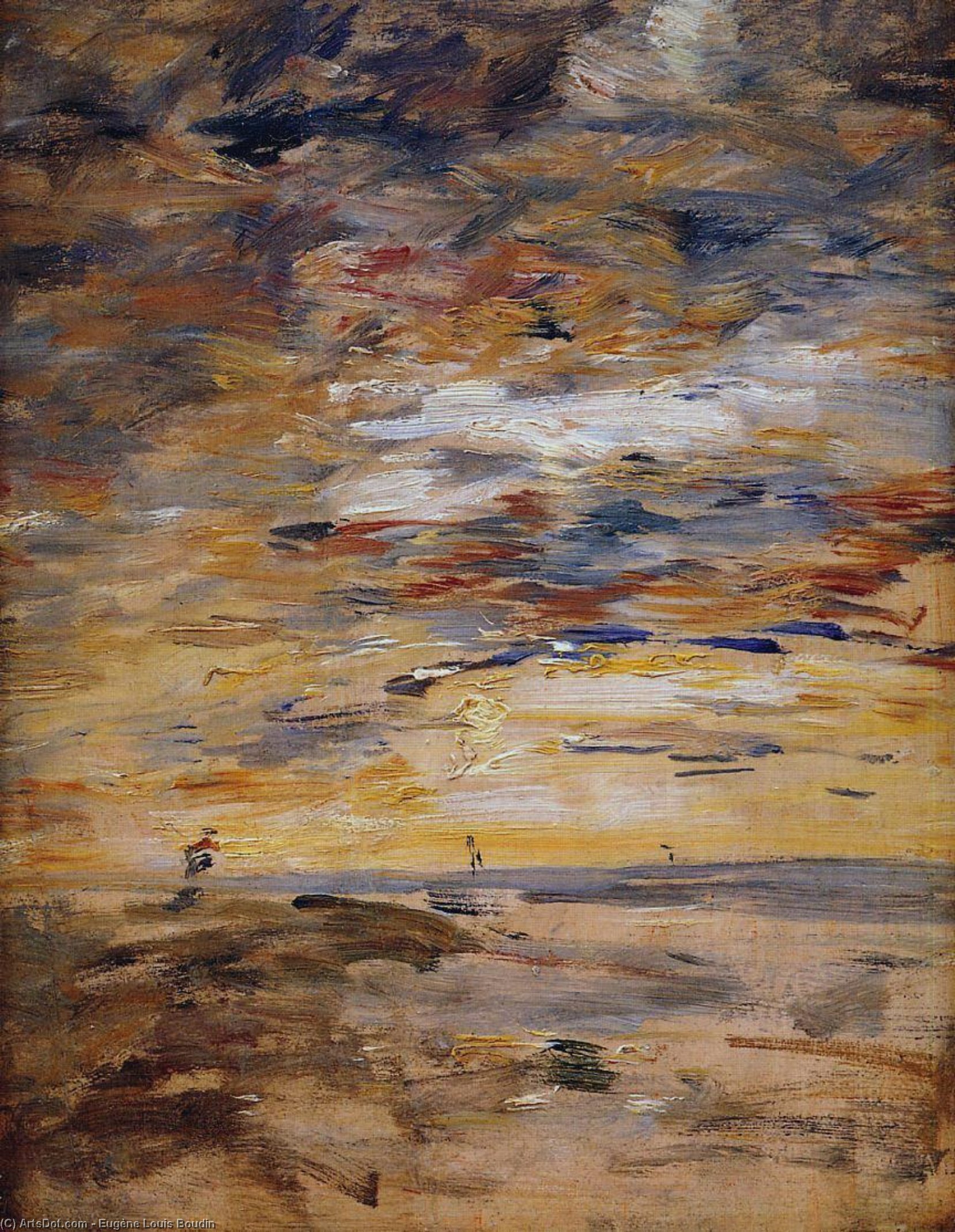
‘Sky at Sunset,’ created in 1890 by Eugène Boudin, exemplifies Impressionism with its masterful depiction of a tranquil seascape bathed in the warm hues of twilight. Two figures stand on the beach observing the mesmerizing sunset sky filled with textured clouds.
Eugène Boudin (1824-1898): Pioneer of plein air painting & key influence on Impressionism. Discover his atmospheric seascapes, beach scenes & masterful light studies!
Its seamless integration with the coastal landscape and innovative use of natural light. The building was designed to harmonize with its marine environment, featuring natural light filtering systems and translucent panels that enhance the viewing experience.
A Moment Frozen in Time: Eugène Boudin’s ‘Sky at Sunset’
The painting “Sky at Sunset,” created circa 1890 by Eugène Louis Boudin, stands as a quintessential example of Impressionist landscape art—a testament to capturing fleeting sensations rather than meticulously recreating visual reality. Boudin, born in Honfleur, France, in 1824, established himself as one of the foremost painters of his era, dedicating his life to portraying the coastal scenery of Normandy with unparalleled sensitivity and observation. This particular canvas embodies his signature approach: a deceptively simple depiction of a twilight sky brimming with atmospheric haze and vibrant hues.
### Artistic Technique & Impressionistic Vision
Boudin’s technique—primarily pastel on paper—was revolutionary for its time. Unlike traditional oil painting, which prioritized blending colors to achieve smooth gradations, Boudin employed loose, visible brushstrokes that allowed the pigment itself to shimmer and blend organically within the viewer's eye. The pastel medium offered exceptional luminosity and tonal range, perfectly suited for conveying the ephemeral qualities of sunset light—a challenge that Boudin tackled with remarkable skill. Notice how he builds up layers of color, subtly shifting from warm oranges and reds at the horizon to cooler blues and violets higher in the sky. These textured strokes aren’t merely descriptive; they actively contribute to the painting's emotional resonance.
### Historical Context & The Rise of Impressionism
“Sky at Sunset” emerged during a pivotal moment in art history—the burgeoning Impressionist movement. Artists like Boudin, Claude Monet, and Camille Pissarro rejected the academic conventions of their predecessors, prioritizing direct observation and capturing the immediacy of experience. They sought to depict not what the eye *sees*, but what it *feels*. The painting reflects the broader intellectual currents of the period, influenced by scientific advancements in optics and a growing fascination with psychology—ideas that encouraged artists to explore subjective perception and emotional expression. Boudin’s work aligns seamlessly with this ethos, capturing the tranquil beauty of the seaside at dusk – a scene increasingly appreciated for its contemplative mood.
### Symbolism & Emotional Resonance
Beyond its technical brilliance, “Sky at Sunset” possesses subtle symbolic significance. The expansive sky represents infinity and transcendence—a visual metaphor for contemplation and spiritual awareness. The clouds themselves symbolize change and impermanence, mirroring the cyclical rhythms of nature and reminding us of the fleeting beauty of each passing moment. Boudin’s masterful use of color evokes a profound sense of serenity and nostalgia – transporting the viewer back to a time when life moved at a slower pace and the natural world held dominion over human concerns. The painting's muted palette enhances this feeling, inviting viewers into a space of quiet reflection.
### Legacy & Inspiration for Contemporary Design
Today, “Sky at Sunset” continues to inspire artists and designers alike. Its luminous pastel tones resonate with a timeless elegance that lends itself beautifully to interior spaces—particularly coastal homes where the colors echo the hues of twilight seascapes. Reproductions of this iconic artwork offer an opportunity to bring Boudin’s vision into modern living, capturing not only the aesthetic beauty of Impressionism but also its enduring message of peace and appreciation for the sublime grandeur of nature.