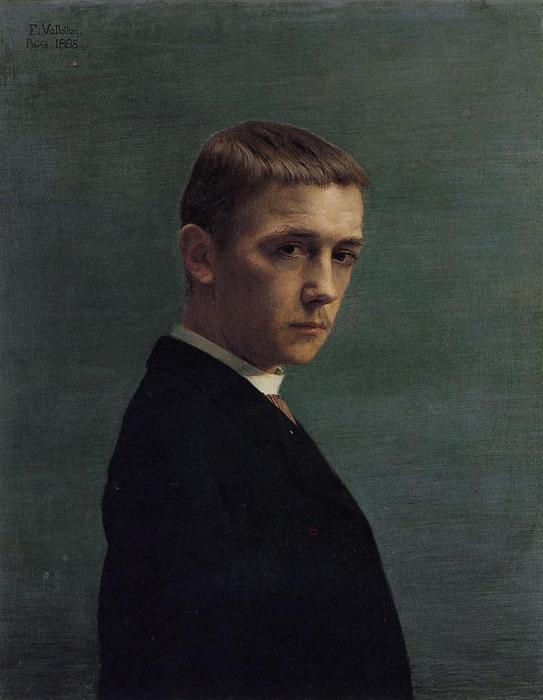
This striking black and white portrait by Félix Vallotton exemplifies the understated realism characteristic of Les Nabis, showcasing Vallotton's exploration of psychological depth within a classical framework. Created in 1885, it reflects Vallotton’s formative years as an artist.
Félix Vallotton: A Pioneer of Modern Woodcut and Psychological Portraiture
Vallotton’s “Self Portrait at 20” stands as a testament to the artist's unwavering commitment to capturing the essence of human experience with remarkable precision and understated emotion. Painted in 1885, shortly after his arrival in Paris and enrollment at the Académie Julian, this monochrome depiction reveals Vallotton’s formative artistic vision—a departure from academic conventions yet firmly rooted in observation and a profound understanding of tonal nuance. The photograph showcases a young Vallotton seated before a dark background, gazing directly at the camera with an expression that conveys both seriousness and introspection. His gaze is unwavering, conveying a quiet contemplation that invites viewers to consider the complexities of identity and self-awareness.
- Style: Vallotton’s style aligns squarely within the burgeoning movement of Les Nabis—a group dedicated to rejecting Impressionism's fleeting effects in favor of exploring psychological depth and formal experimentation.
- Technique: Executed with meticulous attention to detail, the portrait utilizes a limited palette of shades of gray, skillfully manipulating tonal variations to sculpt form and convey mood. Vallotton’s masterful control over chiaroscuro—the interplay between light and shadow—creates dramatic contrasts that heighten the sense of presence and immediacy.
The Influence of Holbein and Ingres: Early Artistic Foundations
Vallotton's formative years were marked by exposure to the artistic legacies of Hans Holbein the Younger and Jean-Auguste Dominique Ingres—artists whose mastery of realism and anatomical accuracy profoundly impacted Vallotton’s stylistic development. Holbein’s portraits, characterized by their unflinching depiction of human anatomy and psychological subtlety, instilled in Vallotton a desire for truthful representation—a core principle that would permeate his oeuvre throughout his career. Similarly, Ingres's idealized compositions championed classical beauty and harmonious proportions, shaping Vallotton’s aesthetic sensibilities and informing his approach to visual composition.
Les Nabis: Embracing Formal Innovation
Vallotton’s association with Les Nabis—a collective of artists who sought to redefine the boundaries of artistic expression—proved pivotal in propelling him toward groundbreaking innovations. This group championed a rejection of Impressionistic subjectivity, prioritizing instead a focus on formal elements such as line and color (though Vallotton largely eschewed color) to convey emotion and psychological insight. The Nabis’s exploration of symbolism and their deliberate avoidance of decorative ornamentation reflected a broader intellectual climate—one grappling with anxieties about modernity and searching for new ways to articulate the human condition.
Symbolism and Emotional Resonance
“Self Portrait at 20” transcends mere visual representation; it embodies Vallotton’s artistic philosophy—a belief that art should illuminate the inner workings of the human psyche. The artist's deliberate restraint in color contributes to a palpable sense of solemnity, inviting viewers to contemplate themes of selfhood and vulnerability. Vallotton’s gaze captures not just physical likeness but also an intangible quality—a quiet contemplation that speaks volumes about the artist’s internal state. This portrait remains a compelling example of Vallotton's ability to distill complex emotions into a deceptively simple visual form, securing its place as a cornerstone of modern art history.
Beyond the Portrait: Exploring Vallotton's Wider Artistic Legacy
While “Self Portrait at 20” exemplifies Vallotton’s stylistic prowess, it represents only one facet of his multifaceted artistic output. His exploration of landscapes and still lifes—often imbued with subtle symbolic resonances—further demonstrates his commitment to conveying profound psychological truths through visual language. Consider also his masterful woodcuts, which gained international acclaim during the 1890s and solidified Vallotton’s reputation as a pioneer of modern printmaking. These works continue to inspire artists today, demonstrating Vallotton's enduring influence on the trajectory of artistic innovation.