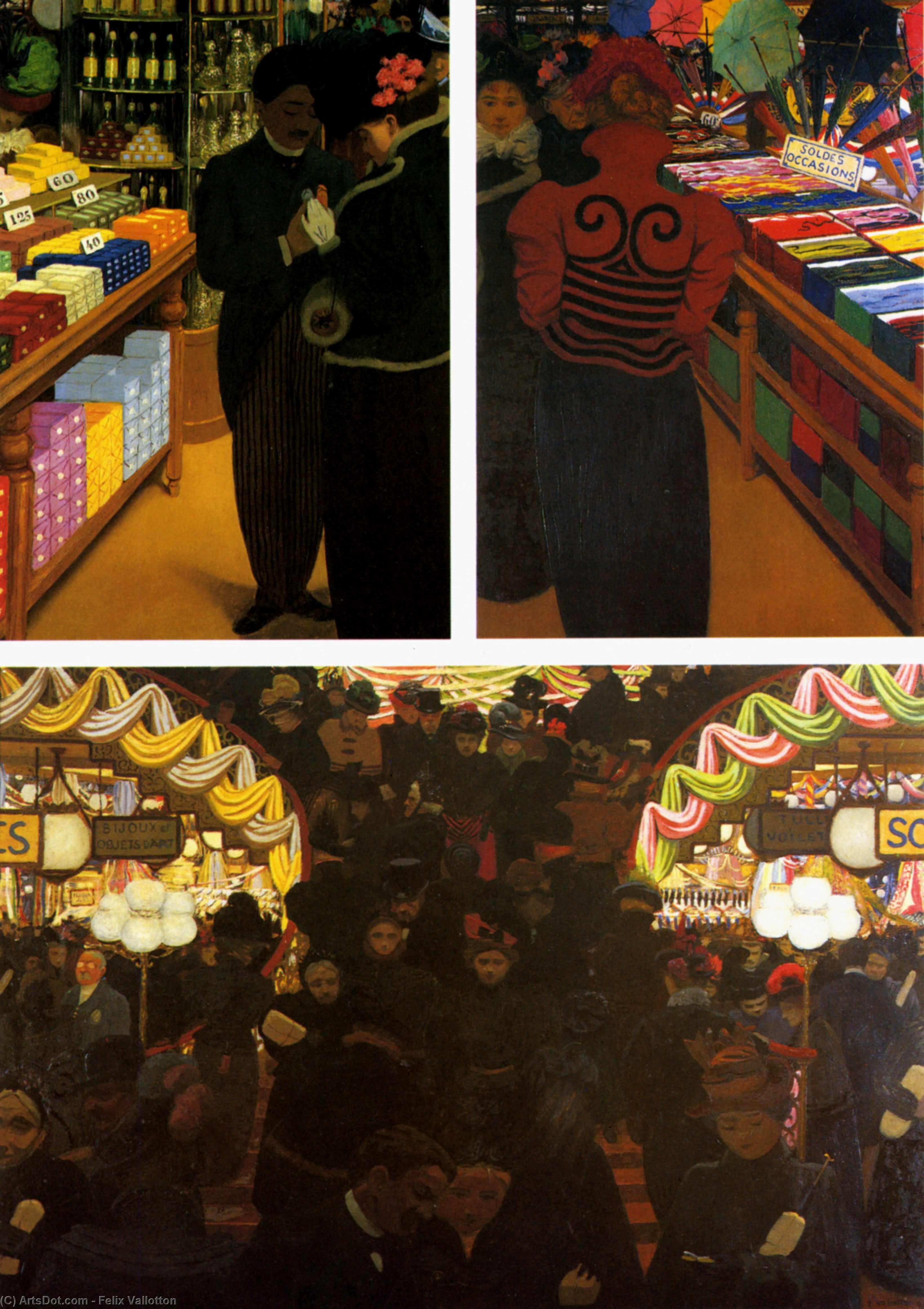
The Vibrant Pulse of Daily Life: Exploring "The Good Market"
To gaze upon Félix Vallotton's triptych, "The Good Market," is to step directly into the heart of a bustling nineteenth-century thoroughfare. This work is far more than a mere depiction of commerce; it is a vibrant tapestry woven from human interaction, the rich scent of exotic goods, and the ceaseless rhythm of daily life in a major urban center. The composition itself, divided across three distinct panels, invites the viewer to wander through its scenes—from the focused exchange between two men near a counter to the careful contemplation of a woman selecting provisions.
Vallotton captures the energy with an almost journalistic immediacy, yet imbues it with a sophisticated artistic detachment. The crowd is not simply rendered; it breathes. One can almost hear the calls of the vendors and feel the press of bodies moving through the narrow aisles. It speaks to a time when public life unfolded dramatically in these open-air marketplaces, serving as both an economic engine and a crucial social stage.
A Glimpse into Fin de Siècle Parisian Life
Painted around 1898, this triptych anchors itself firmly within the *fin de siècle* period—that exquisite, transitional moment at the close of the nineteenth century. While Vallotton’s personal journey saw him bridging his Swiss origins with the bohemian fervor of Paris, "The Good Market" grounds us in a more universal, yet distinctly modern, experience. The style reflects an engagement with contemporary realism, moving away from idealized historical narratives toward the gritty, beautiful truth of everyday existence. It possesses the observational rigor of academic training but filters it through a modernist sensibility that finds poetry in the mundane.
For the collector or designer, this piece offers a window into a bygone era's material culture and social dynamics, suggesting an atmosphere of robust vitality perfect for lending character to a grand hall or a richly appointed study.
Mastery of Composition and Technique
Vallotton’s technique in this work is characterized by its clarity and decisive brushwork. While the subject matter—the market—demands a sense of chaotic movement, Vallotton employs compositional structure to maintain visual harmony across the three panels. The interplay between light and shadow sculpts the figures and the piled goods, giving depth to what could otherwise be a flat depiction. His handling of color is masterful; it is rich without being saccharine, suggesting the deep reds of ripe produce against the muted tones of clothing and stone.
When considering a reproduction for your space, note how this technique translates: the vibrancy remains palpable, allowing the texture of the paint to mimic the tactile reality of the goods displayed—the rough weave of sacks, the sheen on polished fruit. It is art that rewards close inspection.
Symbolism and Emotional Resonance
Beyond the visible transactions, "The Good Market" subtly explores themes of sustenance, community, and the passage of time. The market itself symbolizes human endeavor—the daily ritual necessary for survival and connection. There is a quiet dignity in the interactions; even amidst the bustle, moments of private exchange or focused selection are captured. It evokes a feeling of nostalgic immersion—a longing not just for a specific place, but for a perceived simplicity found within structured routine.
Owning this piece allows one to curate an emotional atmosphere of grounded energy. It is art that does not shout its drama but rather hums with the steady, compelling music of life continuing, beautifully observed.