The Enigmatic Gaze: Unpacking Eugène Delacroix's "A Jewish Woman of Algiers"
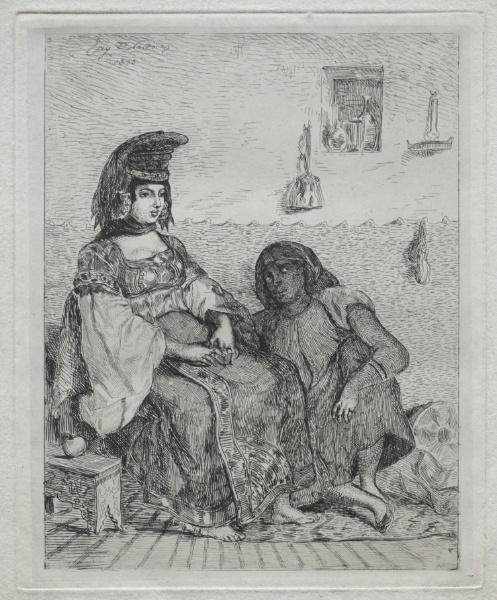
Eugène Delacroix’s “A Jewish Woman of Algiers” (Femmes d’Alger dans leur appartement), painted in 1834 and later revisited in a powerful 1847 iteration, is far more than a mere depiction of a scene from North Africa. It's a carefully constructed meditation on identity, vulnerability, and the complex interplay between observation and representation. The painting immediately draws the viewer into a dimly lit interior, dominated by the presence of four women – three richly adorned and one shrouded in shadow – within a space that feels both intimate and subtly unsettling. This isn’t a straightforward portrait; it's a staged drama, a carefully orchestrated tableau designed to provoke contemplation about the lives and experiences of those outside the dominant European gaze.
Delacroix, deeply influenced by his travels in Algeria during the Romantic era, sought to move beyond the traditional academic style that emphasized idealized beauty. Instead, he embraced a more expressive approach, utilizing loose brushstrokes, dramatic chiaroscuro (the contrast between light and dark), and a vibrant, almost feverish palette of grays and blacks. This technique wasn’t simply about rendering form; it was about conveying emotion – the quiet melancholy of the central figure, the subtle tension within the group, and the overall atmosphere of contained mystery.
Line, Shadow, and Texture: The Language of Etching
“A Jewish Woman of Algiers” is an etching, a medium that inherently demands precision and control. Delacroix masterfully exploits this characteristic, employing a sophisticated system of hatching and cross-hatching to build up form and texture with remarkable subtlety. The meticulous rendering of fabric—the billowing robes, the intricate jewelry—is achieved through layers upon layers of these fine lines, creating an almost tactile quality. Notice how the light catches on the folds of the garments, while deep shadows define the faces and create a sense of depth within the confined space. The artist’s use of varying line weights – thicker lines for outlines and areas of shadow, thinner lines for details—further enhances this effect, guiding the viewer's eye across the composition.
The monochromatic palette, entirely composed of shades of gray, is crucial to the painting’s mood. It amplifies the drama of light and shadow, intensifying the emotional impact of the scene. The absence of color forces the viewer to focus on form, texture, and the expressive power of line. It's a deliberate choice that aligns with Delacroix’s Romantic sensibilities – a rejection of the idealized beauty favored by Neoclassical artists in favor of a more raw and emotionally charged representation.
Symbolism and Context: A Window into 19th-Century Algeria
The painting's title, “A Jewish Woman of Algiers,” immediately raises questions about its intended meaning. Delacroix’s choice to specifically identify the subject as Jewish reflects his interest in exploring diverse cultures within North Africa during a period marked by European colonialism and fascination with the ‘exotic.’ The scene itself is deliberately ambiguous; it's not clear whether the women are engaged in a private conversation, or if they are simply observing the viewer. This ambiguity contributes to the painting’s enduring power, inviting viewers to project their own interpretations onto the scene.
The presence of the black woman, partially obscured and seemingly retreating into the shadows, is particularly significant. Some scholars interpret her as a symbol of vulnerability and marginalization within colonial society. Her gaze, directed away from the viewer, suggests a sense of detachment and perhaps even resignation. Delacroix’s work, therefore, can be seen as a subtle critique of European attitudes towards non-European cultures – a recognition of their complexity and inherent dignity.
A Legacy of Romantic Intensity
“A Jewish Woman of Algiers” remains one of Delacroix's most celebrated works, embodying the core tenets of the Romantic movement. It’s a testament to his ability to capture human emotion through expressive line work and masterful use of light and shadow. Reproductions of this iconic painting offer a remarkable opportunity to experience the intensity and complexity of Delacroix’s vision – a window into a fascinating period in art history and a poignant reflection on themes of identity, culture, and representation. ArtsDot offers meticulously crafted hand-painted reproductions that faithfully capture the nuances and emotional depth of this extraordinary masterpiece.