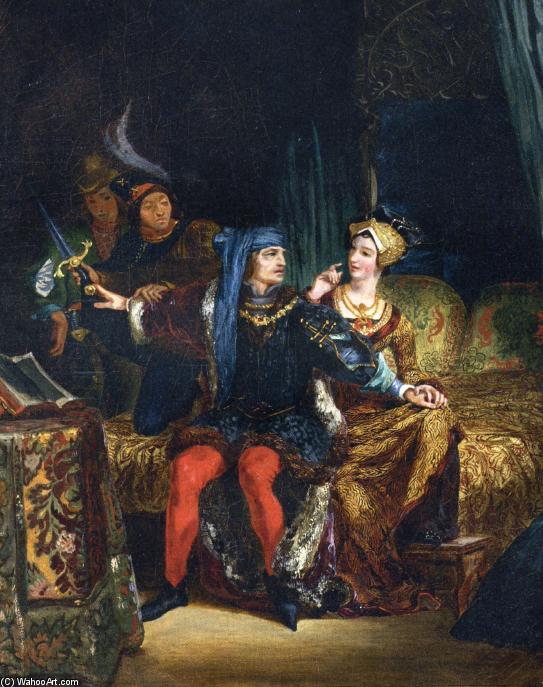
Delacroix's 'Charles VI and Odette de Champdivers' captures a poignant royal romance with vibrant colors & dynamic brushstrokes. Explore the painting’s historical context, artistic influences & Delacroix’s legacy.
Explore the vibrant world of Eugène Delacroix, a leading French Romantic artist! Discover his dramatic scenes, exotic themes & masterful use of color. See iconic works like 'Liberty Leading the People'. #Delacroix #Romanticism #FrenchArt
Charles VI and Odette de Champdivers: A Dance of Desire and Decay
Eugène Delacroix’s “Charles VI and Odette de Champdivers,” painted in 1824, is not merely a portrait; it's a visceral exploration of power, vulnerability, and the intoxicating allure of illicit love. This oil on canvas, housed within the Musée Eugène Delacroix in Paris, offers a glimpse into the turbulent life of King Charles VI of France – a man grappling with madness and surrounded by a web of intrigue – and his passionate relationship with Odette de Champdivers, a woman who held considerable sway over his affections. The scene unfolds within a richly appointed chamber, a space simultaneously opulent and shadowed, reflecting the duality at the heart of the narrative. Delacroix masterfully employs vibrant colors—deep reds, blues, and golds—to create an atmosphere of both luxury and unease, drawing the viewer into the drama unfolding before them. Notice how he uses light to highlight key elements: the king’s tormented face, Odette's serene expression, and the details of their surroundings – a book lying open, a wine glass poised, all contributing to a sense of heightened intimacy and impending doom.
Historical Context and Royal Intrigue
The painting is deeply rooted in the historical context of Charles VI’s reign, a period marked by mental instability and political turmoil. The king suffered from bouts of severe illness, often described as “the madness,” which led to erratic behavior and numerous affairs. Odette de Champdivers, known as "la petite reine" (the little queen) by those close to the court, was one of his most trusted mistresses, a woman who possessed both beauty and intelligence. The opera *Charles VI*, penned by Louis de Bernières in 1824, provided Delacroix with direct inspiration for this work, depicting a pivotal scene where the king, overwhelmed by despair, reaches out to Odette for solace. Delacroix’s interpretation goes beyond a simple illustration of the opera; he delves into the psychological complexities of both figures, capturing Charles's desperate plea and Odette’s quiet dignity in the face of his madness. The inclusion of other courtiers—servants, nobles, and onlookers—adds to the sense of a private drama unfolding within the confines of the royal chamber, hinting at the wider repercussions of the king’s actions.
Delacroix's Technique: A Symphony of Color and Emotion
Delacroix was renowned for his dynamic brushwork and expressive use of color, techniques that are vividly displayed in “Charles VI and Odette de Champdivers.” He employed a loose, painterly style—a hallmark of the Romantic movement—characterized by visible brushstrokes and an emphasis on capturing fleeting moments of emotion. Observe how he builds up layers of paint to create texture and depth, particularly in the fabrics of the clothing and the details of the room’s furnishings. The use of chiaroscuro – the dramatic contrast between light and shadow – further intensifies the emotional impact of the scene, highlighting Charles's anguish and Odette’s composure. Delacroix’s masterful handling of color is particularly noteworthy; he uses rich reds to evoke passion and danger, while cooler blues and greens suggest a sense of melancholy and decay. The painting isn’t simply a representation of figures; it’s an embodiment of feeling, conveyed through the artist's bold and unrestrained application of paint.
Symbolism and Emotional Resonance
Beyond its historical context, “Charles VI and Odette de Champdivers” is laden with symbolism. The sword grasped by the king represents his authority and vulnerability—a symbol of a power he struggles to control. Odette’s calm demeanor in contrast to Charles's frantic gestures speaks volumes about her strength and resilience. The book lying open suggests a moment of contemplation, perhaps reflecting on the consequences of his actions. Even the wine glass, a symbol of indulgence and pleasure, carries an undercurrent of foreboding. Delacroix masterfully uses these seemingly simple details to create a complex tapestry of meaning, inviting viewers to contemplate the themes of love, loss, madness, and power. The painting’s enduring appeal lies in its ability to evoke a profound sense of empathy for both figures, recognizing their shared humanity amidst the chaos of royal life. It's a poignant reminder that even within the most opulent settings, vulnerability and despair can lurk beneath the surface.