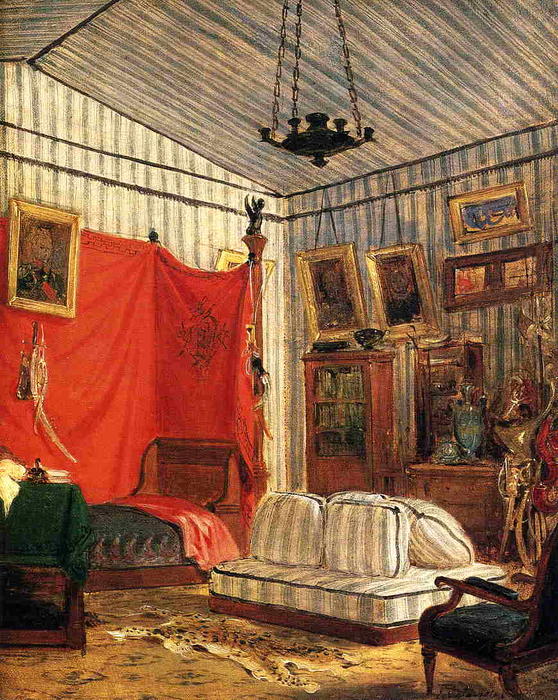
Explore Delacroix’s ‘Count de Mornay’s Apartment’! A richly detailed 1832 oil painting showcasing Romantic elegance & refined decadence. Discover its artistic significance at the Louvre.
Explore the vibrant world of Eugène Delacroix, a leading French Romantic artist! Discover his dramatic scenes, exotic themes & masterful use of color. See iconic works like 'Liberty Leading the People'. #Delacroix #Romanticism #FrenchArt
Explore the Louvre Museum in Paris! Home to iconic masterpieces like the Mona Lisa & Venus de Milo, journey through art history from ancient Egypt to Renaissance icons. Plan your visit today!
A Glimpse into Intimate Parisian Life: Delacroix’s ‘Count de Mornay's Apartment’
Eugène Delacroix, a leading figure of the French Romantic movement, offers us an unusually intimate scene in *‘Count de Mornay's Apartment’* (1832). Unlike his grand historical paintings, this work presents a quiet domestic interior – the private sanctum of a prominent political figure. The painting isn’t merely a depiction of a room; it is a carefully constructed tableau that speaks to intellectual pursuits, refined taste, and perhaps, a subtle melancholy. Delacroix masterfully transforms an everyday setting into a compelling narrative about life lived within these walls.
Romanticism & the Interior: Style and Technique
Delacroix’s Romantic sensibility is evident in his expressive brushwork and rich color palette. While seemingly realistic, the scene isn't photographic; it’s *felt* rather than simply observed. The artist employs a warm, muted tonality dominated by reds, browns, and golds, creating an atmosphere of cozy intimacy. Notice how light plays across the surfaces – illuminating the bed linens, highlighting the textures of the velvet curtains, and casting soft shadows that add depth and dimension. The loose brushstrokes, characteristic of Delacroix’s style, imbue the scene with a sense of movement and life, preventing it from feeling static or overly formal. The composition is deliberately asymmetrical, avoiding rigid symmetry in favor of a more naturalistic arrangement – mirroring the lived-in quality of the space. This contrasts sharply with the Neoclassical emphasis on order and precision prevalent at the time.
Symbolism & Historical Context
The painting offers clues to the life and personality of its owner, Count de Mornay, a key figure in French politics during the July Revolution. The scattered books suggest intellectual curiosity and political engagement – De Mornay was known for his liberal views and literary salon. The presence of artwork within the room further emphasizes this cultivated atmosphere. Even seemingly mundane objects like the clock contribute to the narrative, subtly reminding us of the passage of time and the fleeting nature of life. Painted in 1832, during the Restoration period following Napoleon’s reign, the work reflects a growing interest in private life and domesticity as subjects worthy of artistic representation – a shift away from solely focusing on historical or mythological themes. The painting can be seen as a visual embodiment of Romantic ideals: an exploration of individual emotion, subjective experience, and the beauty found in everyday moments.
Emotional Resonance & Lasting Appeal
*‘Count de Mornay's Apartment’* evokes a sense of quiet contemplation and understated elegance. It invites viewers to step into this private space and imagine the conversations that took place within its walls, the thoughts that occupied De Mornay’s mind, and the atmosphere of intellectual exchange that likely permeated the room. The painting isn’t dramatic or overtly emotional; rather, it possesses a subtle power that lies in its ability to capture a fleeting moment of tranquility and introspection. For interior designers, this work offers inspiration for creating warm, inviting spaces that blend sophistication with comfort. Its rich color palette and textured surfaces can inform choices in fabrics, furnishings, and lighting. For collectors, it represents a rare glimpse into the private world of a prominent historical figure, rendered by one of France’s most celebrated artists.