A Dramatic Encounter in Ink: Delacroix’s Shakespearean Vision
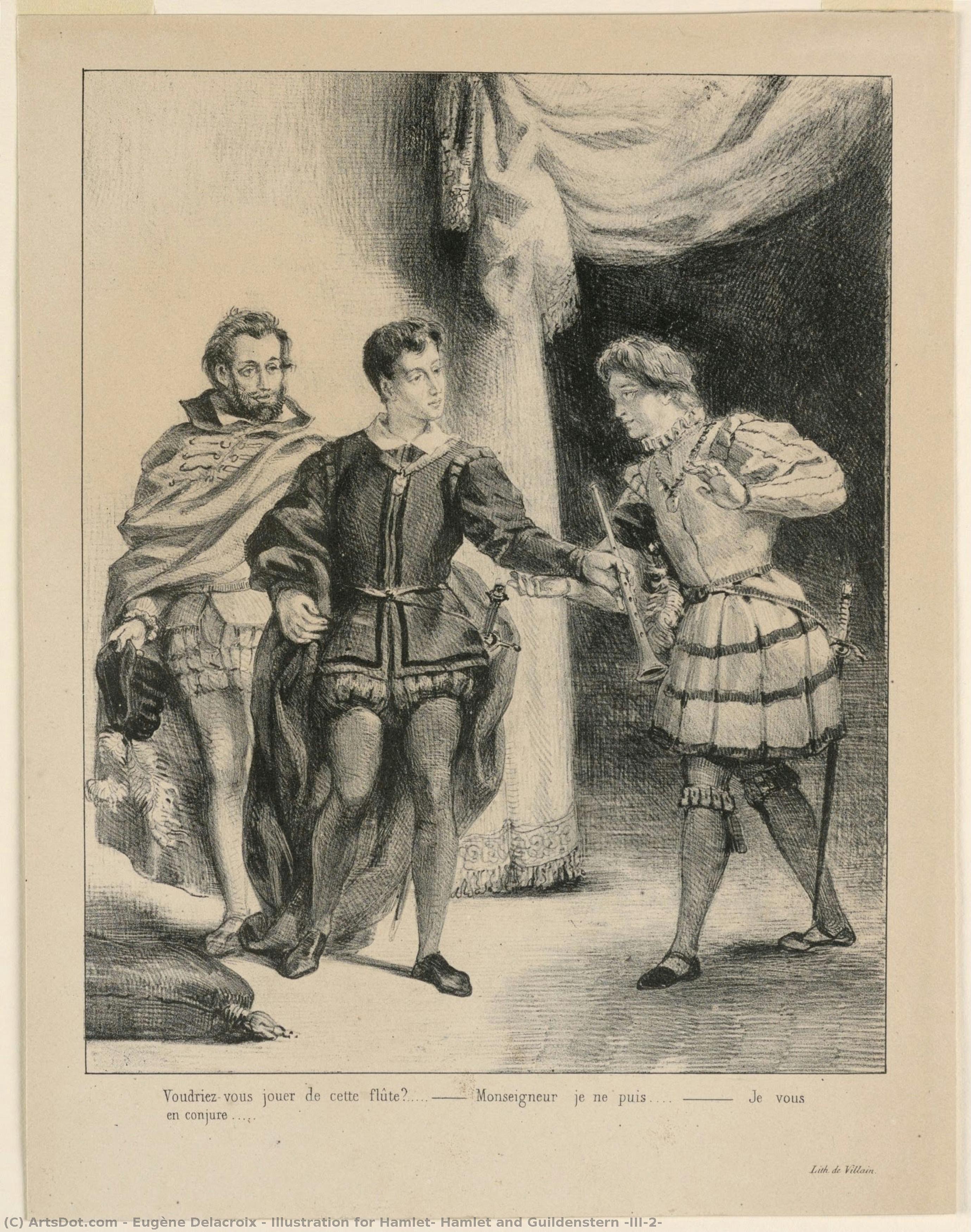
In this evocative black and white illustration from 1835, the legendary French Romantic master Eugène Delacroix breathes life into one of literature's most tension-filled moments. Capturing a pivotal scene from Act III, Scene 2 of Shakespeare’s Hamlet, the artwork presents a masterful study of interpersonal drama and psychological depth. The composition centers on the complex interplay between Hamlet, Guildenstern, and Rosencrantz, rendered with a starkness that emphasizes the weight of their shared history and the looming shadows of betrayal. Delacroix, ever the dramatist, utilizes the absence of color to focus the viewer's eye on the raw textures of period costume and the expressive gestures of the characters, creating a scene that feels less like a static drawing and more like a captured moment of theatrical intensity.
The artistry lies in the delicate balance between the foregrounded observers and the central protagonists. A quiet figure sits upon a bench, accompanied by a resting dog, acting as a silent witness to the unfolding Shakespearean tragedy. This inclusion adds a layer of voyeuristic depth to the piece, inviting the viewer to step into the role of the onlooker, peering into a private moment of political and personal maneuvering. The technique reflects Delacroix’s rejection of Neoclassical rigidity; even in this monochromatic medium, one can sense his signature movement and emotional turbulence. The linework guides the eye through the intricate folds of the characters' attire, suggesting the heavy, somber atmosphere of the Danish court.
For the discerning collector or interior designer, this illustration offers a profound sense of historical gravitas and intellectual sophistication. It is a piece that speaks to the soul of the Romantic era—a time defined by an obsession with the sublime, the tragic, and the human condition. When integrated into a curated space, such as a library, a study, or a gallery-style living room, this reproduction serves as a powerful focal point. Its monochromatic palette allows it to harmonize beautifully with both contemporary minimalist settings and more traditional, opulent decors, providing a window into the 19th-century fascination with the dramatic arts. Owning such a work is not merely about possessing an image, but about hosting a dialogue with one of history's most influential artistic spirits.