A Symphony of Form and Flight: Exploring Fernand Léger’s “Children in the Bird”
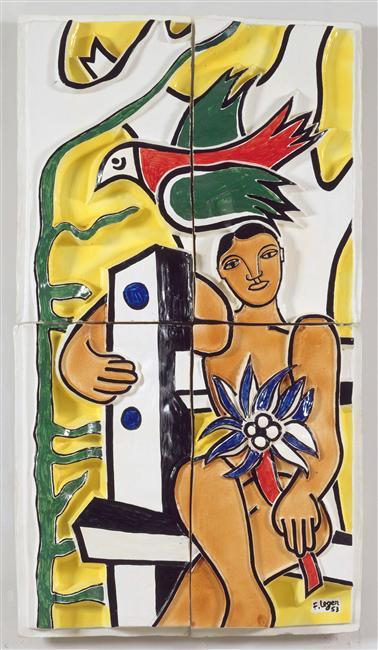
Fernand Léger's "Children in the Bird" transcends mere depiction; it embodies a profound engagement with the burgeoning spirit of modernity. Painted in 1953, this artwork isn’t simply a visual record of a woman cradling a bird—it’s an assertion that art could simultaneously embrace abstraction and honor the tangible realities of industrial progress. Léger's formative years spent amidst the Norman countryside instilled within him a sensitivity to organic shapes and textures, which he skillfully juxtaposed against the angular geometries characteristic of Cubism. This duality is powerfully realized in the painting’s composition: The woman’s seated posture anchors the scene, while the bird perched upon her shoulder serves as a visual emblem of liberation and renewal—a deliberate echo of the era's fascination with flight and technological advancement.
- Style & Technique: Léger’s signature Cubist style dominates “Children in the Bird,” characterized by fragmented planes rendered in bold, contrasting colors. Thick impasto – a technique where paint is applied thickly onto the canvas – lends textural richness to the depiction of both the woman and the birds, emphasizing their physicality.
- Historical Context: Created during the mid-20th century, “Children in the Bird” reflects Léger’s broader artistic preoccupation with capturing the dynamism of the machine age. The painting speaks to a period marked by rapid industrialization and urbanization, mirroring anxieties about societal transformation alongside hopes for progress.
- Symbolism: The bird itself is laden with symbolic significance—representing freedom, aspiration, and connection to nature amidst an increasingly mechanized world. Léger’s deliberate inclusion of this element underscores his belief that art could communicate complex ideas beyond literal representation.
Color Palette & Composition – An Orchestration of Vibrancy
The painting's color scheme is deliberately arresting, utilizing hues of yellow, blue, red, green, and white to create a harmonious yet energetic visual experience. These colors aren’t merely decorative; they contribute to the artwork’s emotional impact—the yellows conveying warmth and optimism, while the blues evoke tranquility and contemplation. Léger meticulously arranges these colors within a geometric framework, mirroring the principles of Cubism's exploration of spatial relationships. The placement of the birds and the clock further reinforces this compositional strategy, guiding the viewer’s gaze and enhancing the painting’s overall visual coherence.
Emotional Resonance – Finding Beauty in Industrial Age Anxiety
“Children in the Bird” isn't merely aesthetically pleasing; it possesses a palpable emotional depth. Léger confronts anxieties surrounding societal change head-on, presenting a vision of humanity intertwined with technology—a paradox that speaks to the complexities of the era. Yet, amidst this apprehension lies an undeniable affirmation of beauty and vitality. The woman’s comforting embrace of the bird suggests resilience and hope—a reminder that even in times of upheaval, connections to nature and inner peace can endure. This duality encapsulates Léger's artistic mission: To elevate abstraction beyond mere intellectual exercise into a conduit for profound emotional experience.