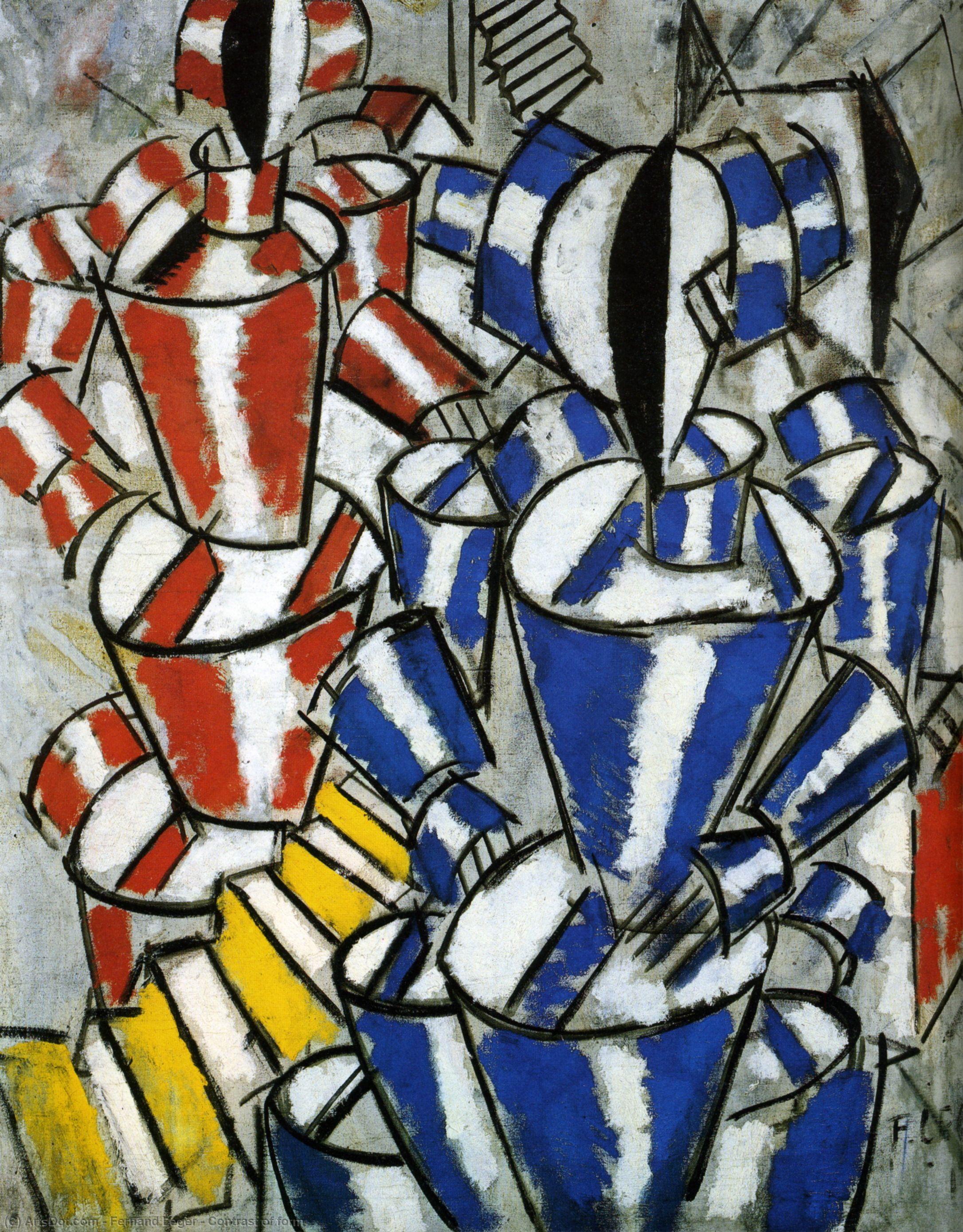
Explore Fernand Leger’s "Contrast of Form" (1913), a dynamic Cubist painting featuring fragmented figures & geometric shapes. A unique piece showcasing his innovative style and bold composition.
Discover Fernand Léger (1881-1955): Pioneer of Cubism & 'Tubism'! Explore bold paintings celebrating modern life, machinery, and the human form – a key forerunner to Pop Art.
Contrast of Form: A Symphony in Geometric Precision
Fernand Léger’s “Contrasts of Forms,” painted in 1913, stands as a cornerstone of Cubist innovation and embodies the burgeoning fascination with industrial modernity that gripped Europe at the time. More than just a depiction of three figures—though they exist within a fragmented landscape—the painting is an exploration of visual language itself, prioritizing formal elements to convey dynamism and disrupting traditional notions of perspective and representation. Léger’s ambition wasn't merely to portray what he saw; it was to distill the essence of the machine age into a powerfully abstract form.
The Analytical Cubist Vision
The artwork firmly establishes itself within the realm of Analytical Cubism, a stylistic movement spearheaded by Picasso and Braque. This approach demanded a radical dismantling of sculptural illusion—the traditional depiction of depth—favoring instead a flattened picture plane dominated by interlocking geometric planes. As evidenced by MoMA’s meticulous documentation (https://www.moma.org/collection/works/78788), Léger meticulously layered oil paint onto canvas, achieving a smooth surface punctuated by subtle brushstrokes that contribute to the overall textural quality without overwhelming the dominant visual impact. The muted color palette—primarily reds and blues—served not as decorative embellishments but as crucial tools for delineating shapes and establishing spatial relationships. This deliberate restriction of hues underscores Léger’s focus on structural clarity, mirroring the precision found in industrial machinery.
A Landscape Fragmented: Symbolism Beyond Representation
Despite its apparent simplicity, “Contrasts of Forms” is laden with symbolic resonance. The landscape itself—a stylized expanse rendered in geometric abstraction—suggests a world transformed by technological progress. Léger’s deliberate omission of realistic detail isn't an absence of observation; it’s a conscious decision to prioritize the underlying structure of reality. The angular lines and sharply defined shapes convey tension and movement, mirroring the ceaseless activity of factories and urban environments. As WikiArt highlights (https://www.wikiart.org/en/fernand-leger/contrasts-of-forms-1913), Léger’s intention was to capture not just what he saw but also *how* it felt—the unsettling yet exhilarating energy of a new era.
Technique and Material Considerations
The painting's materiality – oil on canvas – speaks volumes about Léger’s commitment to capturing the physicality of his subject matter. The layering technique employed ensured that the surface retained subtle variations in texture, subtly hinting at the rough surfaces of industrial materials. Careful attention was paid to achieving a luminous quality despite the limited color palette, demonstrating Léger's mastery of artistic craftmanship.
A Legacy Echoing Through Modern Art
“Contrasts of Forms” represents more than just an aesthetic achievement; it’s a pivotal moment in art history. Its influence can be traced through subsequent movements like Tubism and ultimately foreshadowed the stylistic breakthroughs of Pop Art, cementing Léger's place as one of the most significant figures in shaping the visual language of the 20th century. Reproductions from ArtsDot offer an unparalleled opportunity to experience this seminal artwork firsthand, bringing its bold geometric forms and evocative symbolism into contemporary spaces.