A Study in Geometric Simplicity: Léger’s ‘Portrait of a Man with the Hat’
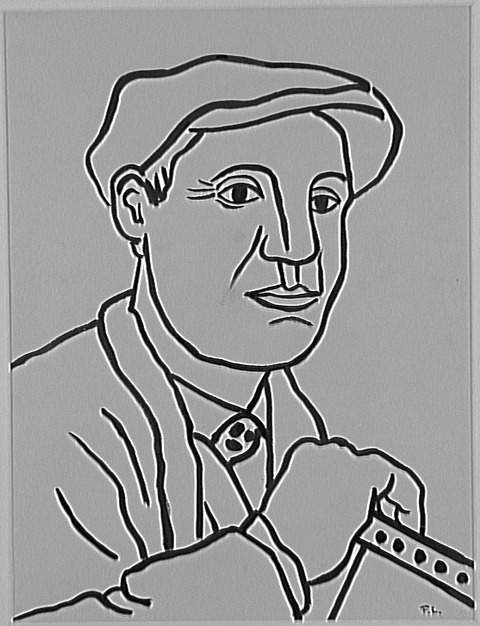
Fernand Léger’s “Portrait of a man with the hat, Study for builders,” created circa 1912, stands as an arresting example of Cubist influence and a deliberate departure from traditional portraiture. More than just a depiction of human form, it embodies Léger's fascination with the burgeoning industrial landscape and his desire to translate its essence into visual language.
- Subject Matter: The artwork presents a solitary male figure—likely intended as preparatory sketch for a larger composition—wearing a hat. His gaze directs slightly off-center, conveying a quiet confidence despite the stark simplicity of the portrayal.
- Style & Technique: Léger’s approach aligns squarely with Cubism's core tenets. Rejecting illusionistic depth and perspective, he employs geometric simplification – circles, ovals, flattened triangles – to represent the subject’s anatomy and attire. The execution is masterful, achieved primarily through bold, continuous lines rendered in ink or charcoal on paper, creating a graphic aesthetic that prioritizes form over realism.
- Color Palette & Composition: Dominated by grayscale hues—ranging from light gray to deep black—the palette underscores the artwork’s focus on line and shape. The central composition emphasizes the man's head and shoulders, positioning him prominently within the frame.
Decoding Geometric Form: Léger’s Tubism
Léger’s distinctive style, dubbed “Tubism” (short for ‘tube’), reflects his profound engagement with the mechanized world around him. He sought to capture not just what he *saw*, but how it *felt*. The geometric forms aren't merely decorative; they represent a conceptual effort to distill the fundamental building blocks of industrial structures—the tubes and cylinders that define factories and machines.
- Geometric Emphasis: Léger’s obsession with tubular shapes isn’t accidental. He believed these forms embodied the dynamism and efficiency of modern technology, mirroring the rhythm of urban life.
- Line as Structure: The prominent use of lines—bold, unbroken contours—becomes paramount in conveying this structural concept. They delineate not only the figure's form but also suggest movement and energy, hinting at the underlying forces shaping the environment.
Symbolism Beyond Representation
Despite its lack of overt symbolism, “Portrait of a man with the hat” communicates an emotional resonance rooted in Léger’s humanist perspective. The calm gaze of the subject speaks to resilience and contemplation amidst the rapid pace of industrial progress. It's a portrait not merely of appearance but of character—a quiet assertion of human presence against the backdrop of technological transformation.
- Reflection on Modernity: Léger’s artwork serves as a poignant commentary on the anxieties and aspirations inherent in the early 20th century. It captures a moment of introspection within a context defined by relentless innovation.
- Emotional Impact: The simplicity of the style—coupled with the deliberate flattening of perspective—creates an immediacy that transcends mere visual representation, inviting viewers to contemplate the human condition within the evolving landscape of modernity.
A Legacy in Line and Shape
"Portrait of a man with the hat, Study for builders" remains a testament to Léger’s pioneering vision—a bold reimagining of portraiture that anticipates the stylistic innovations of Pop Art decades later. Its enduring appeal lies in its masterful execution and its ability to distill complex ideas into deceptively elegant forms.