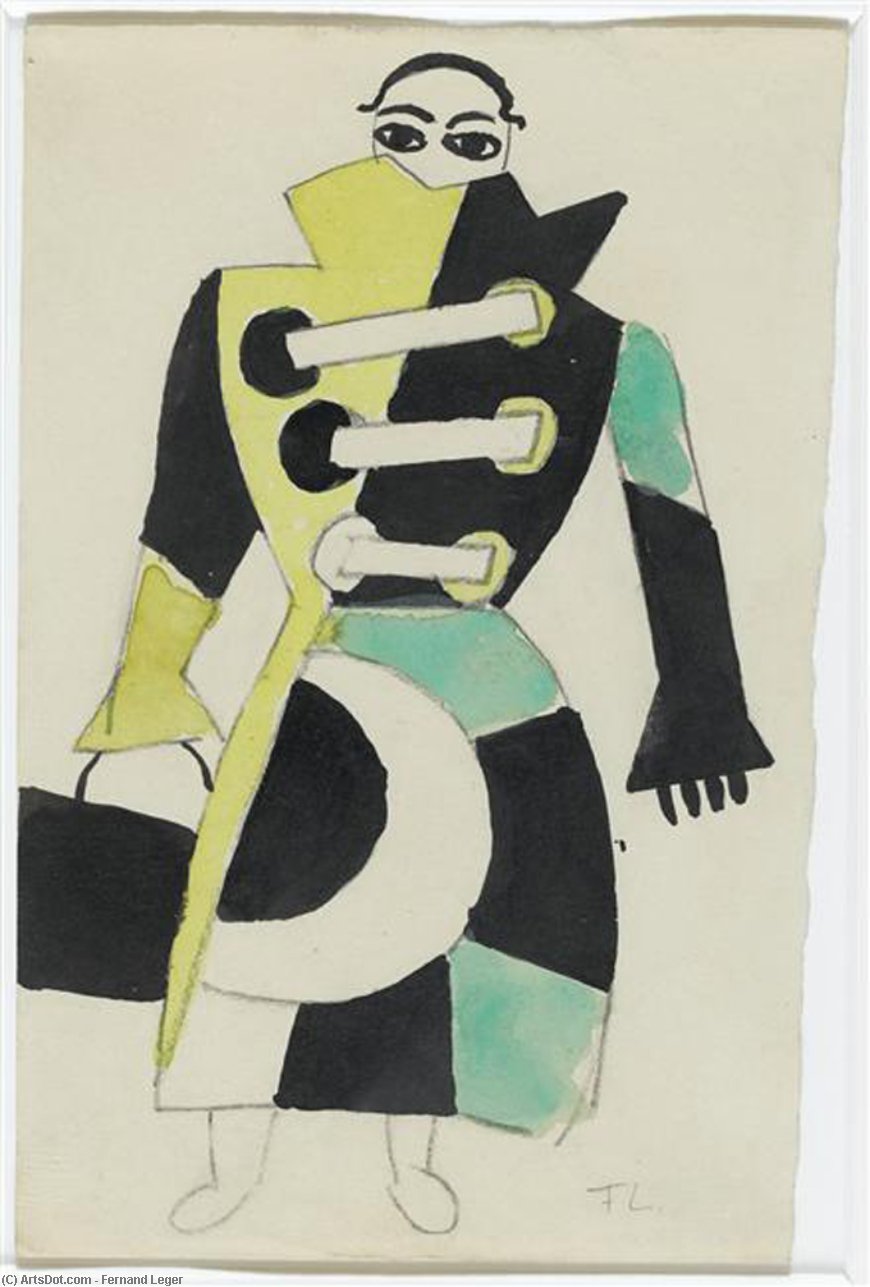
Fernand Léger's 'Project Costume Skating Rink,' a whimsical illustration featuring a bowler hat and skateboard, embodies Cubism’s dynamism with bold colors—a precursor to Pop Art.
Discover Fernand Léger (1881-1955): Pioneer of Cubism & 'Tubism'! Explore bold paintings celebrating modern life, machinery, and the human form – a key forerunner to Pop Art.
Fernand Léger: Embracing Modernity Through Geometric Abstraction
Fernand Léger’s “Project Costume Skating Rink” stands as an arresting example of Cubism's transformative influence on artistic expression in the early 1920s. Born Joseph Fernand Henri Léger in Argentan, Normandy, France, in 1881, Léger embarked upon a remarkable career marked by unwavering dedication to capturing the dynamism and spirit of the burgeoning machine age – a pursuit that positioned him as one of the foremost innovators of his time. Unlike many artists who retreated into purely theoretical abstraction, Léger actively sought to synthesize observation with geometric simplification, resulting in images that simultaneously honored visual reality and conveyed profound emotional resonance.
A Bold Synthesis: Cubism's Geometric Vision
Léger’s artistic breakthrough arrived during his Parisian exile around 1900, where he initially pursued architecture before gravitating towards painting. His formative years were characterized by a fascination with industrial forms – locomotives, factories, and urban landscapes – which profoundly shaped his aesthetic sensibilities. He swiftly adopted Cubism alongside Pablo Picasso and Georges Braque, rejecting traditional perspective and embracing fragmentation as a means of representing three-dimensional objects from multiple viewpoints simultaneously. This stylistic choice wasn’t merely an intellectual exercise; it was a deliberate response to the pervasive influence of technology on daily life, mirroring the fractured contours of mechanized environments. Léger termed his technique “Tubism,” emphasizing the tubular shapes characteristic of industrial structures and conveying a sense of relentless movement.
The Artwork: A Vibrant Illustration
“Project Costume Skating Rink” exemplifies Tubism’s distinctive visual language with remarkable clarity. The image depicts a solitary figure – rendered in bold, angular lines – wearing a bowler hat and sporting a yellow jacket over black trousers. Notably, he holds aloft a skateboard, symbolizing both leisure and the integration of modern technology into everyday pursuits. Léger employs a palette dominated by marine blue and crimson red, creating an atmosphere brimming with energy and vibrancy. Scattered across the canvas are two clocks—one positioned prominently near the upper left corner and another slightly lower—underscoring the relentless passage of time within the context of industrial progress. A handbag rests discreetly in the bottom right quadrant, adding a touch of domesticity to this otherwise stylized depiction.
Symbolism Beyond Representation
Beyond its formal qualities, “Project Costume Skating Rink” carries symbolic weight. The bowler hat represents conformity and social decorum – juxtaposed against the rebellious gesture of holding the skateboard—suggesting a tension between tradition and innovation. Léger’s deliberate use of geometric abstraction isn't merely stylistic; it serves as a conduit for conveying an emotional response to the transformative forces reshaping society. The bold colors amplify this impact, communicating excitement and optimism about the future while simultaneously acknowledging the anxieties inherent in embracing rapid industrialization.
A Legacy of Geometric Expression
Fernand Léger’s contribution to modern art extends far beyond “Project Costume Skating Rink.” His unwavering commitment to exploring the visual language of Cubism paved the way for subsequent artistic movements, notably Pop Art, where artists embraced mass culture and simplified forms to convey immediacy and emotional impact. Léger's enduring legacy resides in his ability to transform observation into a powerfully expressive art form—a testament to his visionary grasp of the spirit of an era defined by technological advancement and aesthetic experimentation.