A Pioneer of Geometric Abstraction: Exploring Fernand Léger’s Still Life with Arm
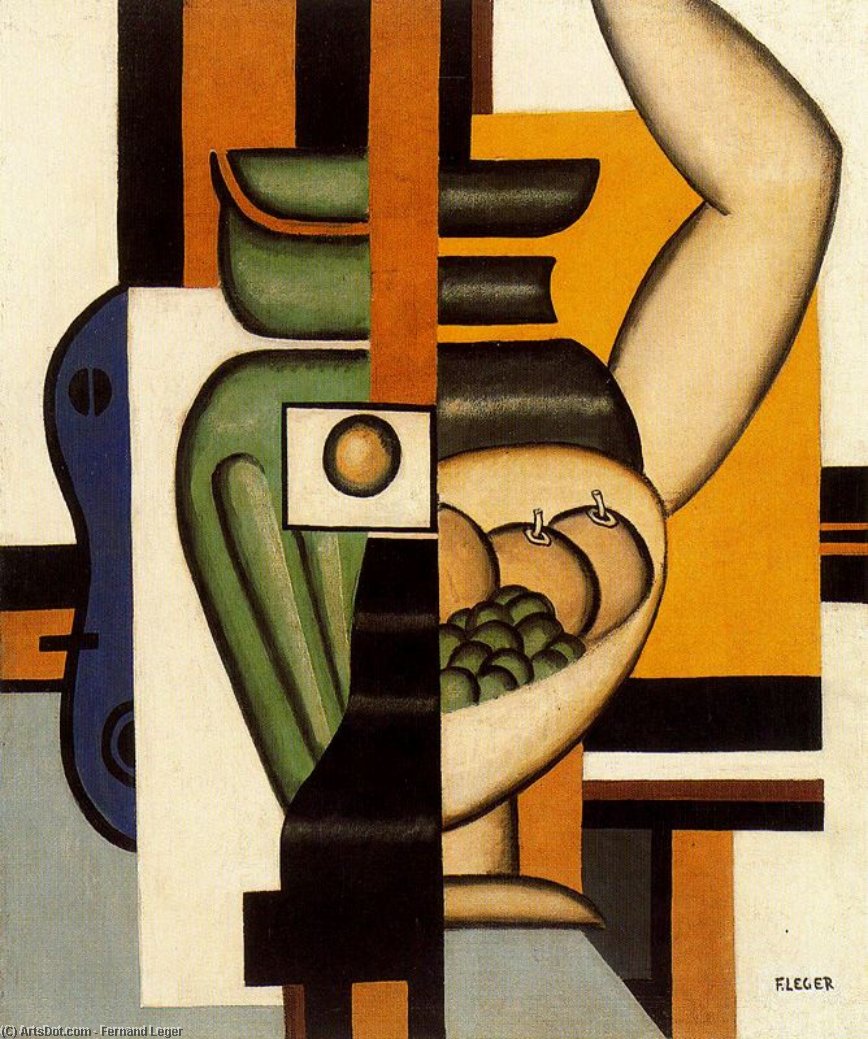
Fernand Léger's "Still Life with Arm" isn’t merely a depiction of fruit; it’s a deliberate manifesto of artistic innovation, encapsulating the anxieties and aspirations of early 20th-century Europe grappling with industrialization. Painted around 1916 during the tumultuous years leading up to World War I, this artwork represents a crucial juncture in Léger's stylistic evolution—a move away from Impressionistic influences toward a rigorously geometric abstraction that would define his oeuvre for decades to come. The painting’s deceptively simple composition belies its profound intellectual engagement with the burgeoning fascination for machine forms and spatial relationships.
- Subject Matter: Léger eschews traditional still life conventions, presenting instead a vase brimming with apples—a commonplace symbol of fertility and abundance—transformed into fragmented geometric shapes. This deliberate distortion serves not to diminish the subject’s inherent beauty but rather to elevate it to a conceptual level.
- Style & Technique: Léger's signature style is characterized by bold, angular lines and flattened planes—a technique he honed during his explorations of Cubism alongside Picasso and Braque. The painting utilizes thick impasto brushstrokes, creating textural surfaces that emphasize the materiality of pigment itself. This tactile approach contrasts sharply with the ethereal qualities favored by Impressionists, grounding the artwork in a physicality that reflects Léger’s own formative experiences.
The historical context surrounding “Still Life with Arm” is paramount to understanding its significance. The pervasive influence of industrial machinery and urban sprawl permeated European consciousness during this period, fueling anxieties about societal transformation and prompting artists to reconsider how they could represent the complexities of modern life. Léger’s geometric abstraction wasn't simply an aesthetic preference; it was a conscious effort to articulate a new worldview—one where form superseded content, mirroring the perceived dominance of mechanical logic over organic intuition. This stylistic choice can be interpreted as a reaction against the sentimentalism and decorative tendencies prevalent in artistic circles prior to World War I.
- Symbolism: Beyond its formal qualities, “Still Life with Arm” carries symbolic weight. The fragmented apple—a traditional emblem of Edenic innocence—is dissected into geometric components, suggesting a loss of wholeness and an embrace of fragmentation as metaphors for the shattered ideals of prewar Europe. Léger’s deliberate simplification underscores the artist's belief that true understanding resides not in detailed representation but in capturing the essence of form.
- Emotional Impact: Despite its austere aesthetic, the painting possesses a palpable energy—a dynamism conveyed through the assertive lines and textured surfaces. It evokes a sense of unease mingled with optimism, reflecting Léger’s conviction that art could serve as a vehicle for confronting anxieties about the future while simultaneously affirming the enduring power of human creativity.
“Still Life with Arm” stands as a cornerstone of Léger's artistic legacy and exemplifies his pioneering role in establishing geometric abstraction as a dominant force within modern art. Its meticulous execution—characterized by bold lines, textured impasto, and a thoughtful engagement with the anxieties of its time—continues to inspire artists and collectors alike, offering a glimpse into the intellectual ferment of an era defined by rapid technological advancement and profound social upheaval. Reproductions of this artwork provide an opportunity to appreciate Léger’s masterful vision and to experience firsthand the enduring beauty of abstract art's ability to communicate complex ideas with remarkable clarity and conviction.