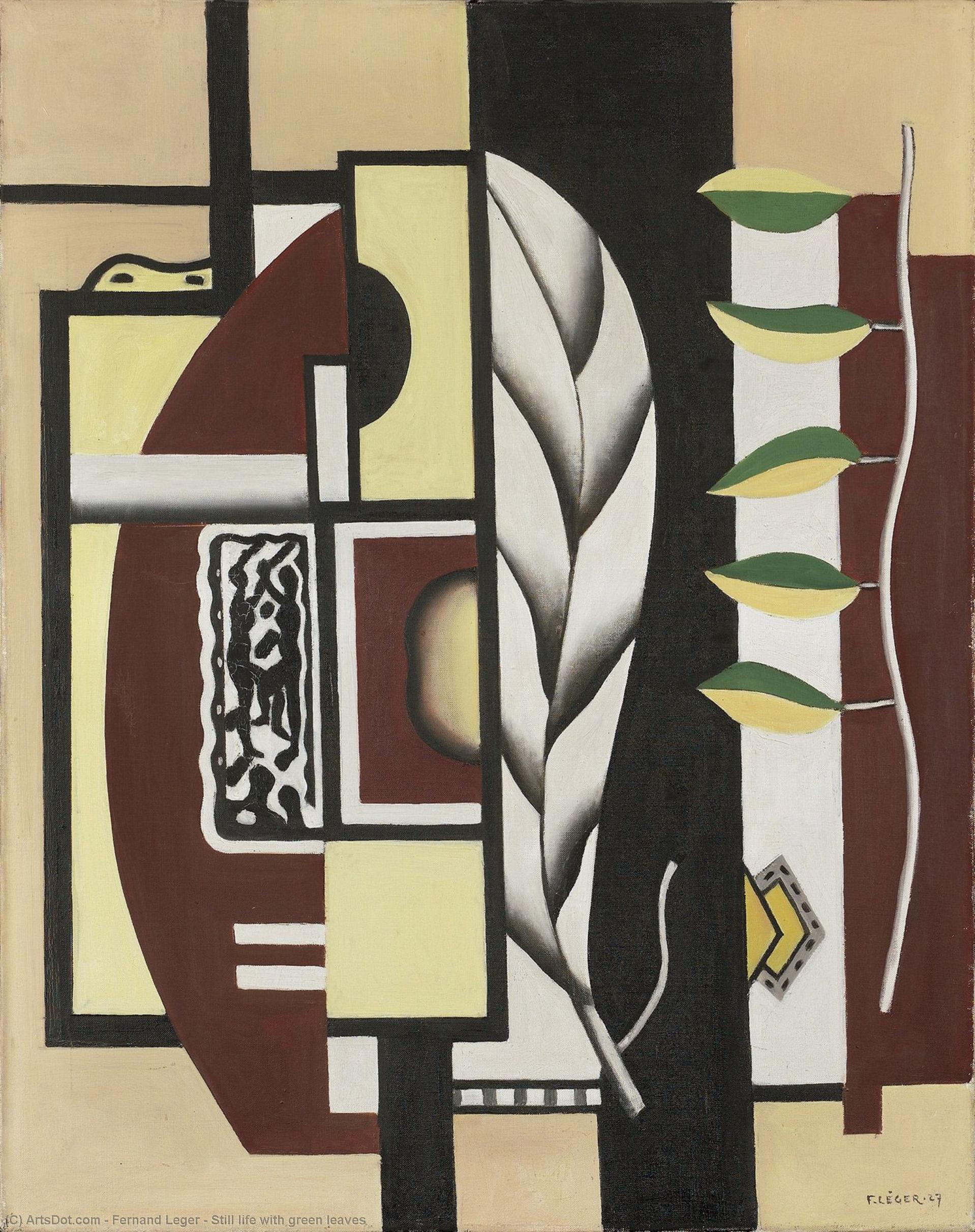
Fernand Léger's 'Still Life with Green Leaves' captures the essence of modernism through simplified forms and vibrant colors, reflecting his exploration of machine age aesthetics.
Discover Fernand Léger (1881-1955): Pioneer of Cubism & 'Tubism'! Explore bold paintings celebrating modern life, machinery, and the human form – a key forerunner to Pop Art.
A Moment Frozen in Time: Exploring Fernand Léger’s “Still Life with Green Leaves”
Fernand Léger's "Still Life with Green Leaves," a deceptively simple composition, offers a profound glimpse into the artist’s revolutionary approach to modern art. Painted in 1929 during a pivotal period of his career – following his initial explorations within Cubism and leading towards his signature “Tubism” – this work transcends mere representation, becoming instead a meditation on form, space, and the burgeoning influence of industrial aesthetics. Léger wasn’t simply depicting objects; he was dissecting them, reimagining their essence through geometric simplification and a deliberate embrace of mechanical logic. The painting's quiet elegance belies a complex intellectual engagement with the changing world around him, a world increasingly defined by factories, machines, and the rhythms of urban life.
Deconstructing Reality: Léger’s Tubism in Action
Léger’s “Tubism,” developed in the early 1920s, sought to capture the dynamism and structural clarity of machinery while simultaneously rejecting traditional representational techniques. This still life exemplifies this approach brilliantly. The bread, a central element, isn't rendered with photographic detail but is broken down into a series of interlocking cylinders and planes – echoes of the gears and cogs that fascinated Léger. Similarly, the leaves are not depicted as organic forms but rather as undulating, biomorphic shapes, suggesting both their natural origins and their inherent structural potential. The bowl, cup, and bananas, though recognizable, are treated with a similar geometric abstraction, their contours simplified and presented in a flattened perspective. This deliberate reduction of detail wasn’t an act of carelessness; it was a conscious effort to strip away the superfluous and reveal the underlying structure of reality – a structure Léger believed increasingly dominated by industrial processes. The use of muted tones—primarily browns, greens, and greys—further emphasizes this sense of mechanical precision and understated power.
The Language of Objects: Symbolism and Emotional Resonance
Despite its apparent austerity, “Still Life with Green Leaves” is rich in symbolic meaning. The bread itself can be interpreted as a reference to sustenance, labor, and the fundamental needs of human existence – themes that resonated deeply within Léger’s own background as a child raised on a farm. The inclusion of leaves introduces an element of nature, suggesting a connection between the industrial world and the organic realm. However, even these natural elements are treated with a geometric sensibility, hinting at the artist's desire to synthesize disparate influences. The arrangement of objects – the bread atop the bowl, the bananas clustered together – creates a dynamic composition that draws the eye across the canvas, inviting contemplation on the relationships between form and function. The painting evokes a sense of quiet observation, a moment suspended in time where the viewer is invited to consider the beauty and complexity inherent in everyday objects.
A Pioneer’s Legacy: Léger's Influence and Artistic Significance
Fernand Léger stands as a crucial figure bridging the gap between early modernism and later artistic movements, including Pop Art. His bold simplification of form, his embrace of industrial aesthetics, and his willingness to challenge traditional notions of representation paved the way for artists like Andy Warhol and Roy Lichtenstein. “Still Life with Green Leaves” is not merely a depiction of inanimate objects; it’s a manifesto – a declaration of Léger's artistic vision and a testament to his belief in the power of abstraction to capture the spirit of the modern age. Reproductions of this work offer a unique opportunity to experience firsthand the innovative thinking of one of art history’s most intriguing figures, bringing a touch of geometric elegance and industrial contemplation into any space. ArtsDot offers meticulously crafted hand-painted reproductions that faithfully recreate Léger's masterful technique and evocative atmosphere, ensuring that his legacy continues to inspire and captivate audiences for generations to come.