A Snapshot of Modern Life: Fernand Léger’s “Street of Dantzig”
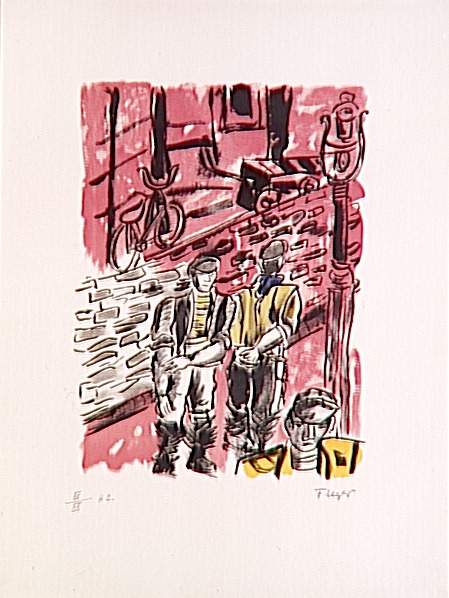
Fernand Léger's "Street of Dantzig," painted around 1914, offers a captivating glimpse into the burgeoning anxieties and aspirations of early 20th-century Europe. This vibrant canvas, executed in Léger’s signature Naïve Art style – often categorized as Primitivism – immediately draws the viewer into a scene brimming with geometric forms and a palpable sense of urban energy. The painting depicts two men engaged in conversation before a brick wall, their hard hats a clear indication of their laboring roles within a rapidly industrializing society. Léger wasn’t simply recording a street scene; he was actively constructing a visual language to articulate the profound changes reshaping human experience.
Naïve Art and the Machine Age
Léger's artistic approach, rooted in his upbringing amidst the rural landscapes of Normandy, dramatically shifted upon his arrival in Paris. He rejected the prevailing trends of abstract expressionism, instead choosing to embrace a style characterized by simplified forms, bold colors, and a deliberate lack of illusionistic depth – hallmarks of Naïve Art. This stylistic choice was profoundly influenced by the rise of industrialization and the increasing dominance of machines in daily life. The men in "Street of Dantzig" aren’t rendered with meticulous realism; they are stylized representations of labor itself, embodying the strength, precision, and geometric logic of the machine age. The clock on the wall further reinforces this theme, a symbol of regulated time and industrial efficiency.
Color, Form, and Composition
The painting’s impact is immediately heightened by Léger's masterful use of color. He employs a palette of primary hues – reds, blues, and yellows – applied with broad, confident strokes that create a sense of dynamism and movement. The geometric forms dominate the composition: the brick wall, the men’s clothing, even the chair are broken down into basic shapes, reflecting Léger's fascination with mechanical structures. The deliberate flatness of the picture plane contributes to the painting’s overall effect, stripping away any illusion of depth and forcing the viewer to confront the subject directly. This technique was revolutionary for its time, anticipating many developments in 20th-century art.
Symbolism and Emotional Resonance
"Street of Dantzig" is more than just a depiction of two workers; it’s a meditation on the human condition within a rapidly changing world. The men's interaction suggests a moment of respite, perhaps a brief conversation amidst the relentless demands of labor. The chair adds another layer of meaning – a symbol of rest and reflection in an increasingly mechanized existence. Léger’s work resonates with a sense of both optimism and unease, capturing the excitement of technological progress while simultaneously acknowledging its potential impact on human relationships and traditional ways of life. This piece is a powerful statement about modernity, inviting contemplation on the relationship between humanity and technology.