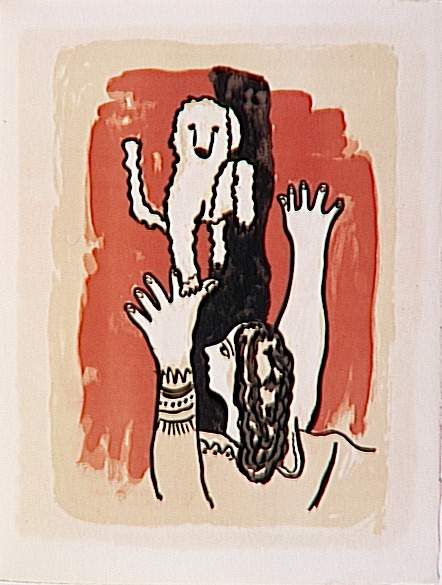
Colorful Fernand Léger painting captures a heartwarming scene of a woman embracing her dogs amidst geometric forms and vibrant reds, reflecting the artist's Machine Age aesthetic – discover museum-quality reproductions on ArtsDot.com.
Discover Fernand Léger (1881-1955): Pioneer of Cubism & 'Tubism'! Explore bold paintings celebrating modern life, machinery, and the human form – a key forerunner to Pop Art.
A Heartwarming Embrace of Modernity: Exploring ‘The Album ''Circus''' by Fernand Léger
This captivating artwork, titled “The Album ''Circus''”, offers a poignant glimpse into the artistic vision of Fernand Léger – a master who dared to reconcile the dynamism of the machine age with deeply human emotion. Painted in 1950, this piece exemplifies Léger’s signature style: bold geometric forms interwoven with surprisingly tender moments. The central figure, a woman enveloped in affection as she cradles a small dog, immediately draws the viewer into a scene brimming with warmth and quiet contemplation. It's a far cry from the stark, industrial landscapes often associated with his work, revealing a surprising sensitivity to domesticity and companionship – themes that subtly underscore Léger’s broader exploration of modern life. The vibrant red wall serves not merely as a backdrop but actively contributes to the painting’s energy, amplifying the sense of movement and vitality inherent in Léger's aesthetic.
The Machine Age Aesthetic: Cubism Reimagined
Fernand Léger’s artistic journey was profoundly shaped by his observations of the burgeoning industrial world. Arriving in Paris around 1900, he witnessed firsthand the transformative impact of machinery on society and sought to translate this experience onto canvas. While initially influenced by Post-Impressionism and Cubism – particularly the work of Picasso and Braque – Léger developed a unique approach. He didn’t simply abstract forms; instead, he meticulously rendered recognizable objects—like the dogs in this painting—using fragmented geometric shapes. This technique, often described as “machine-made,” aimed to capture the essence of mechanical precision while simultaneously conveying a sense of organic growth and vitality. The overlapping planes and angular structures create a dynamic visual rhythm, reflecting the constant motion and transformation characteristic of the modern era.
Symbolism Within Form: Dogs and Domesticity
The inclusion of dogs within this composition is particularly noteworthy. Léger frequently employed animals – often dogs – as recurring motifs in his work, representing not just companionship but also a connection to nature and a rejection of purely urban themes. The woman’s tender embrace of the dog speaks to a desire for simplicity and authenticity amidst the complexities of modern life. It suggests a yearning for a return to fundamental human values—love, loyalty, and connection—values that Léger believed were threatened by industrialization. The dogs themselves are rendered with a remarkable degree of detail, highlighting Léger’s meticulous attention to observation and his ability to imbue even seemingly mundane subjects with profound meaning.
Technique and Emotional Impact
Executed in oil on canvas, “The Album ''Circus''” showcases Léger's masterful control of color and form. The bold use of red contrasts sharply with the softer tones used for the woman and dogs, creating a visually arresting effect. His brushwork is characterized by short, decisive strokes that contribute to the painting’s energetic feel. More than just a depiction of a scene, this artwork evokes a powerful emotional response – one of warmth, affection, and perhaps even nostalgia. It's a reminder of the enduring human need for connection and companionship, rendered with Léger’s signature blend of abstraction and realism. A museum-quality reproduction offers an exceptional opportunity to experience the full impact of this remarkable work.