A Whirlwind of Humanity: Decoding Léger’s ‘The Album “Circus”’ (15)
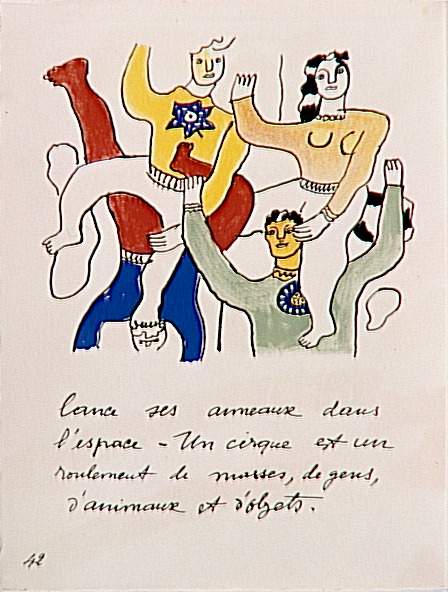
“The album ''Circus'' (15)” by Fernand Léger is a captivating and energetic work, created in 1950, that embodies the artist's distinctive style and fascination with modern life. This piece isn’t a traditional circus scene as one might expect; instead, it presents a dynamic interplay of figures suggesting performance, ritual, or perhaps simply the vibrant chaos of human interaction.
Subject & Composition
The artwork depicts a densely populated space filled with overlapping male and female figures engaged in what appears to be an acrobatic display or ceremonial dance. The composition is deliberately crowded, creating a sense of movement and immediacy. There’s no clear foreground or background; depth is achieved through the layering of forms rather than traditional perspective techniques. Integrated French text adds another layer of narrative intrigue, hinting at stories within the spectacle.
Style & Technique
Léger's style in this work leans heavily towards
Expressionism, with echoes of
Surrealism. The figures are simplified and somewhat distorted, prioritizing energy and form over precise representation. His signature “Tubism” – a personal offshoot of Cubism – is evident in the emphasis on cylindrical shapes and bold outlines. The technique primarily involves expressive line drawing, punctuated by areas filled with flat washes of vibrant color. This combination creates a visually striking contrast between structure and fluidity. The materials used are likely paper and ink, lending an intimate quality to this dynamic scene.
Historical Context & Artistic Evolution
Fernand Léger (1881-1955) was a pivotal figure in the development of modern art. Initially influenced by Impressionism – as seen in earlier works like
“Le Jardin de ma Mère” – he quickly moved towards Cubism, developing his unique “Tubism.” He became associated with the Puteaux Group, a collective of avant-garde artists exploring new forms of abstraction. By 1950, Léger had already established himself as a pioneer who bridged the gap between abstract art and figurative representation, celebrating modern life, machinery, and the human form.
“The album ''Circus'' (15)” reflects this ongoing exploration, showcasing his continued interest in bold forms and dynamic compositions.
Symbolism & Interpretation
The symbolism within the artwork is open to interpretation. The figures could represent performers embodying spectacle and entertainment, participants in a communal ritual, or even abstract representations of energy and movement itself. The integration of French text suggests a narrative element, perhaps alluding to themes of community, performance, or the human condition. The lack of defined space contributes to a dreamlike quality, inviting viewers to project their own meanings onto the scene.
Emotional Impact & Interior Design Considerations
“The album ''Circus'' (15)” evokes a sense of exhilaration and controlled chaos. The vibrant colors and dynamic composition create an energetic atmosphere, while the slightly unsettling distortions add a layer of intrigue. This artwork would be a striking addition to a modern or eclectic interior. Its bold aesthetic pairs well with minimalist spaces, providing a focal point of color and energy. Alternatively, it could complement more ornate settings, adding a touch of avant-garde flair. The piece’s dynamic nature makes it particularly suitable for living rooms, dining areas, or creative workspaces – any space where a sense of vibrancy and intellectual stimulation is desired.
- Style: Expressionism, Surrealism, Tubism
- Colors: Bold and vibrant, contrasting hues
- Materials: Paper, Ink
- Themes: Performance, Community, Human Interaction, Modernity