A Symphony of Form and Movement: Exploring Fernand Léger’s ‘The Album ''Circus'''
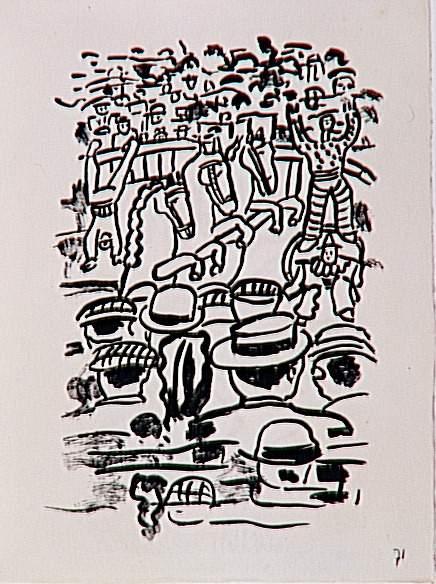
- Subject Matter: Léger's 'The Album ''Circus''' captures a vibrant tableau vivant – a snapshot of a circus performance viewed by an expectant audience. Unlike traditional depictions of circuses emphasizing spectacle and grandeur, Léger focuses on the collective experience of witnessing the event, prioritizing the interplay between performers and spectators.
- Style: The painting exemplifies Léger’s signature Cubist aesthetic, albeit tempered with a distinctly lyrical quality. While retaining the geometric fragmentation characteristic of Cubism—particularly evident in the stylized figures and architectural elements—Léger abandons the harsh angularity often associated with the movement, opting instead for softer contours and a more harmonious composition.
Technique: Léger employed a bold palette dominated by muted tones of grey, ochre, and brown, skillfully layering paint to create textured surfaces that mimic the materiality of concrete and metal. This technique underscores Léger’s fascination with industrial forms and his desire to convey their inherent dynamism through visual representation.
Historical Context: Embracing Modernity's Rhythm
‘The Album ''Circus''’ was created in 1950, marking a pivotal moment in Léger’s artistic career. Following his initial foray into Cubism and Futurism—movements that celebrated speed and technological advancement—Léger continued to explore themes of urban life and industrial progress throughout his oeuvre. The painting reflects the broader cultural anxieties and aspirations of postwar Europe, where artists wrestled with reconciling tradition and innovation amidst the rapid transformations brought about by scientific breakthroughs and mass production.
Symbolism Beyond Geometry: Layers of Meaning
Beyond its formal geometric structure, ‘The Album ''Circus''’ resonates with symbolic significance. Léger deliberately utilizes simplified forms to represent human figures and architectural elements—a conscious decision to distill complex realities into essential visual components. The umbrella serves as a subtle emblem of protection and contemplation amidst the bustling crowd, inviting viewers to pause and consider the individual experience within the collective spectacle. Furthermore, Léger’s muted color palette evokes a sense of melancholy and introspection, hinting at the inherent loneliness of encountering the monumental forces of modernity.
Emotional Impact: Capturing Transient Beauty
Ultimately, Léger's ‘The Album ''Circus''’ succeeds in conveying an arresting emotional impression. The painting doesn’t aim for dramatic narrative or emotive expression; rather, it seeks to capture the fleeting beauty of a shared moment—the anticipation and wonder experienced by those observing a circus performance. Léger’s masterful manipulation of form and texture imbues the artwork with a palpable sense of energy and movement, reminding us that even in seemingly sterile environments like industrial spaces, there exists an enduring capacity for aesthetic contemplation.