Fernand Léger: Capturing the Rhythm of Industry
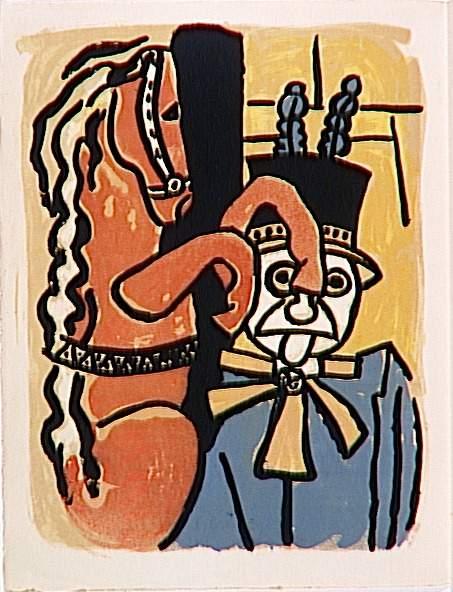
Fernand Léger’s “The Album ‘Circus’,” painted in 1950, isn't merely a depiction of a circus scene; it’s an ambitious exploration of how modern art could grapple with the burgeoning influence of industrialization. Léger, born Joseph Fernand Henri Léger in Argentan, Normandy, in 1881, initially pursued architecture but swiftly gravitated towards painting after relocating to Paris around 1900, establishing himself as a vital participant in the Parisian avant-garde movement.
Unlike many artists of his era who embraced pure abstraction as an escape from realism, Léger deliberately sought to synthesize observation and innovation. His formative years spent working on farms instilled a physicality that would inform his artistic approach – he wasn’t interested in discarding the tangible world but transforming it through a radically new visual vocabulary.
Style and Technique: Geometric Abstraction
Léger's distinctive style is characterized by geometric abstraction, heavily influenced by Cubism and Futurism. He employed bold, angular shapes – cubes, cylinders, cones – to represent mechanical forms and rhythms. These elements weren’t simply decorative; they conveyed a sense of movement and dynamism, mirroring the relentless pace of industrial progress.
His technique involved layering paint in thick impasto—a textured surface created by applying pigment thickly onto the canvas—giving his paintings an almost sculptural quality. This physicality mirrored Léger's own engagement with the physical labor of his youth and underscored his conviction that art could communicate directly with the viewer’s senses.
Historical Context: The Machine Age
"The Album ‘Circus’” emerged during a period marked by unprecedented technological advancements – the “Machine Age.” Léger witnessed firsthand the transformative effects of factories, railways, and automobiles on society. He responded to this shift not with despair but with an optimistic determination to represent it aesthetically.
The circus itself served as a potent symbol for Léger’s time. It represented spectacle, illusion, and controlled chaos – elements he skillfully captured in his painting. The juxtaposition of the horse and clown—a traditional circus duo—highlighted the tension between nature and technology, mirroring the broader anxieties and aspirations of the era.
Symbolism and Emotional Impact
Beyond its formal qualities, “The Album ‘Circus’” resonates with deeper symbolic meanings. The clocks symbolize time’s relentless march forward, emphasizing the inescapable influence of industrial progress on human experience. Léger's masterful use of color—primarily reds and yellows—creates an energetic visual atmosphere that conveys excitement and optimism.
Ultimately, Léger aimed to inspire awe and contemplation. He wanted viewers to confront the complexities of modernity while appreciating its inherent beauty. “The Album ‘Circus’” remains a powerful testament to Léger’s artistic vision – a celebration of form, movement, and the enduring spirit of innovation.