Fernand Léger: Bridging Mechanization and Organic Beauty
Fernand Léger stands as a singular figure in the landscape of twentieth-century art, defying easy categorization and establishing his own distinctive visual language. Born Joseph Fernand Henri Léger in Argentan, Normandy, in 1881, he embarked on an artistic journey marked by experimentation and a profound engagement with the burgeoning influence of industrialization upon human experience. Unlike many artists of his era who retreated into abstraction as a refuge from representation, Léger actively sought to synthesize disparate movements – Cubism and Futurism – forging a path that would ultimately propel him to prominence as a forerunner of Pop Art.
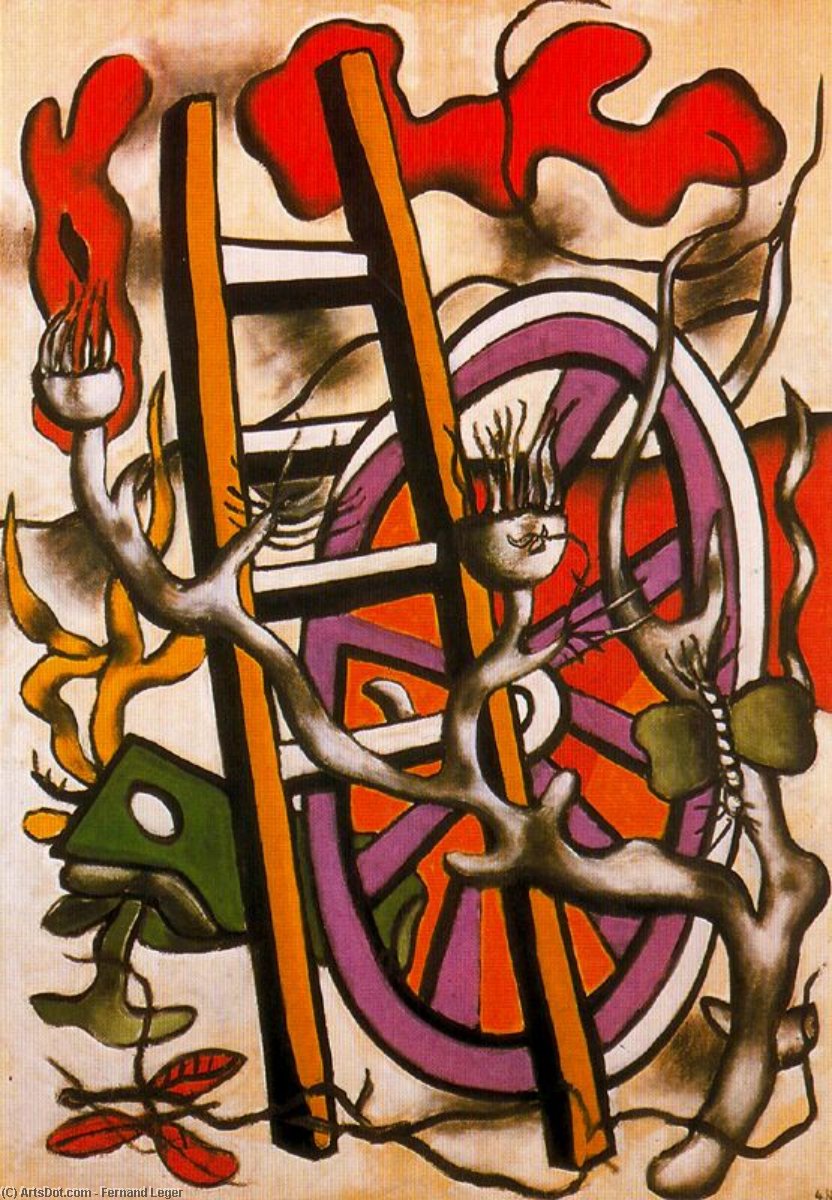
His artistic vision was deeply rooted in the physicality of rural life, contrasting sharply with the mechanized world he envisioned. This duality informs his oeuvre, particularly exemplified by “The Butterfly on the Wheel,” created in 1948. Léger’s approach wasn't merely stylistic; it represented a deliberate attempt to grapple with the anxieties and aspirations of a rapidly changing society.
Purism: A Synthesis After War
“The Butterfly on the Wheel” belongs to Purism, an artistic reaction born from the devastation of World War I. Influenced by Cubism’s fragmentation of form, Futurism’s dynamism and celebration of speed, and Precisionism’s meticulous rendering of detail, Léger distilled these elements into a powerfully reductive style. This movement rejected sentimentality and embraced geometric abstraction as a means of conveying emotion—a bold departure from the prevailing artistic trends.
The painting's palette is deliberately restrained, dominated by muted blues and browns that underscore the melancholic mood. Léger’s masterful use of flat planes of color creates an illusion of depth without resorting to traditional shading techniques. This technique emphasizes the essential forms—the wheel, the butterfly—rather than attempting to capture photographic realism.
Symbolism Within Geometric Form
The juxtaposition of organic and mechanical elements is central to Léger’s artistic strategy. The butterfly, rendered in delicate pastel hues, represents fragility and beauty amidst the harshness of industrial progress symbolized by the wheel—a gear or cogwheel—constructed from angular lines and geometric shapes. This deliberate contrast isn't merely decorative; it encapsulates Léger’s philosophical preoccupation with reconciling nature and technology.
Consider the ladder ascending towards the butterfly, a visual motif that speaks to aspiration and striving for transcendence. Similarly, the spoon and cup—simple yet evocative forms—suggest nourishment and contemplation. Léger's meticulous attention to detail within these geometric abstractions elevates the painting beyond mere stylistic convention, inviting viewers to contemplate profound questions about humanity’s relationship with its environment.
A Legacy of Innovation
"The Butterfly on the Wheel" remains a testament to Léger’s pioneering spirit and his contribution to the development of modern art. It exemplifies his ability to synthesize disparate influences into a singular artistic vision—a vision that continues to resonate with audiences today. As a handmade oil painting reproduction, it offers an opportunity to experience the beauty and intellectual depth of Léger's masterpiece firsthand.