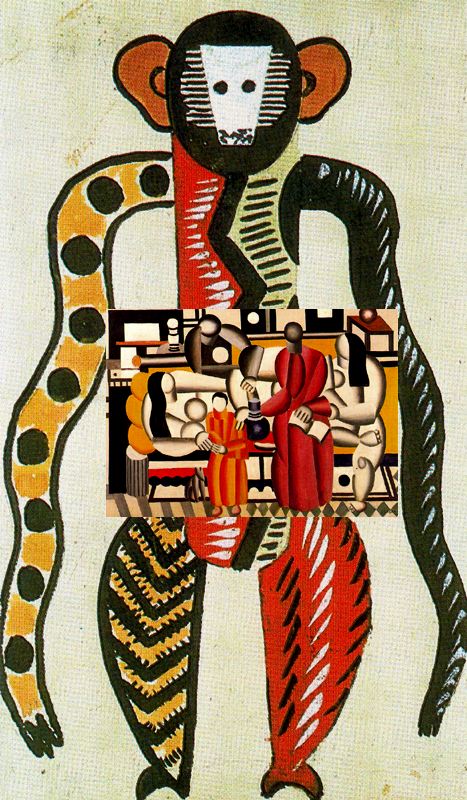
Fernand Léger's "The Creation of the World, The Monkey" explodes with tubular forms and bold color, capturing modernity’s mechanical spirit. A pivotal Tubism masterpiece by a groundbreaking artist.
Discover Fernand Léger (1881-1955): Pioneer of Cubism & 'Tubism'! Explore bold paintings celebrating modern life, machinery, and the human form – a key forerunner to Pop Art.
The Creation of the World, The Monkey: A Symphony in Cylinders and Bold Color
Fernand Léger’s “The Creation of the World, The Monkey” transcends mere visual representation; it embodies a profound exploration of modernity's spirit—a conviction that art could not merely mirror reality but actively engage with its transformative forces. Painted in 1923 during his peak creative period, this striking oil painting exemplifies Léger’s signature Tubism style and stands as a cornerstone of his artistic legacy. More than just depicting a monkey amidst geometric forms, it's an invitation to contemplate the burgeoning influence of science fiction on artistic thought and the enduring quest for human evolution.
A Bold Departure from Cubist Conventions
Léger initially embraced Cubism alongside Picasso and Braque, dissecting objects into fragmented planes that challenged traditional perspective. However, he swiftly recognized the limitations of this approach in conveying the dynamism inherent in industrialized society. Tubism emerged as a deliberate reaction—a stylistic rebellion fueled by Léger’s fascination with Jules Verne's “Journey to the Center of the Earth.” Rejecting the analytical Cubist fragmentation, Tubism prioritized cylindrical forms and simplified shapes, creating an illusion of movement and emphasizing the underlying structure of objects. This technique is vividly realized in "The Creation of the World," where the monkey’s body—rendered as a bold cylinder—dominates the composition against a backdrop of interlocking geometric planes.
Symbolic Resonance: Evolution and Technological Advancement
The monkey itself serves as a potent symbol within Léger's oeuvre, representing not just animal instinct but also the process of adaptation and progress. Positioned upright on its hind legs, it confronts the viewer with an unwavering gaze—a gesture mirroring humanity’s ambition to conquer new frontiers. Surrounding the monkey are recognizable symbols of technological advancement: a telephone, a clock, and an airplane – tangible reminders of Léger's engagement with the anxieties and aspirations surrounding rapid industrialization. These elements aren’t merely decorative; they actively contribute to the painting’s thematic core—the belief that human evolution is inextricably linked to embracing innovation.
Color as Catalyst for Emotional Impact
Léger’s masterful use of color amplifies the painting's emotional resonance. Vibrant hues—primarily reds, yellows, and blues—burst forth from the geometric background, creating a palpable sense of energy and excitement. This chromatic boldness aligns perfectly with Purism, another artistic movement Léger championed, which sought to distill visual experience into its purest form through simplified shapes and bold colors. The deliberate absence of shading reinforces this impression of immediacy and contributes to the painting’s captivating dynamism.
A Legacy of Modern Vision
“The Creation of the World, The Monkey” remains a testament to Fernand Léger's singular artistic vision—a conviction that art could illuminate the complexities of the modern age while simultaneously celebrating its boundless potential. Its enduring appeal lies not only in its stylistic innovation but also in its profound contemplation of humanity’s relationship with technology and its unwavering faith in the transformative power of evolution. A reproduction of this masterpiece offers a glimpse into Léger's groundbreaking aesthetic, inviting viewers to engage with a timeless exploration of form, color, and symbolism.