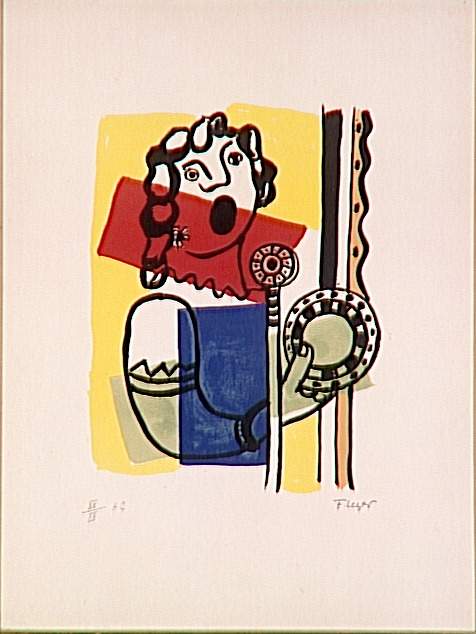
The singer on the radio

Explore Fernand Léger’s ‘The Singer on the Radio,’ a vibrant Cubist-Expressionist print featuring fragmented figures & bold colors. A dynamic, unsettling artwork reflecting modern life.


Fernand Léger (1881 - 1955)

Discover Fernand Léger (1881-1955): Pioneer of Cubism & 'Tubism'! Explore bold paintings celebrating modern life, machinery, and the human form – a key forerunner to Pop Art.

A Dynamic Portrait of Modernity: Fernand Léger’s “The Singer on the Radio”

  • Subject and Composition: This vibrant artwork presents a fragmented, yet compelling depiction of a human figure – “The Singer on the Radio.” Rather than aiming for realistic representation, Léger deconstructs the subject into geometric forms, primarily rectangles, circles, and triangles. The composition is deliberately asymmetrical, with visual weight concentrated in the upper left quadrant, creating a dynamic tension that draws the eye across the canvas. A strong rectangular shape contains the core of the figure, suggesting both confinement and a stage-like setting.
  • Style & Influences: “The Singer on the Radio” exemplifies Léger’s distinctive style – a fascinating blend of Cubism and Expressionism. While clearly influenced by the analytical fragmentation characteristic of Cubism, particularly in its geometric breakdown of form, the artwork transcends mere intellectual exercise through its bold color palette and energetic execution. Léger developed his own unique brand of Cubism often referred to as “Tubism,” emphasizing cylindrical forms and a machine-like aesthetic.
  • Technique & Materials: The work appears to be a print or reproduction, likely executed using flat color application techniques – indicative of Léger’s approach. This method creates a graphic quality, almost naive in its directness, yet powerfully impactful. The use of ink on paper (or similar substrate) contributes to the artwork's crisp lines and vibrant hues. The flatness of the colors and lack of visible texture further emphasize the work’s modern aesthetic.
  • Color Palette & Emotional Impact: A striking combination of reds, blues, yellows, and browns dominates the image. These are not subtle shades; they are bold, assertive, and contribute significantly to the artwork's energetic mood. The intense colors evoke a sense of dynamism and perhaps even a slight unsettling feeling, mirroring the fragmented nature of modern life. The color choices suggest both vitality and a degree of psychological tension.
  • Historical Context & Léger’s Vision: Fernand Léger (1881-1955) was a pivotal figure in 20th-century art, responding to the rapid industrialization and technological advancements of his time. He sought to create an art that reflected the beauty of the machine age and celebrated modern life. His work often featured figures integrated with mechanical elements, reflecting a fascination with the power and dynamism of industry. This piece, while abstracting the figure, hints at this broader interest in modernity.
  • Symbolism & Interpretation: The fragmentation of the singer’s form can be interpreted as a representation of alienation or psychological disruption – common themes in early 20th-century art. It could also symbolize the way individuals are mediated through technology, specifically radio, becoming fragmented signals rather than whole beings. The “radio” element suggests a disembodied voice and presence, further emphasizing this sense of fragmentation.
  • For Collectors & Designers: “The Singer on the Radio” is an excellent example of Léger’s signature style and offers a compelling statement piece for any collection. Its bold colors and dynamic composition make it particularly well-suited to modern interiors, adding a touch of intellectual sophistication and artistic energy. A high-quality reproduction will capture the vibrancy and impact of the original, bringing a piece of art history into your space.