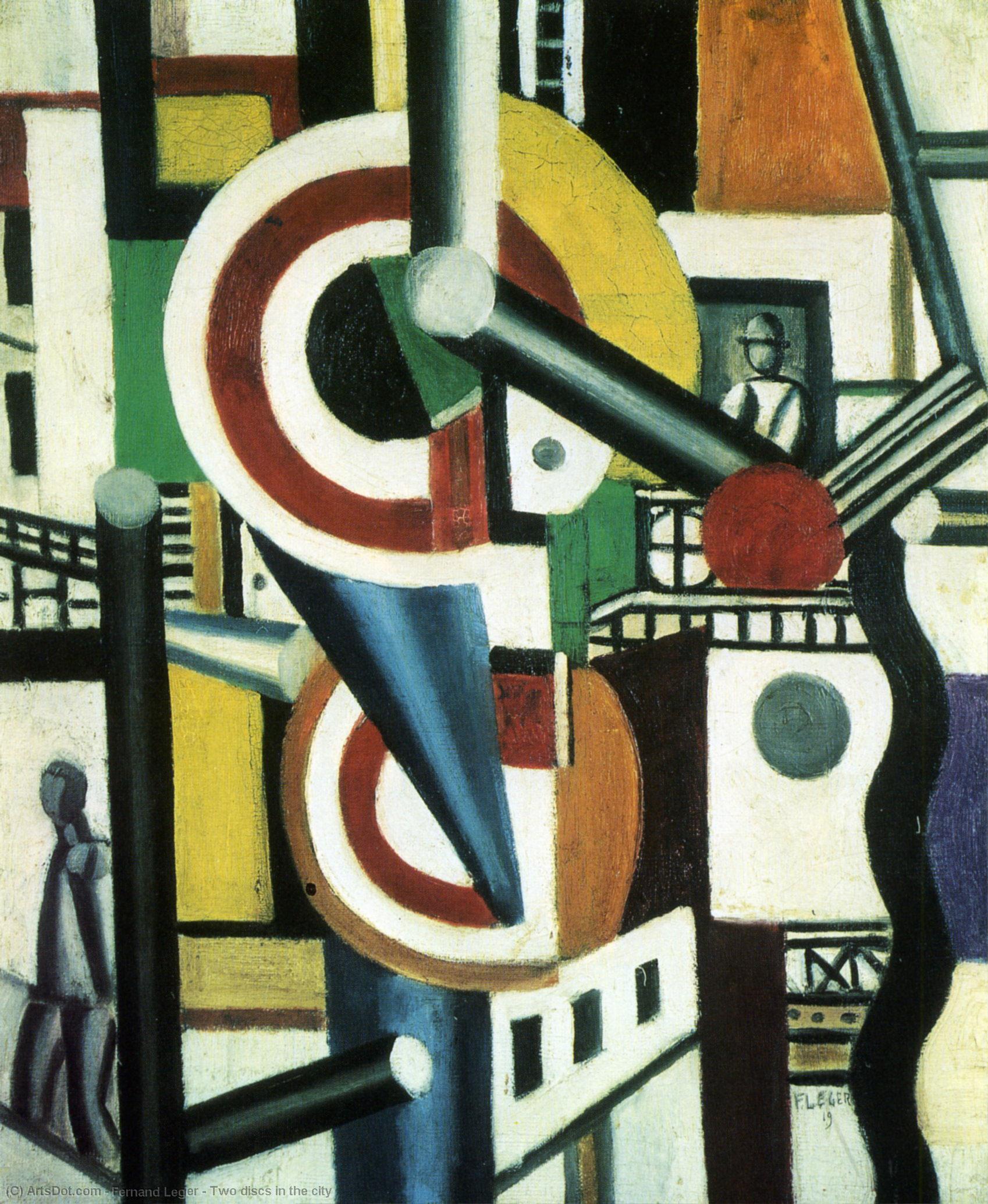
A Chronicle of Urban Rhythm: "Two Discs in the City" by Fernand Léger
Fernand Léger’s “Two Discs in the City,” painted in 1918, is more than a depiction of a Parisian street scene; it's a vibrant manifesto of early 20th-century modernity. Emerging from the heart of Argentan, Normandy, Léger’s artistic trajectory was profoundly shaped by his rural upbringing – a grounding experience that would later fuel his revolutionary approach to representing the burgeoning machine age. This painting, created during a period of immense social and technological upheaval, captures the frenetic energy of urban life with an almost feverish intensity, reflecting the anxieties and aspirations of a world rapidly transforming under the influence of industrialization.
- Subject Matter: The scene unfolds with a striking clarity – a man in a tie, a common figure amidst the city’s bustle, stands before a building crowned with a bold red sphere. Surrounding him are other figures, many clutching umbrellas, suggesting a downpour and adding to the overall sense of urgency.
- Composition: Léger masterfully employs geometric forms – the discs themselves, the angular architecture, and the linear arrangement of figures – to convey movement and dynamism. The composition isn’t simply observational; it's deliberately constructed to evoke the feeling of a machine in motion.
Decoding the Symbolism: Machines and Humanity
Léger’s work is deeply rooted in his fascination with machines, particularly their impact on human life. The “discs” themselves are central to this symbolism. They represent not just mechanical components but also the fragmented nature of modern experience – a world increasingly defined by industrial processes and geometric forms. The red sphere atop the building could be interpreted as a beacon, a symbol of progress, or perhaps even a warning, highlighting the potential dangers of unchecked technological advancement. The inclusion of figures within this mechanized landscape underscores the artist's concern with the human condition in an age of rapid change – how individuals navigate and adapt to a world dominated by machines.
- Color Palette: Léger’s use of bold, primary colors—particularly the striking red—amplifies the painting’s emotional impact.
- Clock Symbolism: The presence of two clocks adds another layer of complexity, referencing both time and the relentless march of progress.
Technique and Style: Cubist Roots with a Modern Twist
“Two Discs in the City” exemplifies Léger’s distinctive style, which evolved from early influences like Paul Cézanne and Pablo Picasso (Cubism) to develop into something uniquely his own. He employed a technique characterized by flattened planes, simplified forms, and a deliberate rejection of traditional perspective. This approach wasn't merely stylistic; it was a fundamental shift in how Léger perceived and represented the world – he sought to capture not just appearances but also the underlying structure of objects and spaces. The painting’s surface is built up with thick impasto strokes, adding texture and further emphasizing the materiality of the forms.
Historical Context and Legacy
Painted in 1918, at the dawn of the 20th century, “Two Discs in the City” reflects a pivotal moment in art history. Léger’s work anticipated many of the developments that would characterize modernism – its embrace of abstraction, its exploration of industrial themes, and its challenge to traditional notions of representation. His influence extended beyond painting, impacting sculpture and design. Today, “Two Discs in the City” stands as a testament to Léger's visionary approach and his enduring contribution to the development of modern art. A hand-painted reproduction offers an unparalleled opportunity to experience this seminal work firsthand.