A Symphony of Red and Blue: The Modernist Vision of Fernand Léger
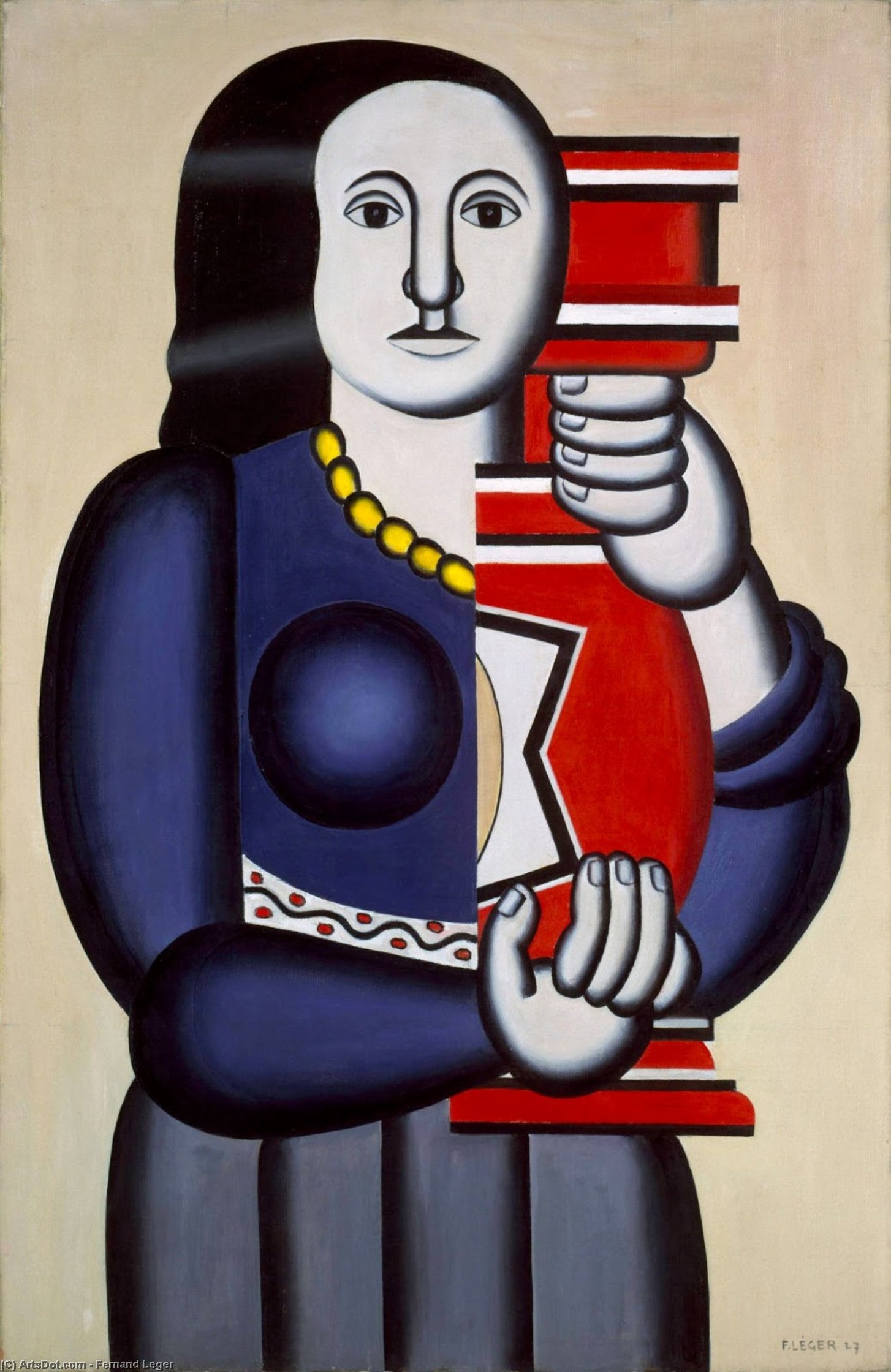
In the vibrant landscape of early twentieth-century modernism, few works capture the rhythmic pulse of the industrial age as strikingly as Fernand Léger’s "Woman Holding a Vase." This masterpiece is far more than a mere depiction of a quiet, domestic moment; it serves as a deliberate manifesto of a new visual vocabulary. Painted during the transformative years between 1925 and 1930, the artwork embodies Léger's unique ability to fuse geometric abstraction with recognizable human forms. As one gazes upon the canvas, they are immediately struck by a profound sense of balance and energy, where the boundaries between the organic human figure and the mechanical precision of the machine age begin to blur into a singular, harmonious expression.
The composition is defined by a breathtaking interplay of color and shape. A striking dialogue emerges between deep, crimson reds and brilliant cerulean blues, colors that dominate the pictorial space with an almost architectural strength. Léger does not use these hues merely for decoration; rather, they are meticulously calculated to create a sense of rhythm that mirrors the repetitive, hypnotic patterns found in urban landscapes and factory machinery. Through his signature technique of thick impasto, the artist applies paint with a physical force that lends the surface a tactile, sculptural quality. The heavy textures catch the light, emphasizing the geometric blocks—rectangles and trapezoids—that delineate the woman’s silhouette and the vase she cradles, distilling her presence into its purest, most essential form.
The Pulse of Progress and the Beauty of Form
To understand this work is to understand Léger's deep connection to the spirit of his era. Influenced by the dynamism of the Futurist movement, Léger internalized the celebration of speed, technology, and progress, yet he moved beyond mere imitation to create something entirely his own. In "Woman Holding a Vase," we see the rejection of traditional illusionism in favor of a flattened, powerful aesthetic that celebrates the beauty of the modern world. The woman herself becomes a symbol of strength and stability amidst the shifting geometries of a changing society. Her form, though simplified through abstraction, retains an emotional resonance that speaks to the resilience of the human spirit within an increasingly mechanized environment.
For the discerning collector or interior designer, this painting offers a profound sense of sophistication and intellectual depth. It is a piece that commands attention, providing a bold focal point that can anchor a contemporary space with its vibrant energy and historical significance. Whether placed in a minimalist gallery setting or a richly textured living space, the artwork invites continuous contemplation. It serves as a window into a time of great transition, offering an enduring aesthetic experience that bridges the gap between the raw power of industrial logic and the delicate grace of human emotion. Owning a high-quality reproduction of this work is not merely about acquiring art; it is about bringing a piece of the modernist revolution into the modern home.