Explore Fernand Léger’s "Guitar" – a Cubist still life of geometric shapes & vibrant color. Commission a custom art piece celebrating your relationship narrative.
Discover Fernand Léger (1881-1955): Pioneer of Cubism & 'Tubism'! Explore bold paintings celebrating modern life, machinery, and the human form – a key forerunner to Pop Art.
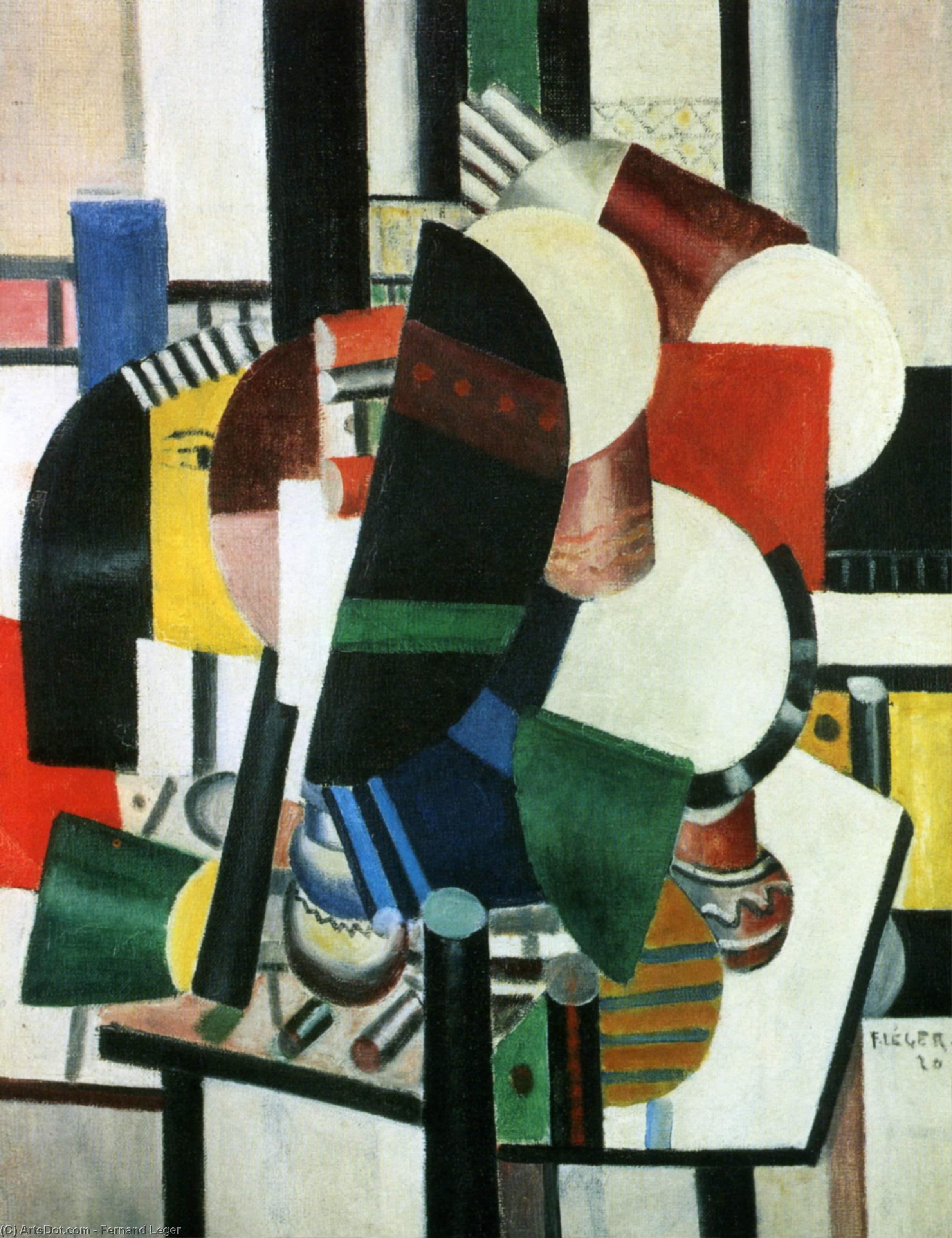
A Symphony of Form: Fernand Léger’s “Woman with Flower Portrait Study”
Fernand Léger's "Woman with Flower Portrait Study," created in 1920, represents a pivotal moment in the artist’s evolution and exemplifies his distinctive approach to Cubism, often referred to as ‘Tubism.’ This work isn’t merely a portrait; it’s a deconstruction and reimagining of form, color, and the very essence of representation.
Deconstructing Reality: Style & Technique
Léger moves beyond traditional portraiture, embracing the principles of Synthetic Cubism. The subject – a woman holding flowers – is fragmented into geometric shapes—primarily rectangles and cylinders—and reassembled in a flattened pictorial space. This isn’t about replicating reality but analyzing it and presenting its underlying structure. He achieves this through bold color blocking, eschewing subtle shading for areas of flat, unmodulated hue. The technique, executed with oil paint on canvas using a palette knife, results in a smooth surface that emphasizes the artwork's inherent flatness. Lines are sharp and angular, defining forms with precision and contributing to the overall sense of mechanical order.
Historical Context: Post-War Modernity
Created after Léger’s harrowing experiences during World War I, “Woman with Flower Portrait Study” reflects a shift in his artistic focus. The war profoundly impacted him, leading him away from pure abstraction and towards a style that embraced the beauty of the machine age alongside human forms. This period saw an increasing fascination with industry and technology, and Léger’s work embodies this sentiment, translating organic subjects into a language of geometric precision reminiscent of mechanical components. He sought to create an art accessible to all, reflecting the dynamism of modern life.
Symbolism & Interpretation
While seemingly abstract, the painting retains recognizable elements—the woman and the flowers. The flowers introduce a touch of natural softness amidst the rigid geometry, perhaps symbolizing beauty, fragility, or renewal. The deliberate simplification of form can be interpreted as a celebration of essential qualities, stripping away superficial details to reveal the core structure of both subject and composition. There’s a sense of monumentality in the figures, elevating everyday subjects to iconic status.
Emotional Resonance & Aesthetic Impact
“Woman with Flower Portrait Study” evokes a feeling of controlled energy and optimistic modernity. The vibrant colors and dynamic arrangement create visual excitement, while the underlying geometric order provides a sense of stability. The painting isn’t overtly emotional in a traditional sense; instead, it offers an intellectual and aesthetic experience. It invites viewers to contemplate the relationship between form and function, representation and abstraction, and the evolving nature of beauty in the 20th century. This artwork is ideal for collectors seeking a significant example of early modernism or interior designers aiming to introduce a bold, sophisticated statement piece into a contemporary space.