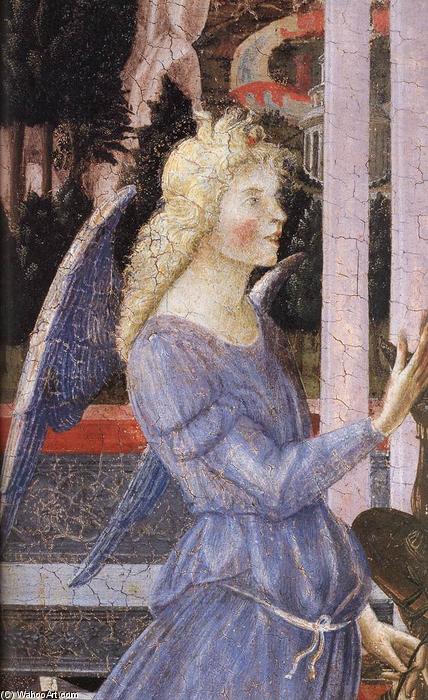
A Moment of Divine Revelation: Deconstructing the Annunciation
Francesco di Giorgio Martini’s “Annunciation,” a detail from this exquisite panel, offers more than just a depiction of a pivotal biblical scene; it's a window into the burgeoning artistic and intellectual currents of late Gothic Italy. Painted around 1470 in Siena, during a period of intense cultural ferment between the waning influence of the medieval world and the ascendance of Renaissance humanism, this work embodies a fascinating synthesis of established tradition and nascent innovation. The scene itself – the Archangel Gabriel announcing to Mary that she will conceive and bear the son of God – is one of the most enduring narratives in Christian art, yet Martini imbues it with a distinctly personal and psychologically astute quality.
The composition immediately draws the eye to the central figures: Gabriel, rendered with an almost startlingly youthful energy, extends his hand towards Mary. His wings, vast and delicately feathered, suggest both his celestial origin and a sense of profound urgency. Mary’s posture is one of contemplative surprise, her gaze fixed on the angel, her hands clasped in a gesture of humility and acceptance. Note the subtle shift in weight – she leans slightly forward, mirroring Gabriel's movement and suggesting an active engagement with the divine revelation. The architectural setting, though somewhat abstracted, hints at a Romanesque or early Gothic space, providing a grounding element to the ethereal narrative.
The Language of Color and Form: A Study in Late Gothic Detail
Martini’s mastery lies not just in his understanding of biblical iconography but also in his meticulous attention to detail and his sophisticated use of color. The palette is rich and luminous, dominated by deep blues – a hallmark of Sienese painting at the time – contrasted with vibrant reds and golds that highlight Mary's garments and the angel’s robes. These colors aren’t merely decorative; they carry symbolic weight, representing divinity, royalty, and spiritual grace. The artist employs a technique known as *sfumato*, subtly blurring outlines and softening transitions between tones, creating an atmosphere of hazy beauty and contributing to the overall sense of mystery.
Close examination reveals a remarkable level of realism in Martini’s rendering of textures – the folds of the drapery, the delicate veins in the angel's wings, the subtle sheen on Mary’s skin. This commitment to naturalism is balanced by an awareness of idealization; the figures possess a certain timeless quality, transcending mere earthly representation. The use of gold leaf, particularly in the halos and decorative elements, further elevates the scene, signifying holiness and divine light.
Symbolism and Context: Echoes of Humanist Thought
Beyond its religious subject matter, “Annunciation” reflects the broader intellectual climate of the time. Martini’s work anticipates many of the principles of Renaissance perspective, evident in the carefully constructed space and the illusionistic depth of the architectural setting. The scene also subtly engages with humanist ideas about human dignity and potential – Mary's acceptance of her role as Mother of God is presented not as a passive submission but as an act of courageous faith. The inclusion of the architectural elements—the columns, arches, and doorway—suggests a meditation on the relationship between the divine realm and the earthly world, a theme central to humanist thought.
Furthermore, Martini’s approach to depicting the figures is remarkably modern for his time. He avoids the stiff, formal poses of earlier religious paintings, instead capturing moments of genuine emotion and psychological complexity. This emphasis on human feeling aligns with the growing interest in individual experience that characterized the Renaissance. The panel's placement within a church setting underscores its function as a devotional object, intended to inspire contemplation and foster a connection between the faithful and the divine.
A Timeless Masterpiece: Reproduction and Beyond
Reproductions of this extraordinary work capture only a fraction of its richness and depth. The meticulous detail, vibrant colors, and profound symbolism are best appreciated in the original. However, high-quality reproductions offer an accessible way to experience Martini’s genius and bring the beauty of this iconic scene into your home or studio. Consider commissioning a hand-painted reproduction – a faithful recreation that honors the artist's vision and preserves the enduring power of “Annunciation.”