A Symphony of Petals: The Romantic Soul of Francesco Hayez
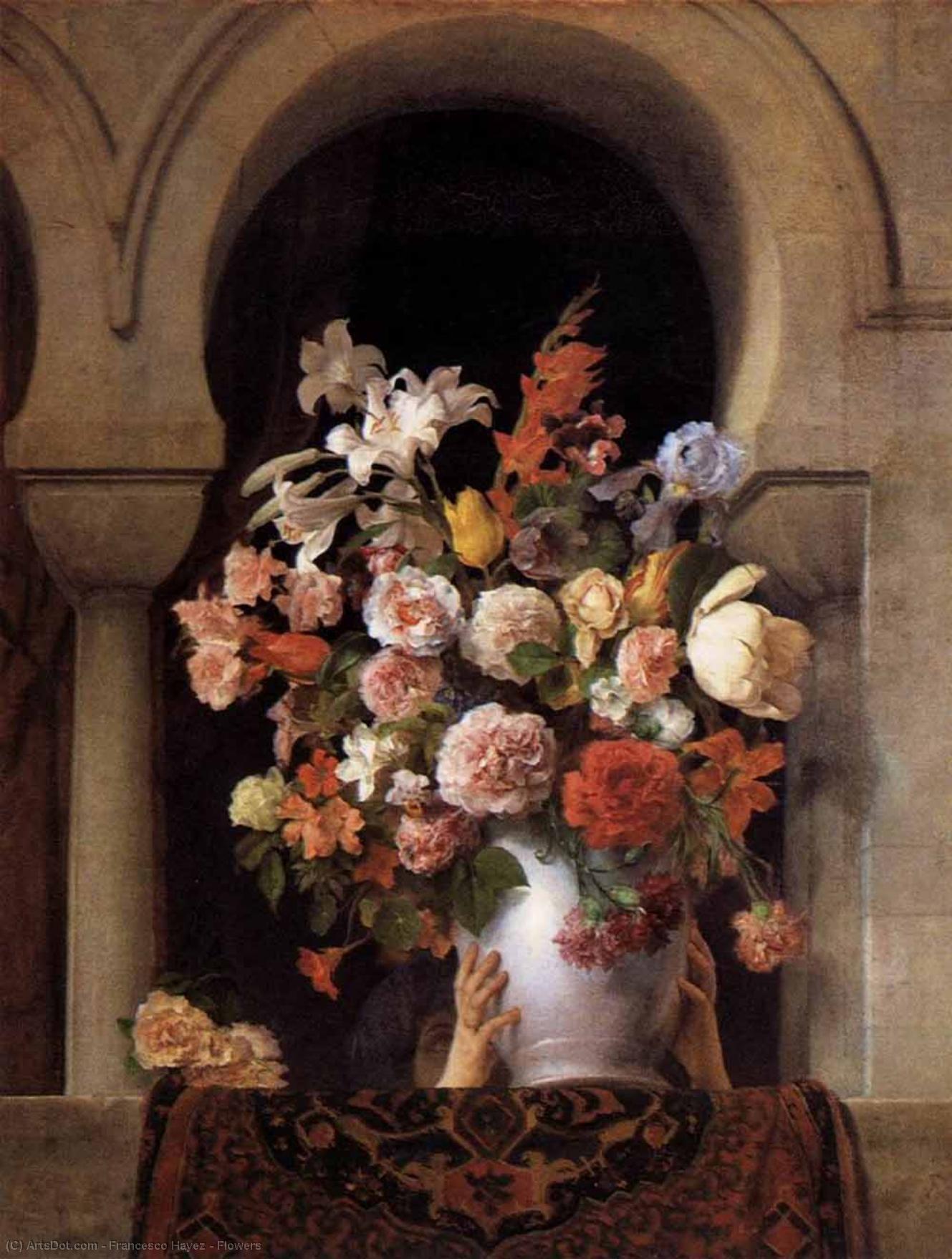
In the quietude of a masterfully rendered still life, Francesco Hayez’s “Flowers” emerges not merely as a botanical study, but as a profound whisper from the heart of Italian Romanticism. Created between 1834 and 1835, this exquisite work transcends the boundaries of simple decoration to offer a window into a turbulent era. While the eye is immediately drawn to the vibrant, overflowing bouquet, the discerning viewer senses an underlying tension—a delicate balance between the ephemeral beauty of nature and the enduring spirit of a nation yearning for unity. Hayez, a master of capturing both the tangible and the intangible, uses this arrangement of blossoms to compose a visual poem that resonates with hope, vitality, and a subtle, poetic melancholy.
The composition is a triumph of classical balance and dramatic contrast. A central vase, brimming with an abundance of life, sits anchored upon a dark, richly patterned cloth. This deep, grounding element serves as the perfect stage for the luminous explosion of color above it. Hayez’s technique is nothing short of breathtaking; through the meticulous application of oil glazes, he achieves a translucent quality that allows light to seemingly dance within each petal. One can almost feel the velvety texture of the crimson roses and the delicate, papery lightness of the lilies. The artist’s ability to manipulate light creates an illusion of shimmering movement, as if a gentle breeze might stir the arrangement at any moment, making the painting feel less like a static object and more like a living, breathing presence.
Symbolism and the Echo of History
To look upon “Flowers” is to engage with the political pulse of nineteenth-century Italy. During this period, much of the Italian peninsula languished under foreign dominion, yet beneath this surface of repression, a fervent nationalist sentiment was beginning to bloom. In the language of Romanticism, flowers were rarely just flowers; they were potent allegories. The lushness of the bouquet can be interpreted as a metaphor for the latent potential and burgeoning strength of the Italian identity. The interplay of light and shadow—the chiaroscuro effect—mirrors the struggle between the darkness of political fragmentation and the bright promise of a unified future.
For the collector or interior designer, this piece offers an unparalleled opportunity to introduce a sense of historical depth and sophisticated elegance into a space. The painting’s ability to harmonize intense color with a serene atmosphere makes it a versatile masterpiece for high-end curation. Whether placed in a sunlit gallery or a moody, classical study, the work commands attention through its sheer technical brilliance and emotional complexity. It is an investment in a piece of history that continues to bloom with new meanings, offering a timeless aesthetic that celebrates both the delicate beauty of the natural world and the indomitable strength of the human spirit.