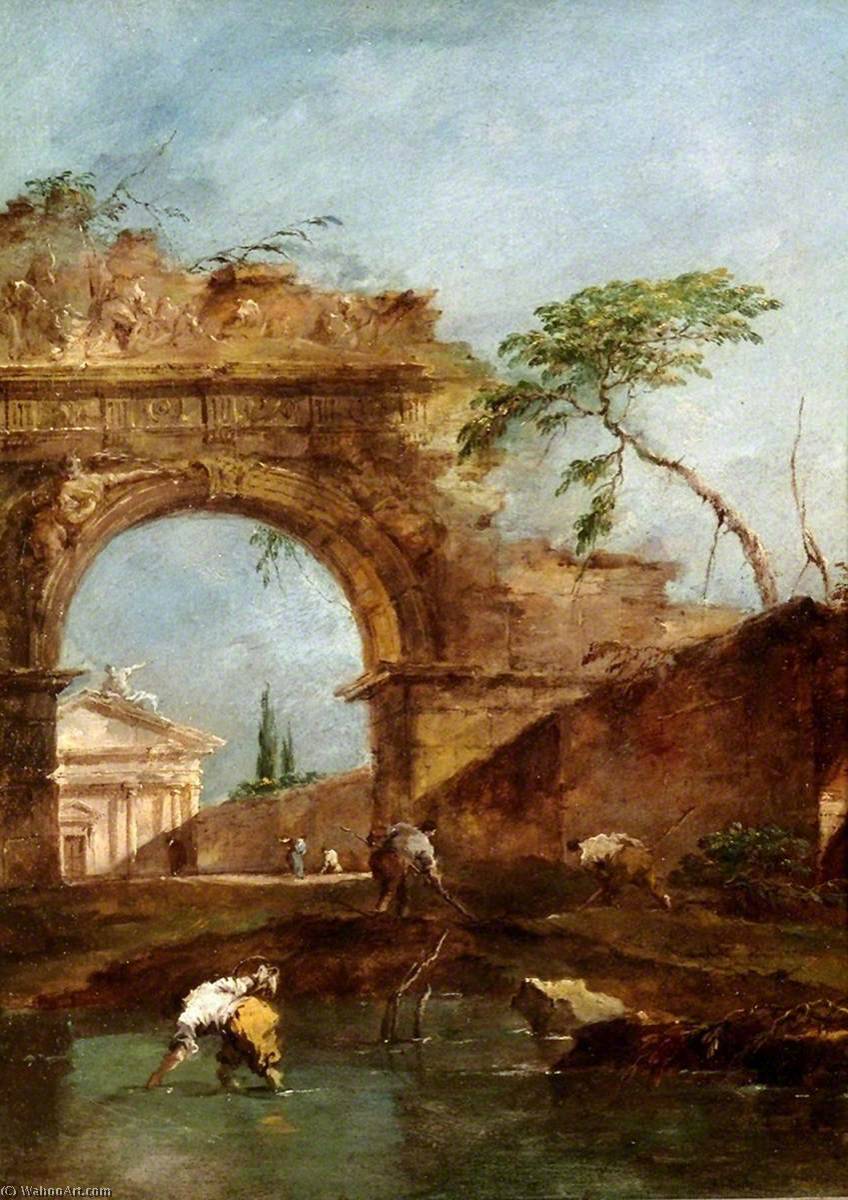
A Twilight Vision: Francesco Guardi’s “Landscape – Capriccio”
Francesco Lazzaro Guardi's "Landscape – Capriccio" isn’t merely a depiction of a vista; it’s a distilled moment, a fleeting memory captured with the melancholic grace characteristic of the Venetian master. Painted in 1780, this work stands as a poignant testament to the fading grandeur of Venice—a city grappling with economic decline and political uncertainty—and reflects Guardi's unique ability to imbue even the most commonplace scenes with an atmosphere of profound beauty and subtle sorrow. The painting unfolds like a dream, inviting the viewer into a world where reality subtly blends with imagination, mirroring the very essence of Venetian life at that time.
The Scene Unfolds: Composition and Detail
At first glance, “Landscape – Capriccio” presents a seemingly simple scene: a man on horseback traversing a gently sloping hillside. However, closer observation reveals a meticulously constructed illusion, a carefully orchestrated tableau of architectural fragments, distant buildings, and atmospheric haze. The composition is deliberately asymmetrical, drawing the eye through a series of receding planes and suggestive details. A crumbling tower hints at forgotten palaces, while a small church nestles amongst the foliage, its steeple barely visible through the swirling mist. The figure on horseback isn’t a heroic warrior but rather an anonymous traveler, lost in contemplation—a symbol perhaps of Venice itself, adrift in the currents of change.
- Architectural Fragments: The painting is replete with architectural elements – arches, columns, and fragments of walls – that appear to be remnants of a vanished city. These aren’t realistic representations but rather evocative suggestions, imbued with a sense of history and decay.
- Atmospheric Perspective: Guardi masterfully employs atmospheric perspective—the technique of diminishing detail and color in the distance—to create a convincing illusion of depth. The hazy background recedes into an ethereal mist, blurring the boundaries between foreground and background.
- The Horseman’s Pose: The rider's posture is deliberately ambiguous, conveying a sense of solitude and introspection rather than action or purpose.
A Venetian Twilight: Style and Technique
Guardi’s style defies easy categorization. He was deeply influenced by Canaletto’s meticulous depictions of Venice, but he moved beyond mere topographical accuracy to create a distinctly personal vision. His brushwork is loose and expressive, characterized by short, broken strokes that capture the fleeting effects of light and shadow. This “pittura di tocco” (painting of touch) technique—a hallmark of Venetian painting—gives the scene a vibrant, almost tactile quality. The colors are muted and atmospheric, dominated by shades of gray, blue, and ochre, creating a sense of melancholy and timelessness. He was considered part of the Venetian School, but his work moved beyond its traditional constraints.
Key Characteristics:
- Loose Brushwork: Short, broken strokes create a dynamic and expressive surface.
- Muted Palette: Dominated by cool grays, blues, and ochres.
- Atmospheric Perspective: Creates a convincing illusion of depth and distance.
Symbolism and Emotional Resonance
“Landscape – Capriccio” is more than just a picturesque view; it’s a meditation on memory, loss, and the passage of time. The crumbling architecture symbolizes Venice's declining fortunes, while the solitary horseman embodies the city’s isolation. The painting evokes a sense of nostalgia for a bygone era—a world that is slipping away into the mists of history. Guardi’s work resonates with an underlying melancholy, reflecting the artist’s own experience of witnessing the decline of his beloved Venice. It's a quiet lament for beauty lost and a poignant reminder of the ephemeral nature of existence.
Today, this artwork continues to captivate viewers with its evocative atmosphere and subtle emotional depth. A high-quality reproduction allows us to appreciate Guardi’s masterful technique and his profound understanding of the Venetian spirit—a timeless vision of a city on the brink.