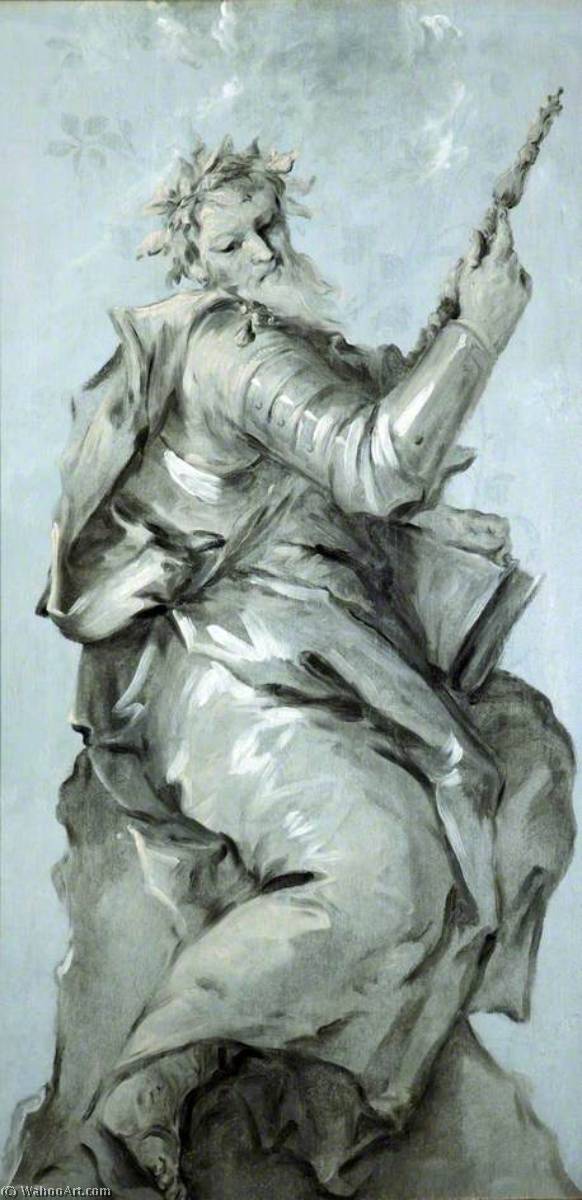
A Portrait of Venetian Melancholy: Francesco Guardi’s “Merit”
Francesco Guardi's "Merit," painted in 1750, is more than just a portrait; it’s a distilled essence of Venice itself – a city grappling with the slow erosion of its former glory. This intimate scene, measuring 128 x 73 cm, offers a poignant glimpse into the twilight years of the Venetian Republic, a period marked by both artistic innovation and profound societal change. The painting depicts a man seated upon a rock, an unassuming yet powerfully evocative gesture that speaks volumes about the sitter’s character and the era he embodies. His posture suggests contemplation, perhaps even regret, while the objects in his hands – a firearm and a book – introduce layers of symbolic complexity.
- Subject Matter: The central figure is presented with remarkable realism, capturing not just physical likeness but also an underlying sense of mood.
- Composition: Guardi masterfully employs atmospheric perspective, blurring the background sky and clouds to draw focus onto the sitter and his immediate surroundings. This technique was a hallmark of his style, contributing significantly to the painting’s dreamlike quality.
- Details: Note the meticulous rendering of the man's attire – the hat, beard, and the worn leather of the rock – all details that ground the scene in a specific time and place.
The Style and Technique of a Venetian Master
Francesco Guardi was a unique figure within the Venetian School, largely eschewing the grand narratives favored by his contemporaries like Canaletto. Instead, he focused on capturing fleeting moments, atmospheric effects, and the subtle nuances of everyday life. “Merit” exemplifies this approach through its loose brushwork, muted color palette dominated by blues, grays, and browns, and a deliberate avoidance of sharp outlines. Guardi’s technique was characterized by *sfumato*, a blurring effect achieved through delicate layers of translucent paint, creating an ethereal quality that softens the edges and enhances the sense of atmosphere. This approach wasn't simply about technical skill; it reflected Guardi’s deep understanding of light and shadow, and his ability to translate these elements onto canvas with remarkable sensitivity.
Key Techniques:
- Sfumato: Creates a hazy, dreamlike effect.
- Loose Brushwork: Adds to the painting’s atmospheric quality.
- Muted Palette: Reflects the melancholic mood of the scene.
Symbolism and Historical Context
The inclusion of the gun in the sitter's hand is particularly significant, given Venice’s history as a maritime republic reliant on naval power. It suggests a readiness for defense, perhaps even a lament for lost dominance. The book, however, introduces an element of intellectual pursuit – a yearning for knowledge or reflection amidst the decline. Painted in 1750, “Merit” stands at a crucial juncture in Venetian history. The Republic was facing increasing pressure from abroad, and internal divisions were weakening its foundations. Guardi’s painting captures this precarious moment with a quiet dignity, suggesting a sense of resignation rather than outright despair. It's a portrait not just of an individual, but of a civilization on the verge of transformation.
Emotional Impact and Artistic Value
"Merit" possesses a profound emotional resonance that transcends its historical context. The painting’s muted tones, combined with the sitter’s contemplative pose, evoke a sense of melancholy and introspection. It is a work that invites viewers to contemplate themes of mortality, loss, and the passage of time – universal concerns that have resonated across cultures and generations. This reproduction offers an exceptional opportunity to own a piece of Venetian art history, capturing the spirit of a bygone era and the enduring legacy of Francesco Guardi’s artistic vision.