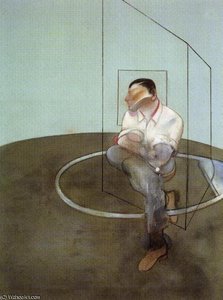
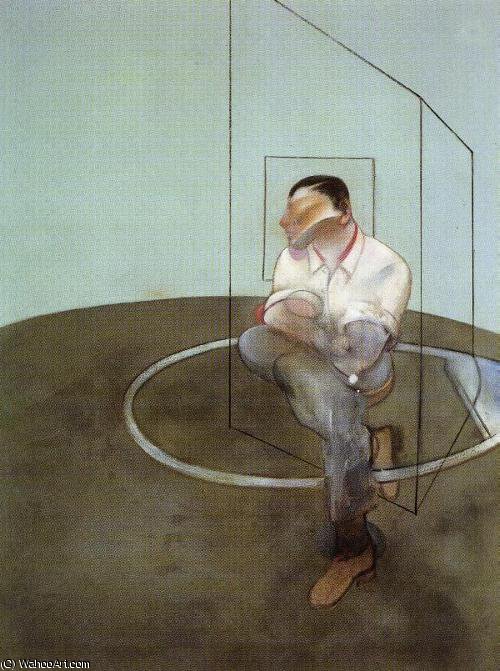
3 Studies for a Portrait of John Edwards, Right – A Descent into Psychological Landscape
Francis Bacon’s “Three Studies for a Portrait of John Edwards, Right” isn't merely a depiction of a figure; it’s an excavation of the human psyche rendered in visceral oil paint on canvas. Completed in 1984, this artwork embodies Bacon’s signature Expressionist style—a deliberate rejection of representational accuracy in favor of conveying raw emotion and confronting unsettling truths about existence.
- Subject Matter & Composition: The central figure dominates the canvas, seated with hands resting on knees, embodying a palpable sense of vulnerability and despair. Surrounding him is a fragmented architectural space—a series of interlocking cubes and rectangles—creating an oppressive environment that visually reinforces the psychological tension at its core. Bacon meticulously crafted this composition to heighten the viewer’s experience of confinement and unease.
- Color Palette & Texture: The subdued color palette—primarily blues, grays, and flesh tones—serves as a counterpoint to the aggressive lines that define the geometric framework. Bacon achieved remarkable textural depth through loose brushstrokes, layering pigment onto the canvas to produce surfaces riddled with irregularities and hinting at decay. This deliberate roughness underscores the artwork’s emotional intensity.
- Technique & Materials: Bacon employed oil paint—a medium known for its ability to capture subtle nuances of tone and texture—with a masterful hand. The technique is characterized by gestural brushstrokes that prioritize feeling over precise detail, mirroring the artist's preoccupation with capturing subjective experience. Sand and dust were incorporated into the paint mixture, further enhancing the textural qualities of the artwork.
- Historical Context & Influences: Produced in the aftermath of World War II, “Three Studies” reflects the anxieties and disillusionment prevalent during that era. Bacon drew inspiration from Surrealism and Cubism, incorporating geometric forms and distorted perspectives to challenge conventional notions of reality. His work stands as a testament to the power of art to confront uncomfortable truths about human nature.
- Symbolism & Emotional Impact: The architectural enclosure symbolizes alienation and imprisonment—themes recurrent throughout Bacon’s oeuvre. The figure's contorted facial expression communicates anguish and despair, inviting contemplation on the darker aspects of consciousness. Viewing “Three Studies” evokes a profound emotional response, prompting viewers to confront their own vulnerabilities and grapple with existential questions.
This artwork resides within Buffalo AKG Art Museum’s impressive collection alongside masterpieces by Picasso, Matisse and Warhol. Its detailed reproduction offers an unparalleled opportunity to appreciate Bacon's groundbreaking approach to portraiture and his enduring legacy as one of the most influential artists of the 20th century.