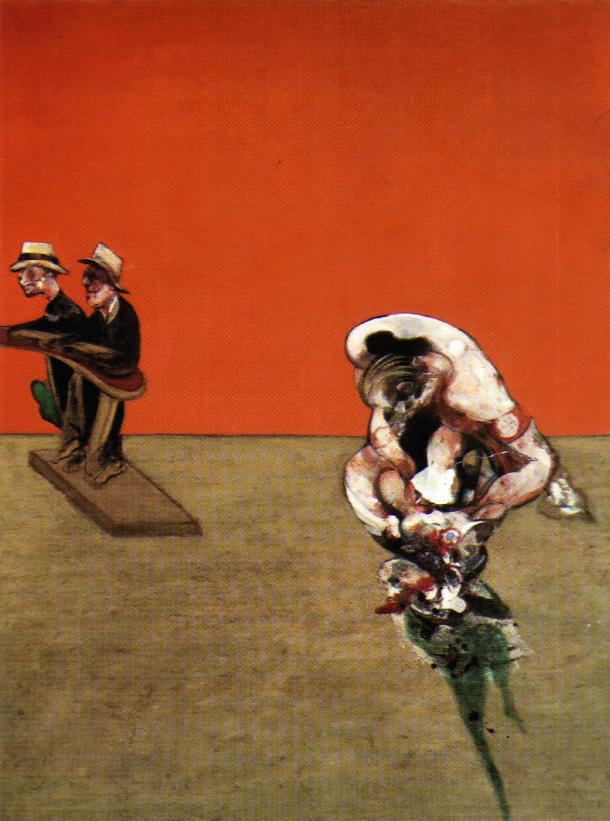
Explore Francis Bacon's visceral 1965 Crucifixion triptych – a haunting masterpiece of Expressionism. Confront themes of suffering, violence & the fragility of life through distorted forms and searing color.
Explore Francis Bacon's (1909-1992) emotionally charged figurative paintings. Known for distorted forms, existential themes & bold expressionism, he remains a cornerstone of modern art. Discover key works & legacy.
A Vision of Modern Anguish
Francis Bacon’s *Crucifixion* (1965) is not an invitation to religious reverence, but rather a brutal and visceral confrontation with the human condition stripped bare. This triptych – a format Bacon returned to repeatedly throughout his career – presents three harrowing panels that dismantle traditional representations of suffering. It doesn't offer solace or redemption; instead, it thrusts viewers into raw physicality and existential dread. Painted in the shadow of post-war anxieties and the looming Cold War, the work stands as a powerful statement on violence, power dynamics, and the fragility of life in an increasingly fragmented world. It’s a challenging piece, undeniably, but one that resonates deeply with those drawn to art that dares to explore the darkest corners of human experience.
Deconstructing Form and Technique
Bacon's style is immediately recognizable for its distorted figures and turbulent brushwork, and *Crucifixion* exemplifies this approach with unsettling force. He employs an aggressive palette dominated by searing reds – a color historically associated with blood, passion, and danger, but here imbued with a sense of raw, animalistic pain. The composition itself is fragmented and chaotic; forms are blurred and contorted, barely resembling recognizable anatomy. Oil paint is applied in layers, often scraped and reworked, creating a textured surface that amplifies the feeling of unease and instability. Notice the stark contrast between the rigidly posed figure on the left panel – seemingly an observer or perhaps even a perpetrator – and the agonizing figures within the central and right panels. The flattened perspective further intensifies the claustrophobic atmosphere, trapping the viewer within this nightmarish scene. Bacon’s technique isn't about precise representation; it is fundamentally about conveying *feeling*, about translating internal turmoil onto the canvas with brutal honesty. He wasn’t interested in depicting what things looked like, but rather how they *felt* to exist within a world saturated with pain and uncertainty.
Historical Context and Subverted Symbolism
While referencing the biblical story of Christ’s crucifixion, Bacon deliberately strips away any conventional religious connotations. He famously stated that for him, the image of the crucifixion was merely “a magnificent armature” – a structural framework upon which to explore his own feelings about human behavior and suffering. The imagery within the triptych—the suggestion of butchered meat, bandages resembling butcher’s frills, and animalistic forms—alludes to slaughterhouses and the dehumanizing aspects of industrialization. The very format of the triptych itself, traditionally reserved for religious altarpieces, is subverted here, becoming a stage not for spiritual devotion but for existential torment. Bacon's work consistently grapples with themes of isolation, mortality, and the inherent violence within human nature – all powerfully present in *Crucifixion*. He wasn’t attempting to offer answers or provide comfort; he was holding a mirror up to humanity, reflecting back its own capacity for cruelty and despair.
Emotional Resonance and Interior Impact
*Crucifixion* is not an easy painting to live with; it demands attention and provokes strong reactions. However, its emotional intensity can also be profoundly captivating. For collectors seeking a statement piece that sparks conversation or for interior designers aiming to create a space that challenges conventional aesthetics, this work offers a unique opportunity. While the subject matter is undeniably dark, the vibrant color palette and dynamic composition prevent it from feeling oppressively bleak. A high-quality reproduction can bring Bacon’s powerful vision into a contemporary setting, serving as a constant reminder of the complexities and contradictions inherent in the human experience. It's a piece that rewards contemplation and invites viewers to confront their own anxieties about existence—a testament to the enduring power of art to disturb, provoke, and ultimately, illuminate the depths of our shared humanity.