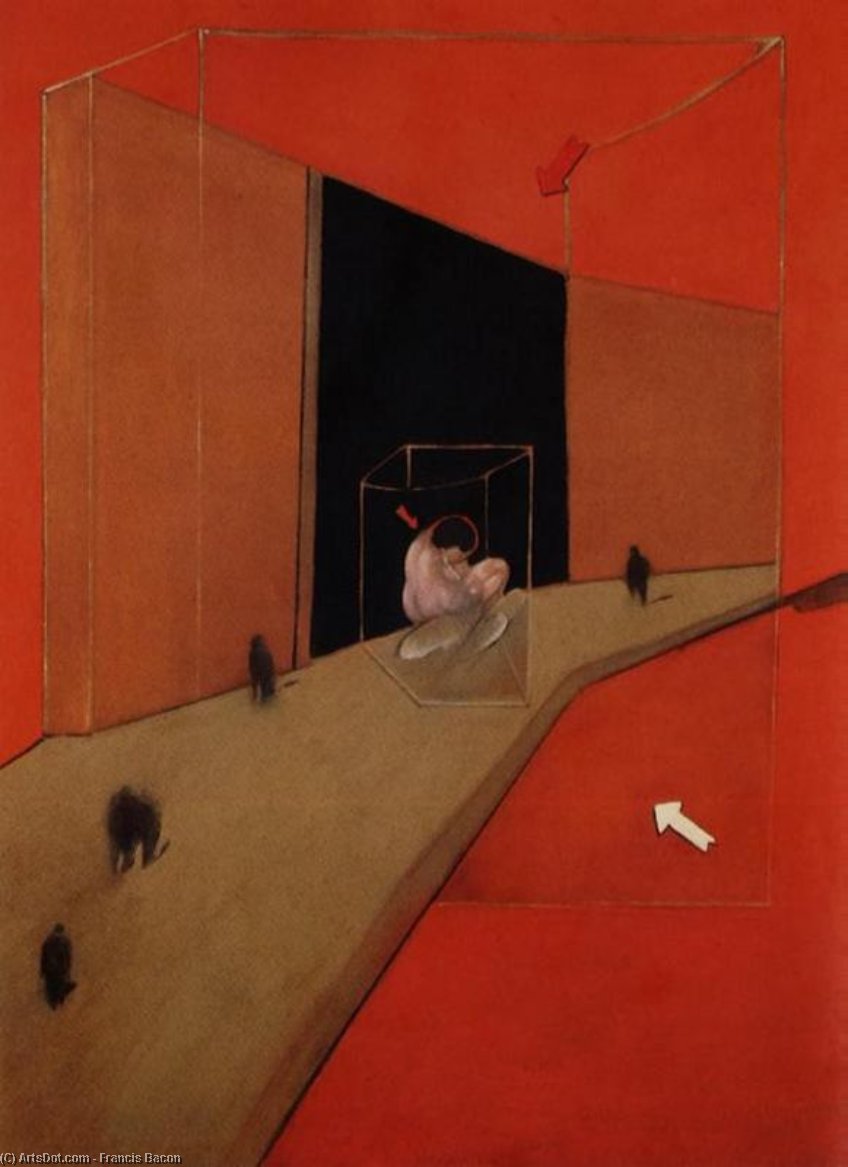
Francis Bacon’s 'Figures in a Street' (1983) is a haunting surrealist masterpiece. Explore its dramatic red & brown palette, unsettling composition & themes of isolation. A powerful work by the iconic Irish artist.
Explore Francis Bacon's (1909-1992) emotionally charged figurative paintings. Known for distorted forms, existential themes & bold expressionism, he remains a cornerstone of modern art. Discover key works & legacy.
A Descent into the Psyche: Exploring Francis Bacon’s 1983 Street Scene
This compelling work by Francis Bacon, created in 1983, is a masterclass in existential unease and psychological tension. It exemplifies his signature style – a brutal yet poetic exploration of the human condition rendered with visceral intensity. The painting presents a solitary figure within an ambiguous architectural space, immediately drawing the viewer into a world of isolation and introspection.
Subject & Composition: Trapped Within Form
The composition is dominated by strong geometric forms – rectangles and diagonals – that create a sense of confinement. A seated figure occupies a raised platform, seemingly suspended before a dark, rectangular void. This arrangement isn’t merely spatial; it feels profoundly *psychological*. The figure doesn't interact with its surroundings but appears trapped within them, or perhaps observing an abyss. The stark contrast between the illuminated foreground and the shadowy recess amplifies this feeling of being caught between worlds. Bacon frequently employed such enclosed spaces, often described as ‘cage-like’, to symbolize humanity’s inherent limitations and vulnerability.
Style & Technique: A Synthesis of Surrealism and Expressionism
Bacon's style is a unique blend of Surrealism and Expressionism. While he rejected being labeled a Surrealist, the dreamlike distortion of perspective and unsettling imagery clearly echo that movement’s concerns with the subconscious. However, it’s the raw emotional power – achieved through Bacon’s expressive brushwork and dramatic use of color – that firmly places him within the Expressionist tradition. The visible brushstrokes and textured surface, indicative of oil on canvas, contribute to the painting's physicality and immediacy. The limited palette of reds and browns further intensifies the sense of claustrophobia and despair.
Historical Context: Late Career Reflections
Created towards the end of his life, this work reflects Bacon’s continued preoccupation with themes of mortality, isolation, and the fragility of existence. Having established himself as a leading figure in post-war British art, Bacon remained relentlessly focused on exploring the darker aspects of human experience. The 1980s were marked by political anxieties and social upheaval; while not directly referencing these events, Bacon’s work captures a pervasive sense of unease that resonated with the era. He built upon decades of artistic exploration, refining his distinctive visual language to achieve ever greater emotional impact.
Symbolism & Interpretation: Confronting the Void
The symbolism within the painting is open to interpretation, but several elements stand out. The arrow-like form pointing towards the darkness can be seen as a metaphor for a journey into the subconscious or a confrontation with death. The figure itself may represent humanity grappling with an overwhelming and unknowable reality. It’s not a portrait of a specific individual, but rather an archetype – a representation of universal human anxieties. The emptiness surrounding the figure emphasizes its isolation and vulnerability.
Emotional Impact & Legacy
This painting is undeniably unsettling. It doesn't offer easy answers or comforting resolutions. Instead, it forces viewers to confront uncomfortable truths about themselves and the world around them. Bacon’s genius lies in his ability to evoke such powerful emotions through purely formal means – color, composition, and brushwork. His work continues to resonate with audiences today because it speaks to fundamental human experiences of loneliness, fear, and the search for meaning in a chaotic universe. It is a potent reminder of the power of art to provoke thought, challenge assumptions, and explore the depths of the human psyche.