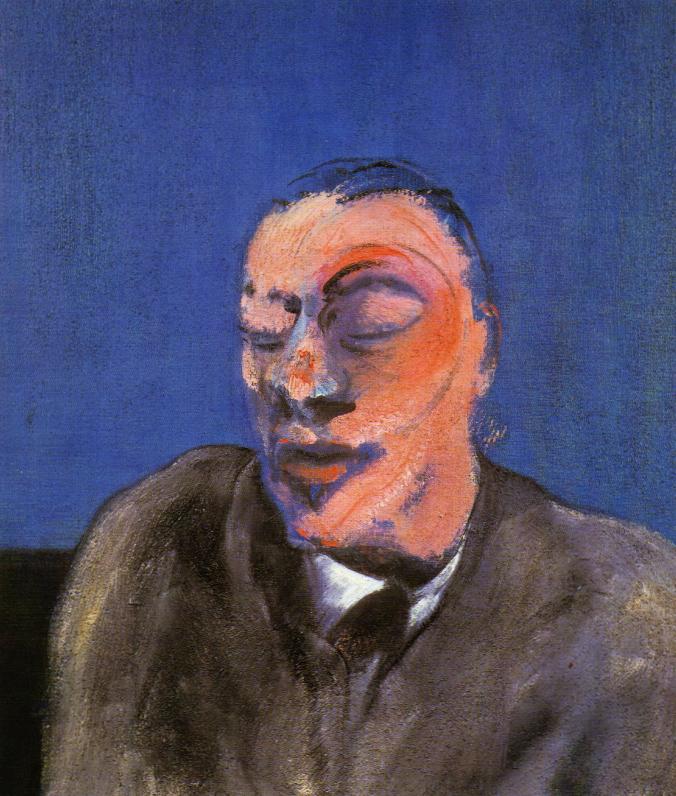
Francis Bacon’s "head ii" (1958) is a striking portrait of intense blues & oranges, showcasing his Expressionist style & visible impasto texture. Explore this iconic work!
Explore Francis Bacon's (1909-1992) emotionally charged figurative paintings. Known for distorted forms, existential themes & bold expressionism, he remains a cornerstone of modern art. Discover key works & legacy.
A Visceral Portrait: Decoding Francis Bacon’s “Head II” (1958)
Francis Bacon's "Head II," painted in 1958, is a powerfully unsettling portrait that exemplifies the artist’s unique contribution to Expressionism and his enduring fascination with the human condition. This work isn’t merely a depiction of a man; it’s an evocation of inner turmoil, isolation, and perhaps even existential dread.
Subject & Composition
The painting presents a tightly cropped view of a male head and shoulders. The subject, dressed in a dark suit jacket and tie, is rendered with a deliberate distortion that moves beyond simple representation. Bacon eschews traditional portraiture conventions, opting instead for an abstracted form where geometric shapes – circles suggesting eyes and mouth, rectangles defining the clothing – are softened by dynamic brushwork. This compression of space and focus on the head intensifies the psychological impact, drawing the viewer into the subject’s confined emotional world.
Style & Technique: A Symphony of Color and Texture
“Head II” is a masterclass in Bacon's signature style. The canvas explodes with a striking contrast between intense blues and oranges/reds. This chromatic tension isn’t arbitrary; it amplifies the emotional weight of the portrait, creating a sense of unease and agitation. Impasto – the thick application of paint – is central to Bacon's technique. The visible brushstrokes aren’t concealed but celebrated, adding a tactile quality and energetic dynamism to the surface. This textural richness contributes to the painting’s raw, visceral impact. The flattened perspective further emphasizes the two-dimensionality of the canvas, rejecting illusionistic depth in favor of an immediate, confrontational presence.
Historical Context & Artistic Influences
Born in Dublin and later working primarily in London, Francis Bacon (1909-1992) emerged as a pivotal figure in post-World War II art. His work reflects the anxieties and disillusionment of the era, moving away from traditional aesthetics towards a more subjective and emotionally charged expression. While influenced by earlier masters like Velázquez – particularly his portrait of Pope Innocent X which Bacon repeatedly reinterpreted – he forged a distinctly modern style. Bacon’s artistic lineage also includes elements of Cubism and Surrealism, though he ultimately transcended these movements to create something entirely his own.
Symbolism & Emotional Resonance
The symbolism in “Head II” is deliberately ambiguous, inviting multiple interpretations. The closed eyes of the subject suggest introspection, vulnerability, or perhaps a shutting out of the world. The overall sense of confinement – implied by the tight cropping and lack of spatial context – speaks to feelings of isolation and psychological pressure. Bacon wasn’t interested in portraying specific individuals but rather universal aspects of human experience: pain, fear, loneliness, and mortality. The distorted features aren't meant to be a literal likeness but an embodiment of these profound emotions.
Impact & Legacy
“Head II” is representative of Bacon’s broader project: to confront the raw realities of human existence without sentimentality or illusion. His work continues to resonate with audiences today because it taps into fundamental anxieties about identity, mortality, and the search for meaning in a chaotic world. For collectors and interior designers, a reproduction of this painting offers a powerful statement piece – one that is both visually striking and intellectually stimulating. It’s a work that demands attention and invites contemplation, adding depth and complexity to any space.