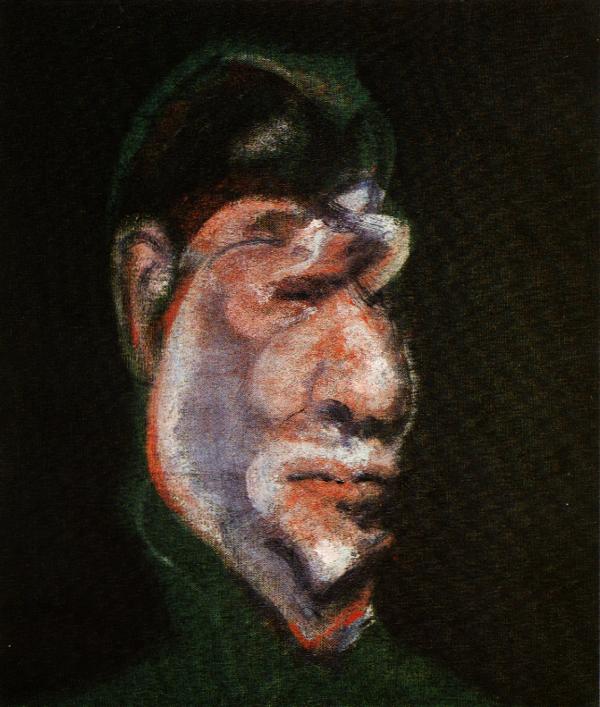
Head IV, 1961 - Francis Bacon: This Expressionist portrait by Francis Bacon depicts a distorted human head bathed in an unsettling green hue, reflecting the artist's signature style and exploring themes of psychological torment and visceral emotion.
Explore Francis Bacon's (1909-1992) emotionally charged figurative paintings. Known for distorted forms, existential themes & bold expressionism, he remains a cornerstone of modern art. Discover key works & legacy.
A Descent into Visceral Expressionism
The painting "Head IV," created in 1961 by the British Surrealist icon Francis Bacon, stands as a chilling testament to the artist's unflinching exploration of human suffering and psychological torment. More than just a portrait, it is an unsettling confrontation with primal emotion rendered in a style that cemented Bacon’s reputation as one of the most influential figures of mid-century art. The work presents a man's head, yet the face appears profoundly distorted and disfigured, stripping away the comforts of traditional representation to reveal something much more raw. Through a masterful manipulation of oil paint on canvas, Bacon employs thick, impasto strokes that build up textured surfaces, creating a sense of physical weight and presence. This deliberate use of distortion is not merely an aesthetic choice but a meticulously crafted tool used to convey internal states and disrupt the viewer's sense of reality.
The Language of Color and Technique
Bacon’s approach to painting famously defied convention, rejecting realism in favor of what he termed “visual violence.” In "Head IV," the palette is dominated by a sickly, greenish hue that permeates the canvas, contributing significantly to an atmosphere of unease. This color choice acts as a visual metaphor for decay and illness, mirroring the psychological disintegration depicted within the portrait. The eyes of the subject are open, yet they seem to stare into a void, gazing off into the distance rather than focusing on any tangible object, which heightens the sense of dissociation. The rich, textured appearance of the oil medium allows the light to catch the ridges of the paint, making the distortion feel almost tactile. For collectors and designers, this piece offers a profound depth that commands attention, inviting a closer look at the layers of movement and shadow that define its haunting character.
Trauma and the Postwar Psyche
To understand the emotional impact of "Head IV," one must consider the historical context of post-World War II Britain. Emerging from a period marked by widespread disillusionment and anxiety, Bacon’s artistic output reflects a pervasive atmosphere of trauma and mortality. The painting grapples with the fragility of human existence, utilizing Surrealist influences to tap into the subconscious anxieties lurking beneath the surface of consciousness. As Bacon famously stated, “I don’t paint what I see; I paint what I feel.” This philosophy is palpable in every stroke of "Head IV," where the subject's identity is lost to a whirlwind of expressive energy. It is a work that does not seek to please the eye with beauty, but rather to provoke the soul through its honest depiction of existential dread, making it an incomparable centerpiece for those who appreciate art that challenges and transforms the space it inhabits.