The Visceral Ache of Existence
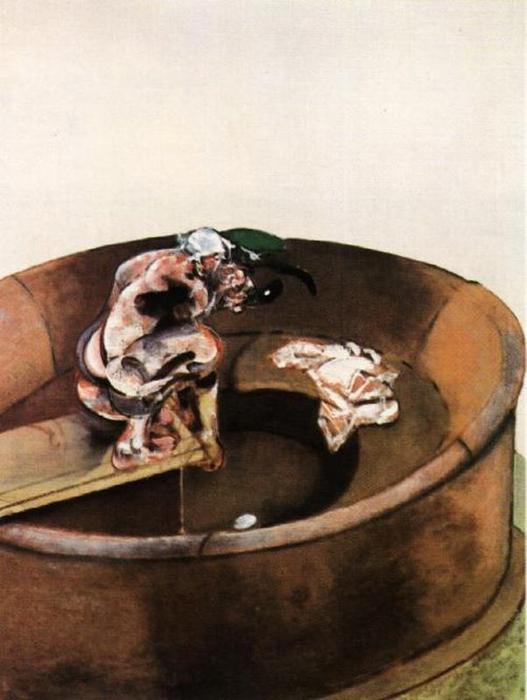
In the hauntingly profound "Portrait of George Dyer Crouching," Francis Bacon invites the viewer into a space where the boundaries between the human form and its environment dissolve into a singular, agonizing cry. Executed in 1963, this masterpiece serves as a window into the artist's most intimate explorations of psychological torment and bodily vulnerability. The subject, George Dyer—a figure central to Bacon’s turbulent personal life—is depicted not merely as a man, but as a soul caught in a state of profound existential dread. Seated within the cold, clinical confines of a ceramic vessel, the figure appears stripped of both clothing and dignity, embodying a raw, naked truth that transcends mere portraiture. It is an immersive experience that forces us to confront the fragility of our own consciousness.
The painting’s power lies in its brutal minimalism, a style where every stroke serves a psychological purpose. Bacon eschews the comforts of traditional representational art, opting instead for a technique defined by expressive gestures and fragmented forms. The canvas is alive with thick, textured applications of crimson and ochre, pigments that seem to pulsate with a feverish energy. By rejecting meticulous blending in favor of layered, often cracked surfaces, Bacon creates a sense of organic decay and instability. The distorted proportions and angular lines do not merely depict a man in a bowl; they communicate the very sensation of disintegration, making the artwork feel as though it is physically breaking apart under the weight of its own emotion.
A Symphony of Shadow and Symbolism
Beyond the immediate shock of the imagery, the composition functions as a complex symbolic landscape. The presence of scattered objects—the lonely chairs positioned in the periphery and the solitary cup resting on the ground—creates a surreal, stage-like atmosphere that feels both claustrophobic and infinitely vast. These elements act as silent witnesses to the subject's isolation, heightening the sense of a man trapped within his own psyche. The vessel itself serves as a potent metaphor for the limitations of the human condition; it is a container that offers both a semblance of protection and a crushing confinement, mirroring the way our memories and traumas hold us captive.
For the discerning collector or interior designer, this work offers more than just a striking visual; it provides a profound emotional anchor for a space. A high-quality reproduction of this piece brings a sophisticated, avant-garde energy to any setting, acting as a conversation piece that demands contemplation. It is an ideal selection for those who appreciate art that challenges the status quo and seeks to evoke deep, introspective moods. To hang such a work is to invite the raw, unfiltered intensity of post-war expressionism into one's home, transforming a room into a sanctuary for thought and a gallery of human resilience.