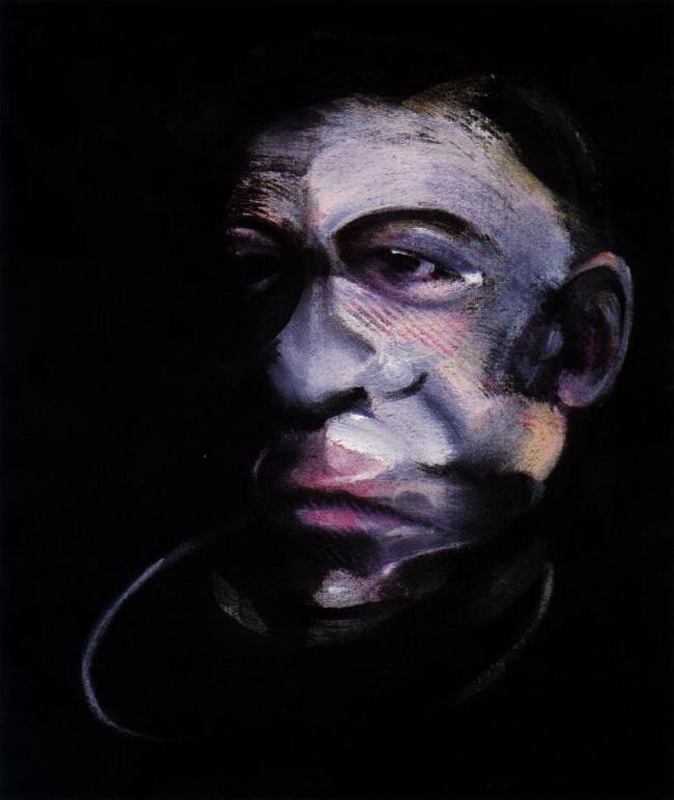
Portrait of Jacques Dupin – An Exploration of Existential Anxiety Through Distortion
Francis Bacon’s “Portrait of Jacques Dupin,” completed in 1990, stands as a quintessential example of Expressionist art—a visceral confrontation with the human condition rendered through unsettling visual language. This grayscale masterpiece transcends mere representation, delving into profound themes of isolation and psychological torment, mirroring the anxieties prevalent in post-war Britain during Bacon’s lifetime. The artwork's enduring power resides not in its meticulous detail but in its masterful manipulation of form and color to evoke a palpable sense of unease.
- Composition & Perspective: The portrait’s claustrophobic framing—a tightly cropped view of Dupin’s face dominating the canvas—immediately establishes a feeling of confinement, mirroring the psychological pressures experienced by individuals confronting existential dilemmas. Minimal background detail amplifies this effect, forcing the viewer to focus intently on the subject's gaze and facial expressions.
- Style & Technique: Bacon employed his signature technique – loose brushwork combined with bold contrasts—to achieve a textured surface that pulsates with energy. The artist deliberately eschewed realism, prioritizing emotional impact over accurate depiction. This stylistic choice aligns perfectly with Expressionism’s core belief in conveying subjective experience rather than objective observation.
- Color Palette & Texture: Dominated by shades of gray and black, punctuated by subtle hints of purple, pink, and beige, the palette contributes to the artwork's somber mood. These colors are applied gesturally, creating a palpable sense of physicality—the thick oil paint reveals itself through visible brushstrokes, mirroring the artist’s preoccupation with capturing the raw materiality of human flesh.
- Symbolism & Emotional Impact: The distorted features – particularly the eyes – convey a profound sadness and vulnerability. Bacon's oeuvre consistently explores themes of suffering and mortality, prompting contemplation on the fragility of existence. “Portrait of Jacques Dupin” isn’t merely a depiction; it’s an embodiment of psychological distress, inviting viewers to confront uncomfortable truths about human experience.
- Historical Context: Created in the aftermath of World War II, Bacon's work reflects the pervasive disillusionment and anxiety of the era. The artist wrestled with personal demons—including his own struggles with mental health—and channeled these anxieties into his art, producing images that resonate powerfully across time.
The artwork’s presence at the Fonds National d’Art Contemporain (FNAC) in Paris underscores its significance within the broader canon of 20th-century art. Bacon's meticulous documentation by Ronald Alley and John Rothenstein—captured in *Francis Bacon: Catalogue Raisonné*—provides invaluable insight into his artistic process and intentions. Furthermore, reproductions of “Portrait of Jacques Dupin” continue to inspire interior designers seeking to infuse their spaces with a sense of dramatic tension and emotional depth. Its enduring appeal testifies to Bacon’s ability to distill complex psychological states into unforgettable visual forms.