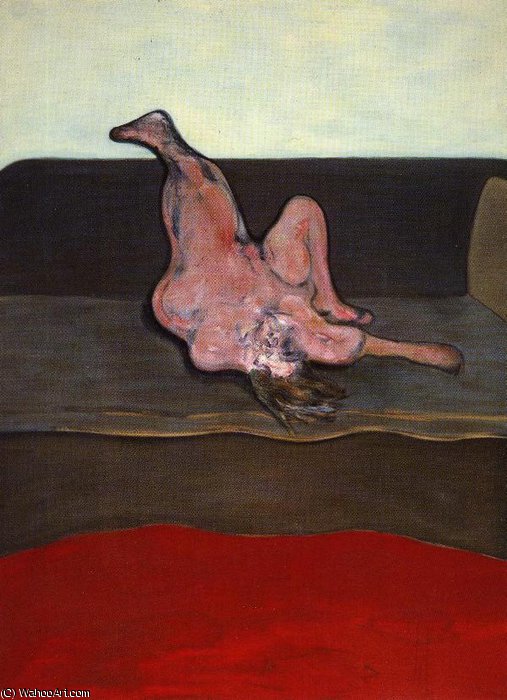
“Reclining Woman,” by Francis Bacon (1961), explores themes of vulnerability and psychological torment through distorted figures against a stark red backdrop. This iconic piece showcases Bacon’s signature style—a visceral depiction of human form—and is currently exhibited at Tate Britain as part of Modern and Contemporary British Art.
Explore Francis Bacon's (1909-1992) emotionally charged figurative paintings. Known for distorted forms, existential themes & bold expressionism, he remains a cornerstone of modern art. Discover key works & legacy.
A Confrontation with the Human Condition
Francis Bacon’s Reclining Woman, painted in 1961, is not merely an object to be viewed; it is a visceral experience that demands an immediate emotional reaction. Upon first encounter, the viewer is struck by the unsettling presence of a figure suspended in a state of profound vulnerability. Set against a stark, blood-red background that vibrates with a haunting intensity, the central subject lies on their back, limbs contorted and legs raised in an exaggerated, almost grotesque manner. This distortion does not merely represent a body; it captures a moment of psychological upheaval. The presence of smaller, less prominent figures flanking the main subject adds a layer of haunting isolation, suggesting a world where the individual is both exposed and profoundly alone amidst a sea of existential uncertainty. For the discerning collector, this piece offers more than decoration; it provides a window into the rawest depths of human emotion.
Brutal Minimalism and the Texture of Suffering
To understand the power of this masterpiece, one must look closely at Bacon’s mastery of Brutal Minimalism. Eschewing the comforts of traditional representation, the artist utilizes a thick, heavy impasto technique that transforms the canvas into something tactile and fleshy. By applying layers upon layers of oil paint with a palette knife, Bacon creates a surface where the medium itself mimics the textures of bone and wounded skin. This deliberate reduction of form serves to strip away the superficial, leaving only the raw essence of emotion. For interior designers seeking a centerpiece of intense, sculptural energy, the physical weight of this technique offers a profound depth; the painting possesses a palpable presence that commands attention, making it an unforgettable focal point in any sophisticated gallery or modern living space.
Symbolism and the Post-War Psyche
The historical resonance of Reclining Woman is inseparable from its visual language. Created in the wake of World War II, the painting breathes the pervasive disillusionment of post-war Britain. Bacon draws heavily upon Surrealist influences, employing irrational juxtapositions and fragmented anatomy to mirror the breakdown of identity and the fragmentation of the human psyche. The way the figure appears dissected or distorted serves as a powerful symbol for the psychological disintegration felt in an era of unprecedented global trauma. It is a masterpiece of existential angst, offering a profound commentary on the inescapable anxieties of the modern age. Acquiring a high-quality reproduction of this work allows one to possess a piece of history that speaks to the most complex and enduring layers of human existence.