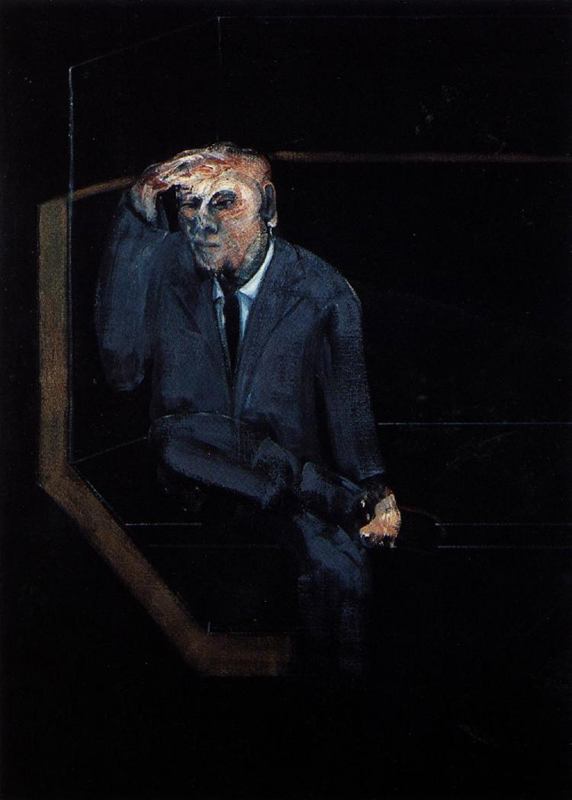
Self-Portrait 7 - A haunting black and white depiction of Bacon's self-image, capturing profound introspection amidst unsettling stillness. Explore the artist’s visceral exploration of identity and emotion.
Explore Francis Bacon's (1909-1992) emotionally charged figurative paintings. Known for distorted forms, existential themes & bold expressionism, he remains a cornerstone of modern art. Discover key works & legacy.
A Window into the Fractured Soul
Francis Bacon’s Self-Portrait 7 is far more than a mere reflection of a face; it is an unmasking of the human spirit in its most vulnerable and turbulent state. Painted in 1953, this work presents a figure caught in a profound moment of introspection, where the physical and the psychological collide with startling intensity. The viewer is met with a gaunt, haunting visage, framed by dark hair, with a head bowed as if under the invisible weight of unspoken anxieties. It is an arresting testament to the artist’s preoccupation with psychological torment, offering an unflinching confrontation with the darker, more unsettling aspects of our inner landscapes. The portrait does not seek to flatter, but rather to delve into the depths of a psyche caught in a moment of profound, heavy stillness.
The Texture of Disquiet
To gaze upon this portrait is to witness the raw power of Expressionism pushed to its absolute limit. Bacon eschewed the comforts of traditional representation, opting instead for a technique that feels almost visceral in its execution. Through the use of heavy, textured brushstrokes and the deliberate application of palette knives, he created a surface riddled with intentional holes and fissures. These are not mere accidental imperfections; they serve as crucial conduits for emotion, mirroring the artist's own fractured sense of self. The choice of a monochrome palette—dominated by somber, atmospheric shades of grey—strips away the distraction of color, forcing the eye to focus on the stark, dramatic interplay of light and shadow. This monochromatic approach amplifies the sense of profound isolation, reinforcing the painting's commitment to portraying internal truth rather than external reality.
Existential Echoes in a Post-War World
The haunting atmosphere of Self-Portrait 7 is inseparable from its historical moment. Emerging from the immediate aftermath of World War II, the painting breathes the air of postwar Britain—a period defined by collective disillusionment and a burgeoning awareness of existential uncertainty. As the world grappled with the trauma of global conflict and the questioning of fundamental human truths, Bacon’s work captured that pervasive sense of loss and instability. For the discerning collector or interior designer, this piece offers more than just aesthetic gravity; it provides a profound emotional resonance. It is a masterpiece of existential angst, making it an ideal centerpiece for spaces that seek to celebrate art which dares to explore the depths of the human condition with uncompromising, beautiful honesty.