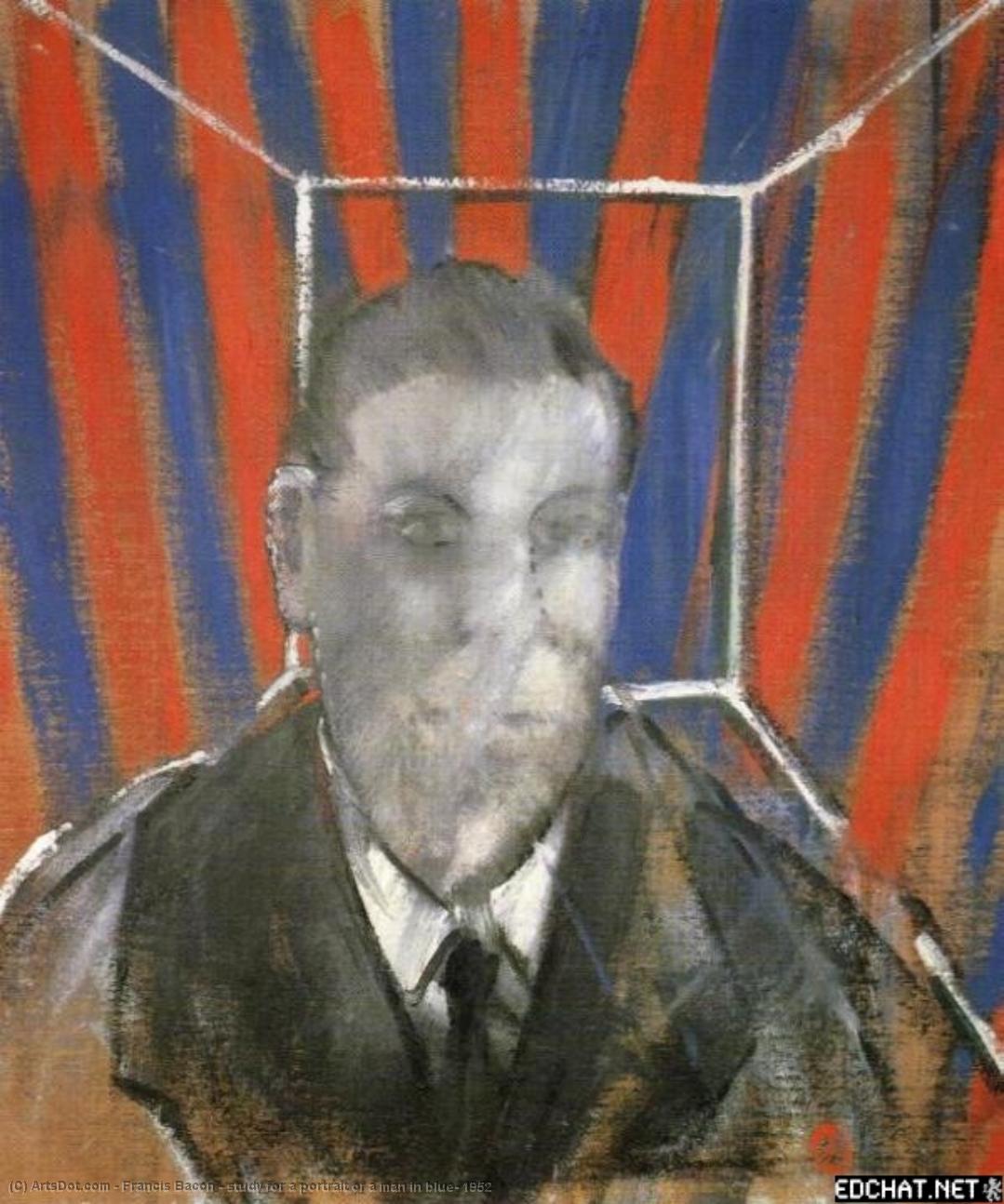
Explore Francis Bacon’s ‘Study for a Portrait of a Man in Blue,’ a powerful Expressionist work featuring bold stripes & emotive figures. A textured pastel study capturing raw emotion.
Explore Francis Bacon's (1909-1992) emotionally charged figurative paintings. Known for distorted forms, existential themes & bold expressionism, he remains a cornerstone of modern art. Discover key works & legacy.
A Study in Anxiety: Francis Bacon’s 1952 Portrait
This striking work on paper, *study for a portrait of a man in blue*, exemplifies Francis Bacon's distinctive and emotionally charged approach to figurative painting. Created in 1952 – a pivotal year also producing his “Screaming Pope” series – this piece isn’t a traditional likeness but rather an exploration of the human condition, rendered with raw intensity and psychological depth.
Subject & Composition
The artwork presents a close-up depiction of a man's head and upper torso. However, Bacon eschews conventional portraiture; the figure is not idealized or flattering. Instead, it’s fragmented and distorted, conveying a sense of unease and vulnerability. The composition is dramatically defined by bold, vertical stripes of red and blue that partially obscure and define the subject. This creates a cage-like effect, visually compressing the figure and contributing to the overall feeling of confinement. It's important to note Bacon often avoided specific identity for his subjects; this man remains anonymous, representing humanity in distress rather than an individual.
Style & Technique
Bacon’s style is firmly rooted in Expressionism, though it transcends easy categorization. He deliberately distorts forms and prioritizes emotional impact over realistic representation. The technique employed here – likely chalk or pastel on paper – is crucial to the work's effect. Visible strokes, smudging, and a textured surface create a sense of immediacy and rawness. This contrasts with areas of smoother rendering on the man’s skin, highlighting certain features while leaving others in shadow. The uneven lighting further enhances the dramatic tension.
Historical Context & Influences
Francis Bacon emerged as a major force in post-World War II art, a period marked by existential angst and disillusionment. His work reflects this atmosphere of uncertainty and trauma. While he admired artists like Velázquez (particularly his portrait of Pope Innocent X, which Bacon repeatedly reinterpreted), his style is uniquely his own. Interestingly, the early 20th century saw a shift away from traditional portraiture towards psychological exploration – think of artists like Oskar Kokoschka or even earlier masters like Nicholas Hilliard who captured inner states through subtle means. However, Bacon takes this exploration to an extreme level of visceral intensity.
Symbolism & Emotional Impact
The bold stripes dominating the background are open to interpretation but powerfully symbolic. They can be seen as representing barriers, confinement, or even the divisions within the human psyche. The man’s distorted features and ambiguous expression evoke feelings of anxiety, isolation, and perhaps even terror. Bacon wasn't interested in portraying happiness; his work confronts the darker aspects of existence. There is a palpable sense of *suffering* emanating from this portrait – a feeling amplified by the limited color palette and the rough texture of the medium. Some scholars have noted parallels between Bacon’s figures and the iconic imagery of mid-century celebrities like Frank Sinatra, suggesting an underlying commentary on fame, vulnerability, and public persona.
Collecting & Interior Design Considerations
A reproduction of this work would make a powerful statement in any collection. Its dramatic composition and intense emotionality demand attention. In terms of interior design, it pairs well with minimalist spaces to create a striking contrast or within more eclectic settings where its boldness can complement other expressive artworks. The limited color palette – primarily red, blue, and neutral tones – makes it surprisingly versatile, working well with both contemporary and traditional décor. However, be mindful of placement; this is not a piece for a serene bedroom but rather one that thrives in spaces designed for contemplation or conversation.