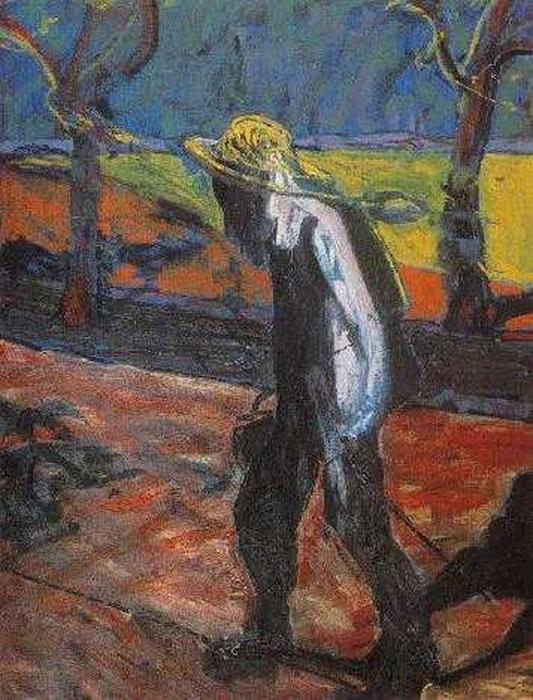
Francis Bacon’s 'Study for a Portrait of Van Gogh IV' is an intense Expressionistic oil painting capturing rural solitude & hardship through bold brushstrokes and unsettling color. A powerful, textured work by a renowned Irish artist.
Explore Francis Bacon's (1909-1992) emotionally charged figurative paintings. Known for distorted forms, existential themes & bold expressionism, he remains a cornerstone of modern art. Discover key works & legacy.
A Haunting Echo: Decoding Francis Bacon’s ‘Study for a Portrait of Van Gogh IV’
This compelling work by Francis Bacon is not a traditional portrait in the conventional sense. Rather, it's a visceral *response* to Vincent van Gogh – an attempt to grapple with the tormented spirit and artistic legacy of a predecessor he deeply admired. The painting depicts a solitary figure, suggestive of a rural laborer or farmer, set within a stark, abstracted landscape. It’s crucial to understand this isn’t about representing Van Gogh himself, but embodying the *feeling* of his work, particularly its inherent loneliness and emotional intensity.
Expressionistic Distortion & Bacon's Unique Style
Bacon firmly established himself as a master of expressive figuration, and ‘Study for a Portrait of Van Gogh IV’ exemplifies this perfectly. The style is profoundly Expressionistic, characterized by bold, gestural brushstrokes and deliberately distorted forms. He rejects realistic representation in favor of conveying raw emotion. Notice the flattened perspective; space isn't convincingly rendered but *felt* through layering of color and receding lines. This deliberate distortion creates a sense of unease and claustrophobia, mirroring the psychological turmoil often associated with Van Gogh’s life and art. The geometric simplification – rectangles defining buildings and trees – further emphasizes this abstraction, reducing the world to its essential, unsettling components.
Technique & Materiality: Impasto and Emotional Texture
Bacon's technique is immediately striking. He employs a thick *impasto*, applying oil paint in visible, almost sculptural layers. This isn’t merely about color; it’s about the physicality of paint itself becoming an expression of emotional weight. The rough, tactile surface invites close inspection and reinforces the sense of rawness. The dramatic lighting – strong shadows emphasizing form – adds to the theatricality and intensifies the psychological impact. It's a technique that feels both violent and vulnerable, mirroring the internal conflicts he sought to portray.
Historical Context: Bacon’s Dialogue with Van Gogh
Francis Bacon emerged in the post-war era, a period grappling with existential anxieties and the aftermath of immense trauma. He was deeply affected by photographs – particularly Eadweard Muybridge's motion studies – and sought to capture fleeting moments of human experience, often tinged with anguish. His fascination with Van Gogh stemmed from a shared sense of alienation and artistic struggle. Bacon wasn’t interested in celebrating Van Gogh’s genius; he wanted to confront the darkness that fueled it. This series of “Studies” represents an intense engagement with Van Gogh's emotional landscape, filtered through Bacon’s own unique sensibility.
Symbolism & Emotional Resonance
While not overtly symbolic, the painting is rich in suggestive elements. The figure’s posture – often interpreted as weary or contemplative – speaks to a profound sense of isolation and perhaps even despair. The rural setting, while seemingly simple, can be read as representing a longing for connection with nature that remains ultimately unfulfilled. The overall effect isn't about telling a story; it's about evoking a feeling. The unsettling color palette – intense and somewhat jarring – contributes to this atmosphere of unease. It’s a painting that doesn’t offer answers, but rather forces us to confront uncomfortable truths about the human condition.
Impact & Legacy
‘Study for a Portrait of Van Gogh IV’ is a powerful example of Bacon's ability to transform traditional portraiture into something profoundly modern and psychologically charged. It continues to resonate with viewers today because it taps into universal themes of loneliness, alienation, and the search for meaning in a chaotic world. For collectors and interior designers, this work – or a high-quality reproduction – offers a bold statement piece that will undoubtedly spark conversation and add depth to any space.