A Tempestuous Vision: Francis Bacon’s ‘Study for Portrait of Van Gogh V’
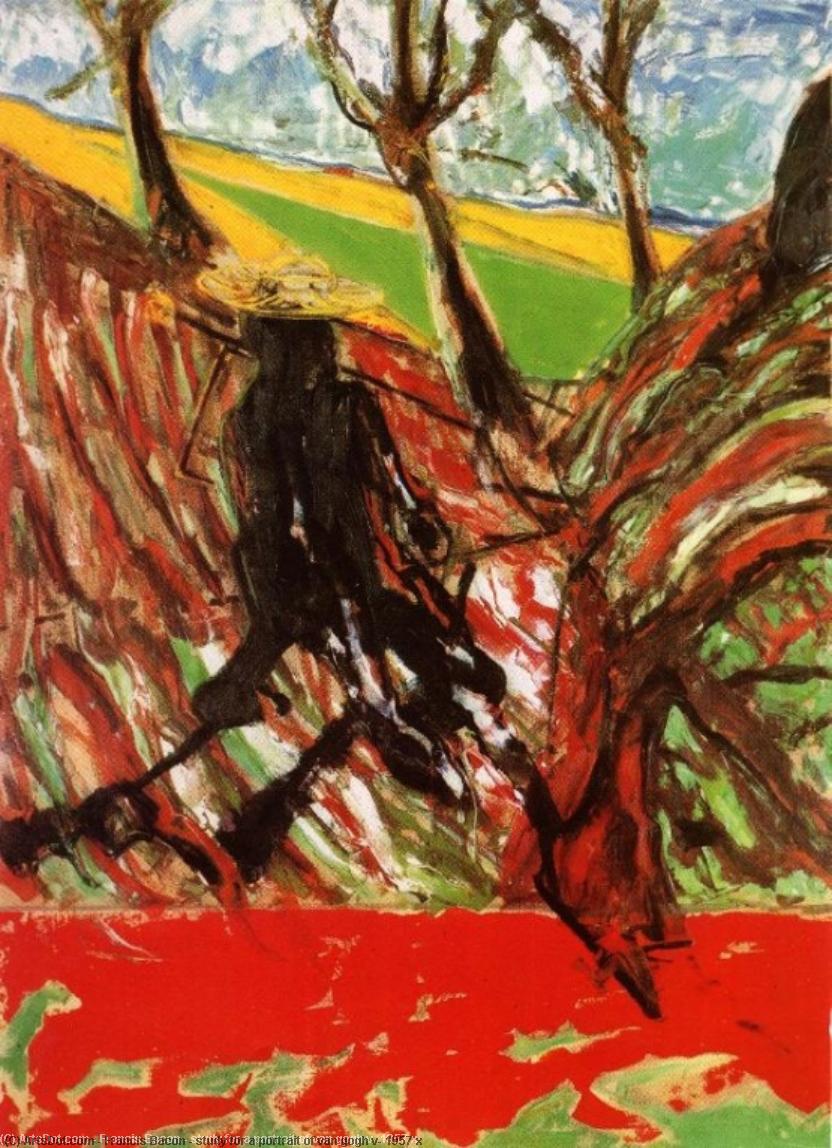
Francis Bacon's ‘Study for Portrait of Van Gogh V’, created in an unknown year, is not a traditional portrait but rather a visceral and emotionally charged response to the art and life of Vincent van Gogh. It stands as a powerful example of Bacon’s unique ability to translate psychological turmoil onto canvas, utilizing color and form to evoke a sense of raw, untamed energy.
Subject & Composition
The artwork eschews direct representation, instead presenting a swirling landscape dominated by intense reds. A monumental tree trunk and its roots anchor the foreground, seemingly struggling within a turbulent, almost liquid mass of color that suggests both earth and water. Above this chaotic base rises a band of yellow and green – a distant suggestion of fields or hills – while the sky is rendered with agitated strokes of blue and white. The composition’s diagonal thrust creates a dynamic sense of movement and instability, pulling the viewer into the heart of the scene.
Style & Technique
- Expressionism: This work firmly resides within the Expressionist tradition, prioritizing subjective emotional experience over objective reality. Bacon doesn’t aim to depict *what* Van Gogh looked like, but rather *how* he felt – or how Bacon perceived his suffering.
- Impasto & Brushwork: The painting is characterized by a heavily textured surface achieved through the generous application of oil paint (impasto). Thick, gestural brushstrokes are visible throughout, contributing to the work’s energetic and almost violent quality. This tactile approach emphasizes the physicality of the painting process itself.
- Distortion & Abstraction: Forms are organic – the tree, roots, hills – but deliberately distorted and blended, lacking sharp definition. Bacon dissolves recognizable shapes into a swirling vortex of color, mirroring the internal chaos he sought to convey.
Historical Context & Influence
Francis Bacon was deeply fascinated by Vincent van Gogh, creating a series of works responding to his life and art. This particular piece is part of that exploration. Bacon’s own turbulent life – marked by personal struggles and a profound awareness of human suffering – likely fueled his empathetic connection with Van Gogh's story. The mid-20th century saw a growing interest in psychological themes within art, and Bacon was at the forefront of this movement.
Symbolism & Emotional Impact
- Red: The dominant use of red is powerfully symbolic. It can represent passion, danger, blood, or even the raw energy of life itself – all emotions deeply associated with Van Gogh’s biography.
- The Tree: The prominent tree and its roots suggest resilience, a connection to the earth, and perhaps the struggle for survival. It could also symbolize the weight of history and the burden of existence.
- Van Gogh's Legacy: Bacon’s work isn’t simply *about* Van Gogh; it’s a dialogue with his artistic spirit. It acknowledges the pain and intensity that fueled Van Gogh’s creativity, while simultaneously offering a modern interpretation of those themes.
‘Study for Portrait of Van Gogh V’ is not an easy painting to look at. It's unsettling, even disturbing. But it is precisely this emotional rawness that makes it so compelling. It invites viewers to confront the darker aspects of human experience and to contemplate the enduring power of art to express profound psychological truths.