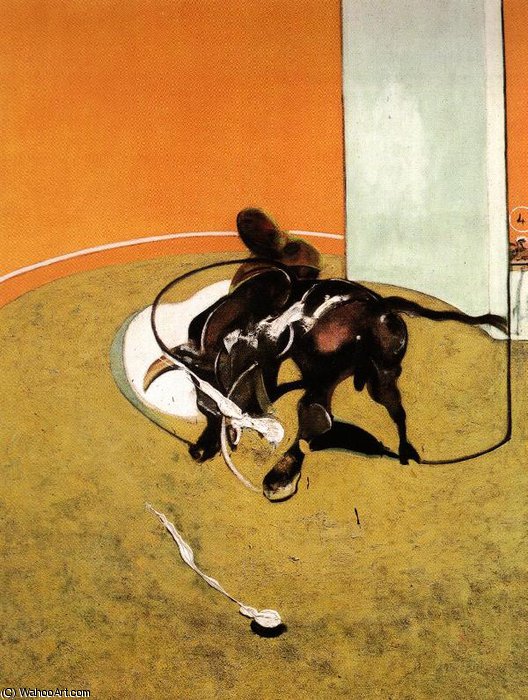
“Second Version of Study for Bullfight No. 1” was created in 1969 by Francis Bacon in Expressionism style. Find more prominent pieces of genre painting at WikiArt.org – best visual art database.
sitename: www.wikiart.org
date: 2024-03-27
tags: ['animals', 'bulls', 'bullfighting']
### Second Version of Study for
A Visceral Encounter with Chaos
In the turbulent landscape of 1969, as the world grappled with the profound anxieties of the Cold War era, Francis Bacon unleashed a vision that would forever haunt the corridors of modern art. His Second Version of Study for Bullfight No.1 is not merely a painting; it is an immersive descent into a realm of fragmented physicality and raw, unadulterated emotion. At first glance, the viewer is met with a scene of intense movement—a dynamic struggle involving horses and figures that seem caught in a moment of violent transition. The composition pulls the eye through a whirlwind of motion, where the boundaries between human agony and animal instinct begin to blur into a singular, breathtaking expression of existential dread.
The subject matter, while rooted in the tradition of the bullfight, transcends mere spectacle. Bacon utilizes the imagery of the arena to explore deeper, more unsettling themes of vulnerability and isolation. The presence of horses, intertwined with an almost claustrophobic closeness, suggests a desperate struggle for connection amidst a landscape of dislocation. Scattered throughout this chaotic theater are dark, ominous birds—crows that act as silent sentinels of doom, their black plumage mirroring the pervasive gloom of the piece. This interplay between the living subjects and the scavenging shadows creates a narrative of impending loss, making the artwork a profound meditation on the fragility of life itself.
The Mastery of Fragmentation and Texture
Technically, this masterpiece stands as a testament to Bacon’s ability to transform the canvas into a psychological battlefield. Drawing inspiration from the fractured perspectives of Cubism, Bacon eschews traditional realism in favor of a style that deconstructs form into geometric shards. This fragmentation serves a vital purpose: it mirrors the splintered psyche of the modern individual, reflecting a world that feels increasingly disconnected and unstable. The figures are not whole; they are echoes of themselves, caught in a state of perpetual dissolution.
The tactile quality of the painting is equally arresting. Through the masterful application of thick impasto, Bacon builds layers upon layers of pigment, creating a surface that possesses a palpable, sculptural weight. This heavy texture does more than just catch the light; it amplifies the emotional gravity of the scene, giving the viewer a sense of the physical struggle embedded within the paint itself. For the discerning collector or interior designer, this piece offers an unparalleled depth of character. A high-quality reproduction of this work brings not just color to a space, but a profound intellectual and emotional resonance, serving as a powerful focal point that invites contemplation and stirs the soul.